Common-section questions 21 and 22, elective question 30 serve as key differentiators
EBS linkage rate at 50%; mid- to high-difficulty questions also tied to EBS materials
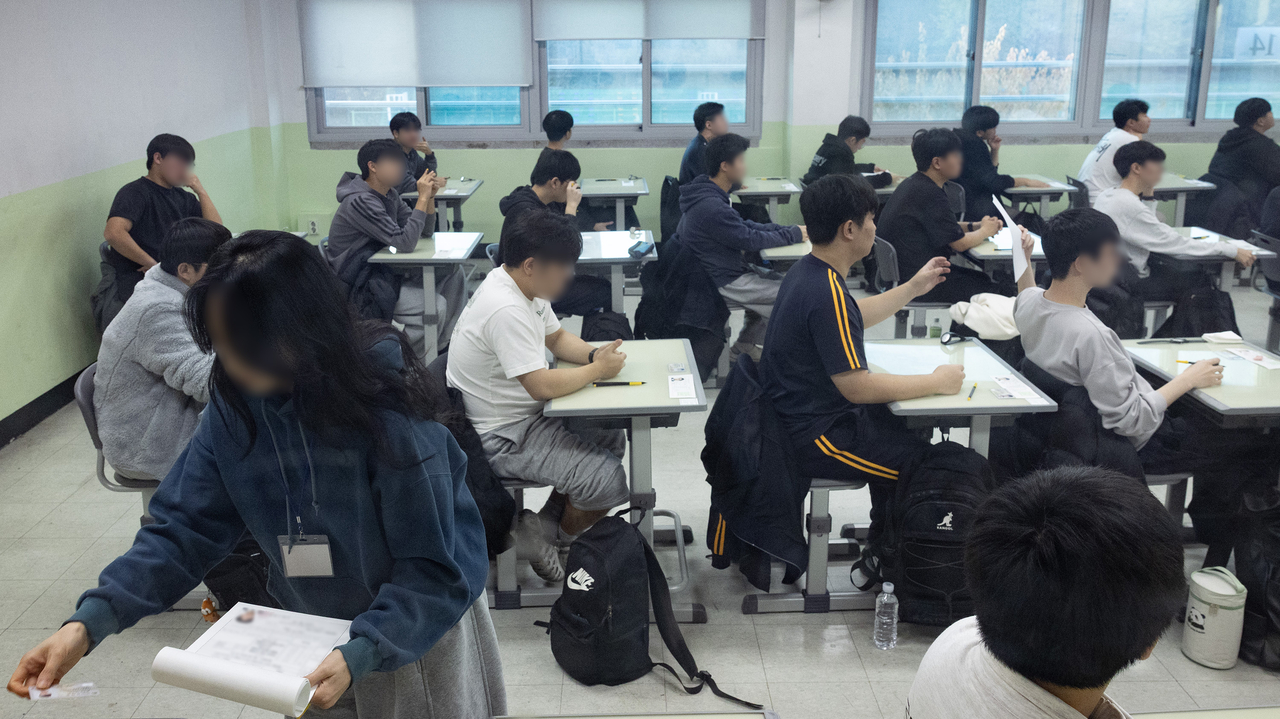
The mathematics section of the 2027 College Scholastic Ability Test, held Thursday, was comparable in difficulty to last year's exam, according to an EBS analysis. The common-section questions were assessed as slightly easier than last year, while the elective-section questions were judged to be at a similar level.
In its analysis of math section trends, EBS said the exam maintained its approach of testing concepts evenly across multiple units and requiring students to infer and interpret function graphs. The test placed both mid-level questions and high-difficulty questions demanding comprehensive reasoning side by side, allowing it to distinguish between mid-tier and top-tier students.
EBS identified common-section question 21 as the most challenging item. It required students to analyze whether a newly defined function derived from a cubic function is differentiable, then use that analysis to infer the original function. Common-section question 22 was also rated as highly discriminating, as students had to identify a hidden rule among the terms of a sequence and calculate their sum.
In the elective sections, question 30 was singled out as the key differentiator across all three tracks — probability and statistics, calculus, and geometry. The probability and statistics question required students to exhaustively check every possible case to calculate a conditional probability. The calculus question asked students to find a function satisfying given conditions and apply integration by substitution. The geometry question required students to determine the positions of points and figures in space and calculate the area of a shape projected perpendicularly onto a plane.
By contrast, common-section questions 13 and 20 were analyzed as mid-level items that could be solved by working through the conditions step by step. EBS said no questions appeared that required the simultaneous use of an excessive number of concepts, nor any that would give an unfair advantage to students who had drilled problem-solving techniques through private tutoring.
The EBS linkage rate stood at 50 percent, with 15 of the 30 questions tied to EBS study materials. EBS said it had applied the concepts and principles from its materials even in mid- to high-difficulty questions, raising the perceived degree of linkage.
The CSAT examination board also said it had focused on assessing students' understanding of fundamental concepts and their capacity for comprehensive thinking, steering away from complex calculations and the rote application of formulas.
"This exam appears to be one that students can prepare for by studying concepts evenly across all units, rather than focusing on any particular area," EBS said.
brunch@heraldcorp.com