EBS, Etoos analyze first-period Korean section
Easier than last year's CSAT, on par with September mock exam
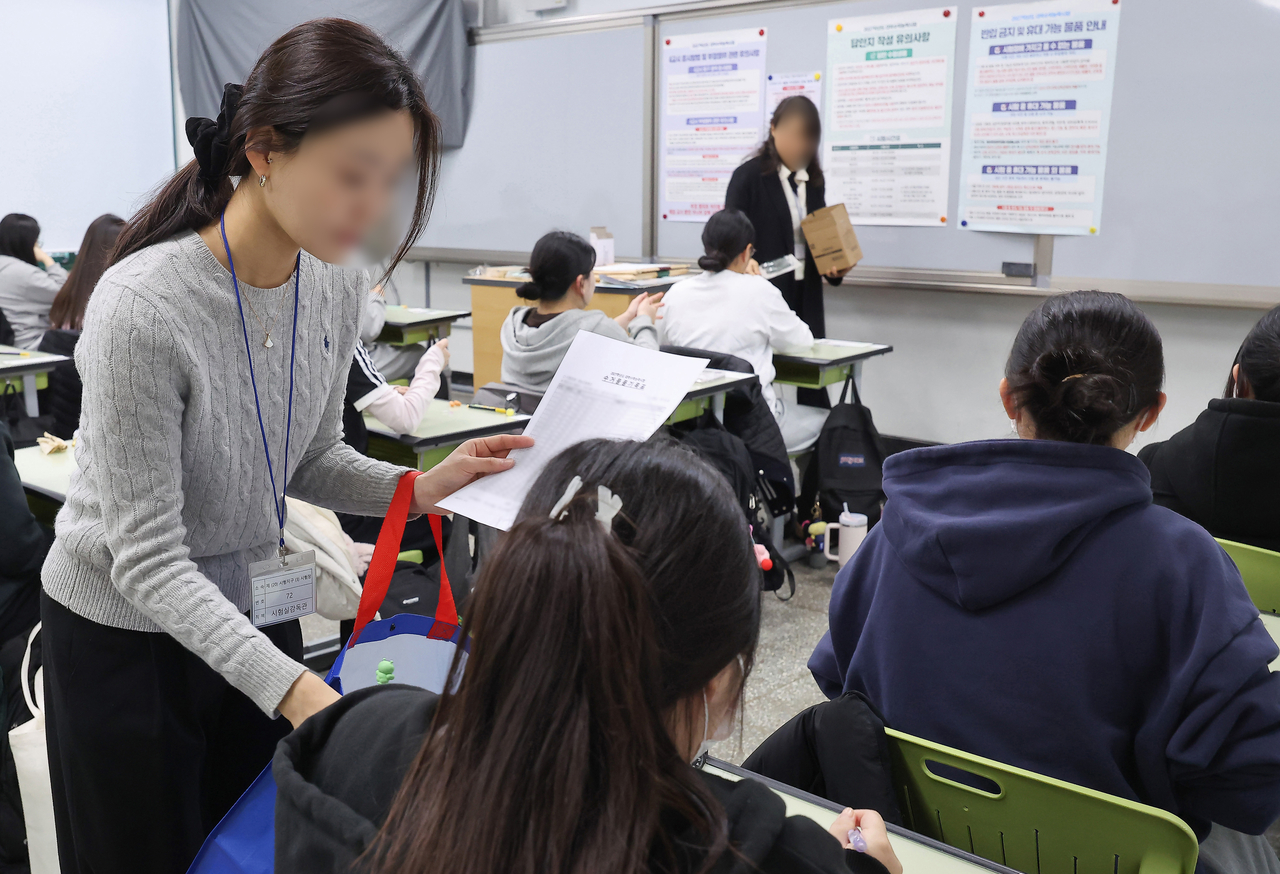
The Korean-language section of the 2027 College Scholastic Ability Test, held Thursday, was easier than last year's exam, analysts said. However, students who chose Language and Media as their elective likely found it harder than those who chose Speech and Composition, resulting in differing perceived difficulty levels among test-takers.
EBS and the private education provider Etoos said the Korean section was easier than both last year's CSAT and the September mock exam. Daesung Hagwon assessed it as slightly easier than last year's test but roughly on par with the September mock, while Jongno Hagwon also said overall difficulty had dropped compared with last year.
EBS said familiar subject matter and clearly presented information reduced the reading burden. The reading comprehension passages covered topics such as reading digital documents and running computer programs, while the literature section drew on everyday themes including glass and mirrors, family and hometown. EBS added that answers could generally be determined from information in the passages, which would have eased time pressure as well.
Questions requiring students to connect multiple pieces of information or apply concepts to specific cases were nonetheless challenging, analysts said. EBS and Jongno Hagwon singled out reading comprehension question 17 — which dealt with legal liability for statements of fact versus statements of opinion — as a strong differentiator. Daesung Hagwon said question 12, which required an understanding of how a computer program executes, was among the more difficult items.
Kim Byeong-jin, director of the Etoos Education Assessment Research Institute, said students may have struggled with questions 12 and 17 in the reading section, which required use of answer choices, as well as question 6, which tested critical thinking. "In the literature section, question 30 on the modern novel — which was not linked to EBS materials — would have been a difficult approach for many students," Kim said.
Among the electives, Language and Media was seen as the more demanding option. Jongno Hagwon said Speech and Composition was easier than last year, while Language and Media was at a similar level to last year's exam.
Im Seong-ho, head of Jongno Hagwon, said students who took Language and Media — which is answered first in the elective section — may have felt pressure from the very start of the exam. Im identified question 37, which required analysis of sentence structure, as particularly difficult.
Daesung Hagwon also assessed Speech and Composition as straightforward, centered on familiar question types. Language and Media question 36, however, required repeated comparison of words and information across the passage and answer choices, making it feel considerably harder. Etoos said both electives each contained one or two questions designed to differentiate among high-scoring students.
Of the 45 questions in total, 24 were linked to EBS materials, a connection rate of 53.3 percent. All four reading comprehension passages drew on topics and key concepts from EBS-linked textbooks. Three literary works were also linked to EBS materials: "Changseon Gameui-rok," Yun Dong-ju's "Chamhoirok" and Yeonan Yi's "Buyeo Nojeonggi."
Kim Won-jung, head of admissions strategy at Daesung Hagwon, said the literature section would likely have produced a wide gap in perceived difficulty between students who had studied EBS-linked materials thoroughly and those who had not.
brunch@heraldcorp.com