Kim Min-seok: 'Preventing tech abuse is politics' duty'
Rep. Lee Ju-hee to chair panel; science committee members join
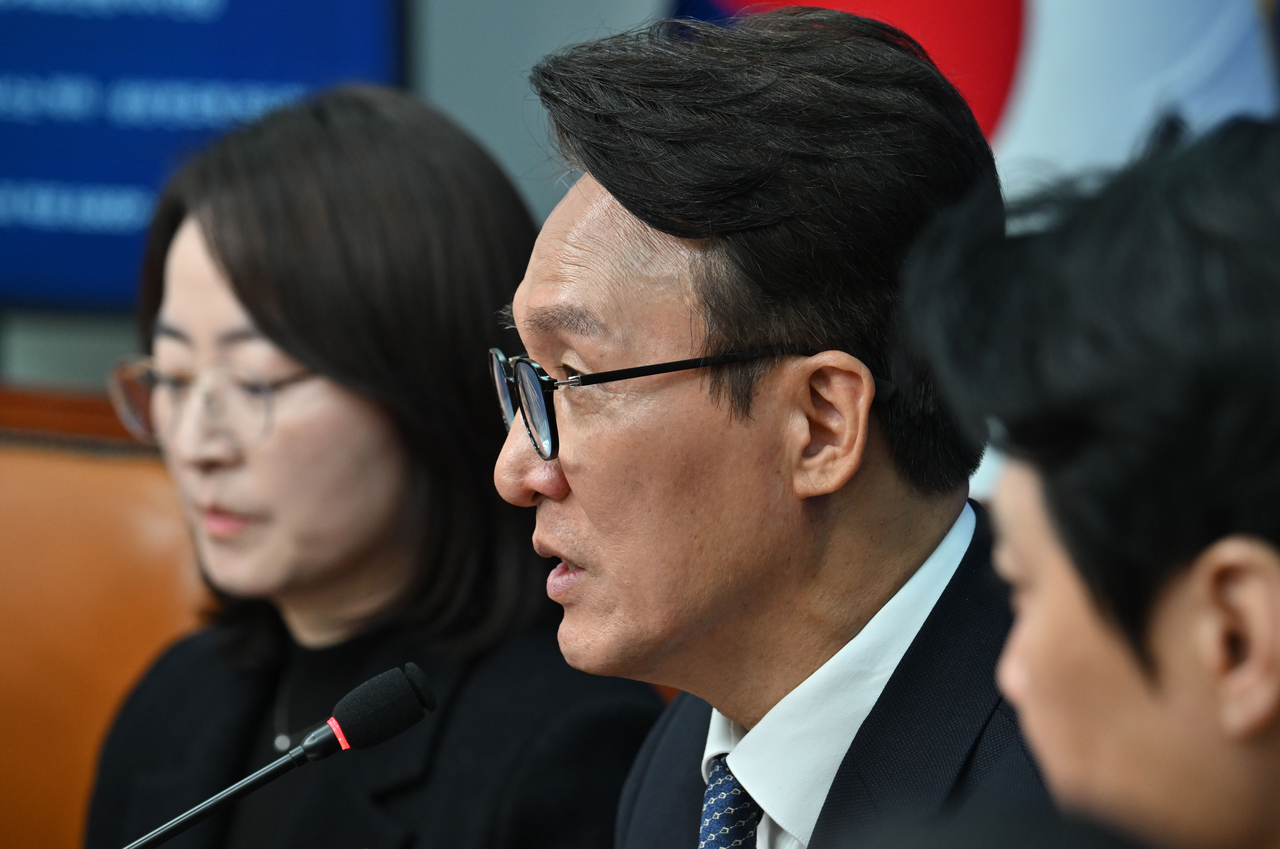
The Democratic Party of Korea on Thursday launched a special committee on information and communications to address AI-assisted hacking, personal data breaches and cheating using smart devices. The move comes as the use of AI-enabled gadgets to cheat on the College Scholastic Ability Test has emerged as a pressing concern, prompting the party to pursue legislation and policy to curb the misuse of such technology.
The Democratic Party held the committee's inaugural ceremony and first meeting at the National Assembly on Thursday — the day of the 2027 CSAT — reviewing the current state of AI-assisted hacking and personal data leaks, as well as the use of ultra-compact cameras embedded in AI glasses and other devices to facilitate cheating.
At the meeting, party leader Kim Min-seok said the country had spent the past several days grappling with entirely new and unforeseen problems. "It seems that everyone — the whole nation — put forward every idea they could and together came up with their own responses," he said.
On the committee's work, Kim said AI had become an inescapable part of daily life and that preventing its misuse was a core obligation of politics and policy. "I understand today's first meeting will timely cover the state of responses to AI hacking and personal data breaches, as well as the current situation with cheating technology using AI glasses and ultra-compact cameras," he said.
He urged the committee to take the lead in clarifying platform accountability through a digital safety law and in developing systematic measures against AI-assisted hacking and personal data leaks.
The committee is expected to work not only on near-term measures to prevent AI-assisted cheating but also on longer-term AI policy. Rep. Lee Ju-hee will serve as chair, and a large number of members from the National Assembly's Science, Technology, Broadcasting and Communications Committee will participate.
Lee outlined the committee's direction, saying it would strengthen AI safety. "We will technically analyze the recent hacking incidents, build a system to verify them ourselves, and conduct in-depth reviews of ways to regulate AI that undermines human dignity," Lee said.
Lee added that the committee would protect core budgets to support South Korea's drive to become one of the world's top three AI powers, monitor whether funds are being spent properly, and push to enact a digital safety law to bring the digital platform ecosystem under a framework that protects people.
Han Jun-ho, who leads the ruling party's side on the science and communications committee, said the panel was resolved to move faster than existing procedures on legislation and budgets. "We will quickly catch up on what we have missed and do our utmost to translate that into public safety," Han said.
mp1256@heraldcorp.com