Briefing on 2027 CSAT question-setting direction
English top-grade rate 'expected to be achieved stably'
Difficulty adjusted to reflect rise in repeat test-takers and 'social studies run'
Private tutoring materials reviewed to exclude ultra-hard 'killer questions'
Emergency alerts sent to deter cheating; enforcement to continue after exam
EBS linkage rates: Korean 53%, math 50%, English 55%
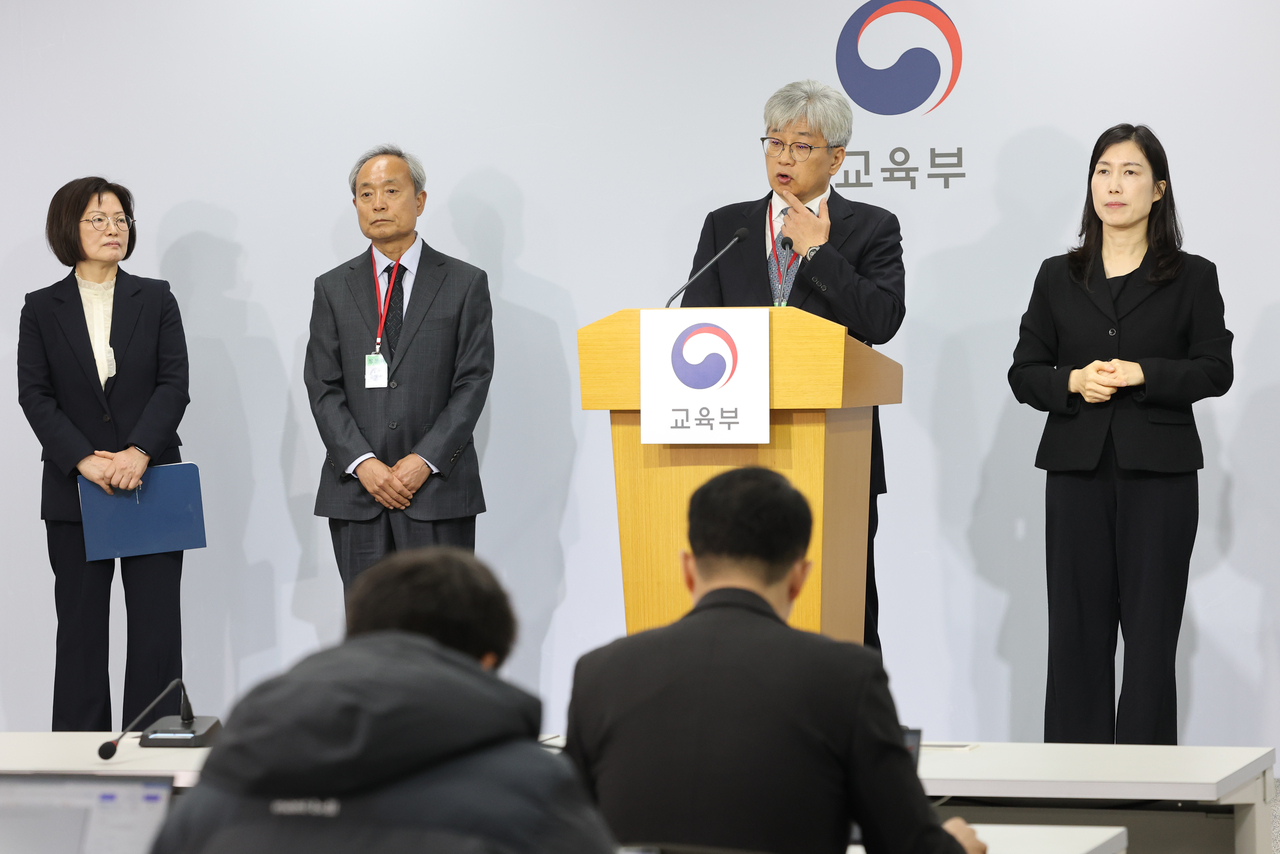
The chief question-setter for the 2027 College Scholastic Ability Test said Thursday that the English section's difficulty had been "fine-tuned" for this year's exam after reviewing the June and September mock evaluations — a response to last year's notoriously hard English section, which drew the nickname "lava English."
The question-setting team also factored in the growing number of repeat test-takers — students retaking the exam after graduation — and the so-called "social studies run," a strategy in which science-track students opt for social studies electives instead of science subjects. The Korea Institute for Curriculum and Evaluation said it would step up enforcement against cheating using AI and other means, and would continue to investigate suspected irregularities even after the exam.
Oh Ki-young, the CSAT chief question-setter, said at a post-exam briefing that the team had "made constant efforts to maintain an appropriate level of difficulty in line with the intent behind introducing absolute grading." He said the proportion of students earning a top grade "is expected to be achieved stably," though he did not specify a target figure.
English difficulty adjusted; 'social studies run' factored into subject balance
Last year's CSAT English section was widely considered unusually difficult, resulting in a low proportion of top-grade scores. The June and September mock evaluations this year also showed a wide gap in difficulty, which observers said left students preparing for the exam confused.
Oh said the June mock evaluation had a high difficulty level that pushed the top-grade rate significantly lower, while the September evaluation produced a higher top-grade rate. "I believed that by carefully calibrating the results of the two evaluations, we could arrive at an appropriate top-grade rate, and that is how we approached the question-setting," he said.
Changes in the test-taking pool driven by the rise in repeat test-takers and the social studies run were also key considerations. Oh said the two trends "could have a particularly significant impact on elective subjects," adding that the team analyzed the characteristics of this year's test-taking pool by comparing the June and September mock evaluation results with last year's CSAT.
"We also examined the actual registration data for this year's CSAT to track trends," he said. "On that basis, we tried to balance the difficulty across elective subjects and reduce any advantage or disadvantage arising from subject choice."
The overarching principle guiding this year's exam was securing differentiation within the scope of public education, the question-setting body said. Oh said questions that would favor students who had focused on private tutoring and drilled problem-solving techniques were excluded. Mathematics questions were designed to avoid overly complex calculations or rote formula application, instead assessing understanding of core concepts and comprehensive thinking skills.
"Before and during the question-setting process, we purchased problem books and mock exam papers from private tutoring companies and used them as verification materials," Oh said. "Questions that the setters and reviewers judged to be closely tied to private tutoring were excluded first. We tried to set a fair exam by removing what are commonly called killer questions — ultra-high-difficulty items."
EBS textbook and lecture linkage rates, measured by number of questions, were 53.3% for Korean, 50.0% for mathematics and 55.6% for English. Korean history, social studies, science, vocational studies, and second foreign language and classical Chinese each came in at 50.0%. English linkage questions used an indirect method, drawing on different passages that share similar themes, topics or main points with EBS textbook passages.
'A few cheaters must not undermine others' efforts': enforcement to continue after exam
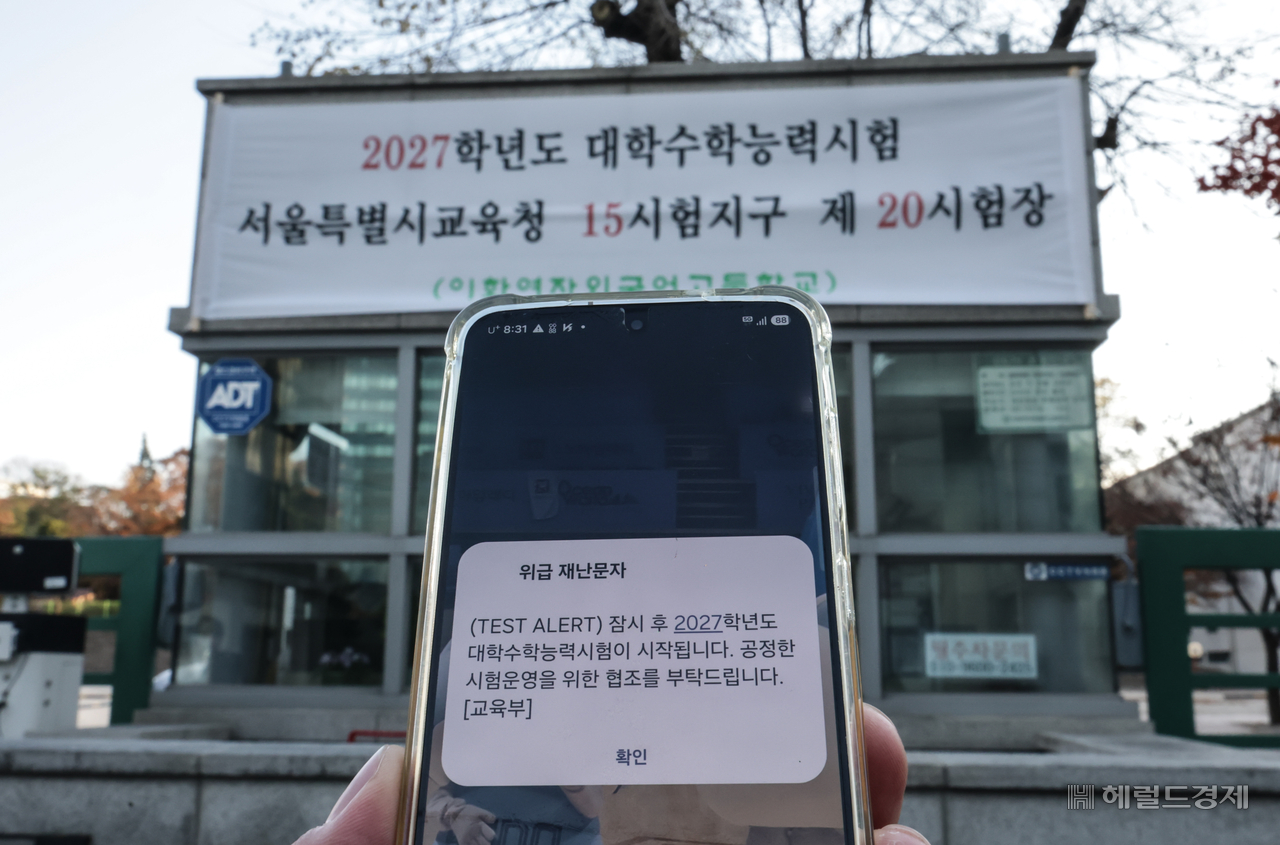
The Korea Institute for Curriculum and Evaluation said it would take an active stance against cheating involving AI. Institute President Kim Moon-hee said the institute had worked with the Ministry of Education to prepare newly introduced measures this year and pledged to ensure fair and rigorous exam administration.
The government sent emergency disaster alerts nationwide Thursday to prevent and detect cheating using smart devices. The first alert sounded at 8:30 a.m., and education authorities said additional alerts would be sent at unannounced intervals. Test-takers who brought smartphones or other electronic devices were required to power them off and hand them to proctors before the first session began. It was the first time emergency disaster alerts had been used to deter CSAT cheating.
Oh said that while confined to the question-setting facility, he had heard news that the country was unsettled by AI-related issues. "There was no particular action we could take from inside, so I trusted the Ministry of Education and the institute to handle the matter well and focused on setting the questions," he said.
Kim said the emergency alerts were designed so that even if a test-taker silenced the notification, the device would still vibrate. "A small number of cheaters must not be allowed to undermine the efforts of all test-takers," Kim said, adding that the institute would actively cooperate with any investigation into suspected cheating even after the exam.
The exam began at 8:40 a.m. Thursday across 1,312 test sites in 85 examination districts nationwide. A total of 551,864 candidates registered, comprising 355,391 current students and 196,473 graduates and others. General test-takers sitting all five sessions were scheduled to finish at 5:45 p.m.
Objections to questions or answers can be submitted through the institute's website from Thursday through Monday at 6 p.m. The institute will review submissions from Tuesday through Dec. 1 before finalizing the answers. Score notifications will be sent Dec. 11.
brunch@heraldcorp.com