About 960,000 married women ages 15–54 have career breaks, down 145,000 in a year; childcare accounts for 491,000 cases; 414,000 have been out of work for 10 or more years; those with youngest child 6 or under work an average 30.9 hours a week, 6.4 hours less than those with teens

The number of married women ages 15 to 54 who left the workforce due to childcare, marriage, or pregnancy and childbirth and have not returned to employment fell to about 960,000 in the first half of this year, dropping below 1 million after declining by 145,000 over the past year. Childcare was the most commonly cited reason for leaving work, accounting for 51.1 percent of cases.
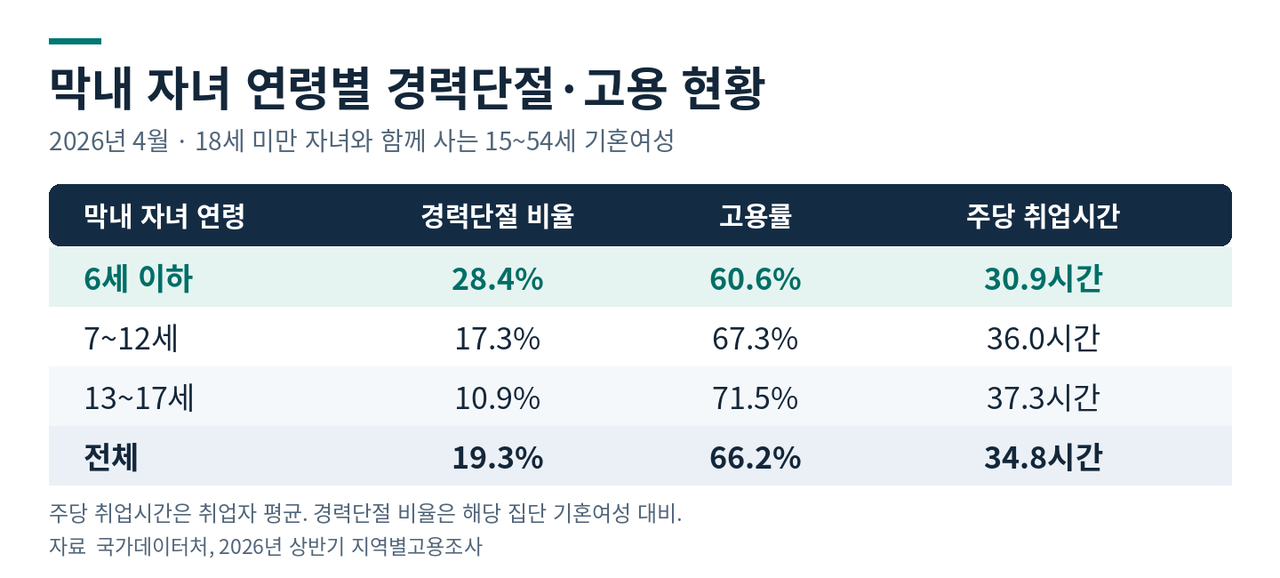
Among married women whose youngest child was 6 or under, nearly 3 in 10 had experienced a career break, and even those who were employed worked the fewest hours per week of any group with minor children.
According to the Ministry of Statistics' "First-Half 2026 Regional Employment Survey: Employment Status of Married Women," released Thursday, 13.4 percent of the approximately 7.15 million married women ages 15 to 54 as of April had experienced a career break — down 1.5 percentage points from a year earlier. The total population of married women ages 15 to 54 covered by the survey also shrank by 253,000 over the same period.
The Ministry of Statistics updated its terminology this year following a revision to the Act on Promotion of Economic Activities of Women with Career Breaks that took effect in July, replacing "women with career breaks" with "women with career experience." The survey counts married women ages 15 to 54 who left work due to marriage, pregnancy or childbirth, childcare, children's education, or family caregiving and were not employed at the time of the survey.
Some 491,000 women left work because of childcare — more than the combined total who left due to marriage (208,000) and pregnancy or childbirth (174,000). Childcare was also the top reason across age groups, accounting for 53.5 percent among both women in their 30s and those in their 40s.
Women who had been out of work for 10 or more years numbered 414,000, down 52,000 from a year earlier, but their share of all women with career breaks rose from 42.1 percent to 43.1 percent. Including those out of work for five or more years, the figure reached 630,000, or 65.6 percent of the total.
Among married women ages 15 to 54 living with children under 18, 772,000 — or 19.3 percent — had experienced a career break. The rate was 28.4 percent for those whose youngest child was 6 or under, 11.1 percentage points higher than for those whose youngest was 7 to 12 (17.3 percent) and about 2.6 times the rate for those with a youngest child ages 13 to 17 (10.9 percent). By number of children, the career-break rate was 18.6 percent for one child, 19.7 percent for two, and 22.8 percent for three or more.
The employment rate for married women whose youngest child was 6 or under rose 2.9 percentage points from a year earlier to 60.6 percent — the largest gain among any age group with minor children — but remained lower than the rates for those with a youngest child ages 7 to 12 (67.3 percent) or 13 to 17 (71.5 percent).
Employed women whose youngest child was 6 or under worked an average of 30.9 hours per week, down 1.2 hours from a year earlier — 5.1 hours less than those whose youngest was 7 to 12 (36.0 hours) and 6.4 hours less than those with a youngest child ages 13 to 17 (37.3 hours). Across all employed married women living with minor children, average weekly working hours fell 0.5 hours to 34.8.
The overall employment rate for married women ages 15 to 54 living with minor children rose 1.9 percentage points from a year earlier to 66.2 percent. The number of employed women in this group edged down by 25,000 to about 2.644 million over the same period. The population of married women living with minor children — the denominator used to calculate the employment rate — fell by 155,000, from about 4.15 million to about 3.995 million, a steeper decline than the drop in employed women.
fact0514@heraldcorp.com