Book concert held for new release 'North Korea Nuclear Diplomacy on the Blade'
'Denuclearization is a long game, not a sprint — bipartisan diplomacy needed'
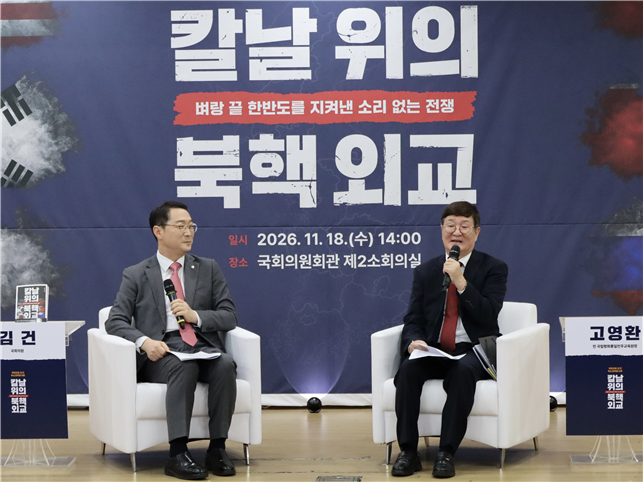
People Power Party lawmaker Kim Geon said Thursday that South Korea "must not step down from the blade" until North Korea abandons its nuclear weapons.
Kim made the remarks at a book concert held Wednesday at the National Assembly to mark the release of his new book, "North Korea Nuclear Diplomacy on the Blade: The Silent War That Defended the Korean Peninsula on the Brink," saying denuclearization "is not a short-distance race but a long game."
He described North Korea's nuclear program not as a bargaining chip but as a means of regime survival, arguing that "hasty agreements and a North Korea policy that shifts with each administration have given Pyongyang the illusion that holding out means winning."
Kim said the end of the Cold War and the dismantling of apartheid in South Africa "were the results of decades of consistent strategy," and added that South Korea "must not step down from the blade until the day North Korea gives up its nuclear weapons."
Kim also pushed back against the view, held in some quarters, that North Korea is skilled at diplomacy. "Brinkmanship tactics that risk walking away from talks altogether cannot be called diplomatic ability," he said. "What North Korea has been left with as a result is only international isolation and economic hardship. True negotiating power is not the skill of forcing the other side to submit — it is the ability to advance national interests."
Kim also stressed the importance of what he calls "domestic diplomacy" — introduced in the book as the "51 percent rule." He recounted how then-Foreign Minister Gong Ro-myung, who faced fierce domestic criticism following the 1994 Geneva Agreed Framework, personally met with opponents to hear their views and persuade them. "Diplomacy is negotiated beyond borders, but its success or failure is decided within them," Kim said. His point was that a bipartisan set of diplomatic principles — ones that can be sustained regardless of which party holds power — is essential.
"It is important to uphold the principle of North Korea's denuclearization across administrations," Kim said. He called for diplomacy built on a strong South Korea-US alliance as its pillar, while harmonizing relations with neighboring countries — an approach he described as expanding the space for survival and prosperity among major powers.
raining@heraldcorp.com