'Kang reversed his promise before study even began'
'Each branch must retain authority over recruitment and commissioning'
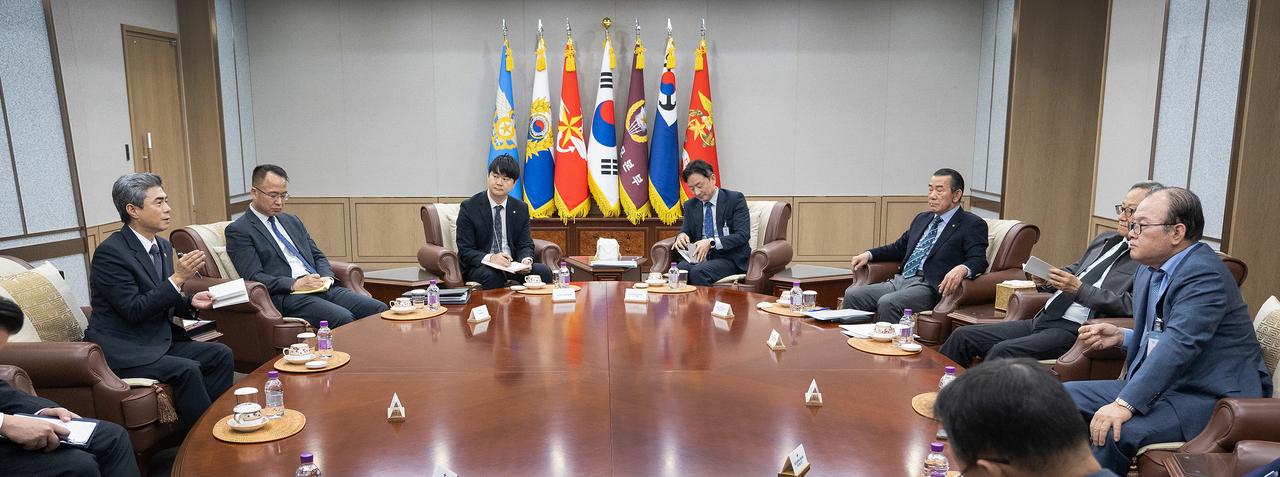
The alumni associations of South Korea's Army, Navy and Air Force academies have rejected the Defense Ministry's revised plan to establish a unified Korea Armed Forces Academy, calling it "a dissolution plan with a new nameplate" and demanding an immediate halt to the initiative.
The associations released a joint statement Wednesday afternoon, expressing "deep outrage at the deceptive policy push by the government and the ruling party" in response to the revised plan the Defense Ministry announced that day following consultations with the Democratic Party of Korea.
The associations dismissed the revised plan's pledges to "respect each branch's distinct character" and "guarantee educational autonomy" as window dressing. They said the substance was unchanged from four months ago: the Army, Navy and Air Force academies would lose their independent status and be reduced to regional campuses of a single academy under direct Defense Ministry control. The inclusion of a proposal to relocate the Korea Military Academy to the Chungcheong region drew particular condemnation. "The government has confessed by its own hand that the true nature of this policy was always to kill the Army academy," the statement said.
The associations said Defense Minister Kang Shin-chul had broken a promise made directly to them. They said that during their meeting with Kang, they had pressed him on two specific points: that each academy's name, facilities and location be preserved, and that the authority over recruitment, curriculum, instruction, graduation and commissioning remain with each branch's academy superintendent.
Kang had confirmed at the time that those authorities "naturally belong to each branch's chief of staff," the associations said. The revised plan, however, transfers those powers to the new unified academy under direct Defense Ministry control, they said.
"To guarantee something in a meeting and then take it away the moment you turn around is a betrayal of good faith and a deception of the armed forces' elders and alumni," the statement said, calling on Kang to explain himself directly before the public.
The associations also raised procedural concerns. The projected cost of the project swung from 2.7 trillion won ($2.02 billion) to 1.5 trillion won — a shift of more than 1 trillion won — in the span of four months. The Defense Ministry has said the actual budget will be determined through a preliminary study, yet the commissioned research has not yet begun. "A study whose findings will not even be consulted is not research — it is a pretext for after-the-fact rationalization and a clear waste of taxpayer money," the statement said.
The timeline also drew criticism. The associations said the ministry had set a 2029 academic year launch date even though no enabling legislation exists and the preliminary study remains unfinished. Moving the founding date forward from the original "mid-2030s" target, they said, "can only be explained by a political calculation to produce a 'result' within the current administration's term."
The associations also objected to the proposed academic structure, under which first- and fourth-year cadets would receive integrated instruction while second- and third-year cadets would train separately at their respective branch academies. They called it "an experiment with no pilot program and no verification." On the plan to leave the Naval Academy in Jinhae and the Air Force Academy in Cheongju in place while relocating only the Army academy, they said the ministry "has not offered a single line of military or educational justification." The Korea Military Academy's Hwarangdae campus in Taereung, they added, is "the birthplace of the Army and a sacred site of national defense."
The associations called the public consultation process a "fiction." Cadets and academy officials — the very people most affected by the policy — were excluded, and a cadet survey was conducted in open-ended format at breakneck speed, they said. "When, by whom, and how were all those responses analyzed, and where in the revised plan were they reflected?" the statement asked. The associations also demanded clarity on whether a request for a presidential meeting, made by the alumni association heads during their meeting with the minister, had actually been conveyed. The civilian advisory committee, they said, was "a prop for policy promotion, incapable of even addressing the question of consolidation."
The associations argued that strengthening education for future warfare, improving faculty compensation, establishing graduate programs and modernizing facilities could all be pursued "faster, cheaper and more safely" within the existing structure. On joint operations capability, they said it could be fully achieved by maintaining each academy's independence while expanding shared coursework and combined training.
rimsclub@heraldcorp.com