Groups call merger-premised research bid a waste of taxpayer money with a pre-set conclusion
Groups say uniform merger ignores port characteristics, erodes regional competitiveness
Groups call for public-private governance that reflects local voices
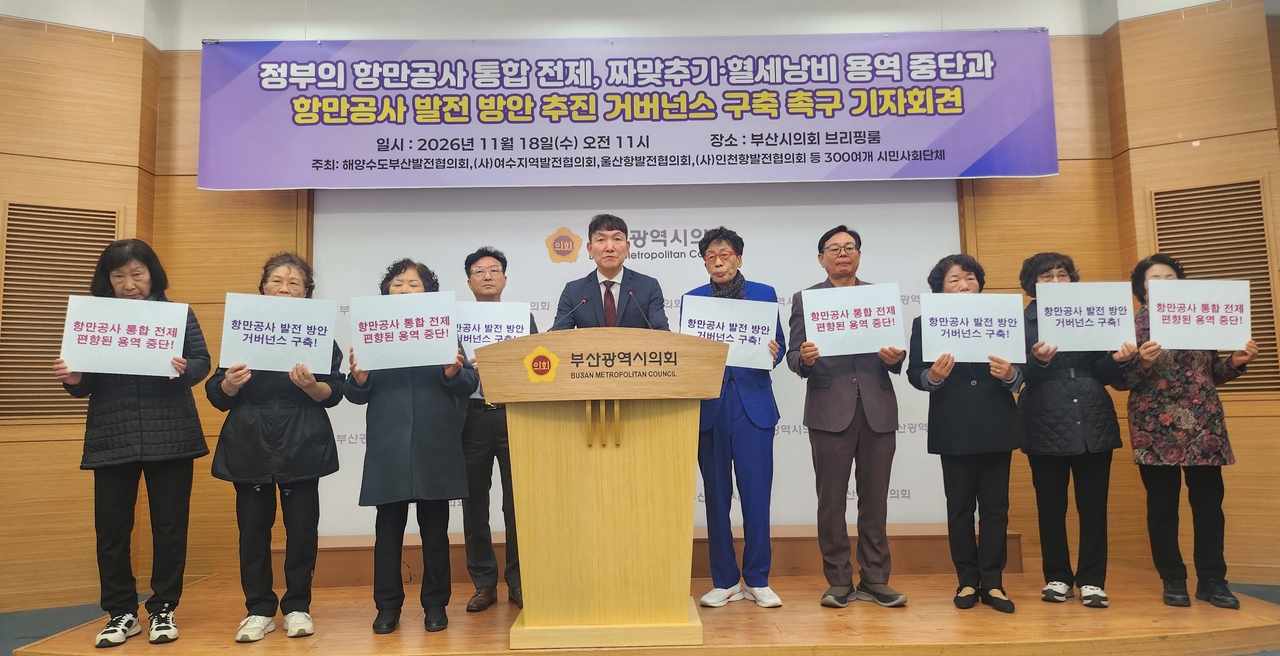
Civic groups from Busan, Ulsan, Incheon and the Yeosu-Gwangyang area held a press conference at the Busan City Council briefing room on Wednesday, demanding the government immediately stop what they called a "rigged, taxpayer-wasting" research project premised on merging the country's port authorities. The call came after the Ministry of Oceans and Fisheries put out a bid on Nov. 5 for a study on establishing a port authority merger roadmap and overhauling related laws and systems.
The groups said the ministry's research project was not an objective, independent policy review but "a predetermined exercise designed to rationalize a conclusion already reached." They criticized the government for treating merger as a given without first adequately verifying its necessity, feasibility, economic benefits or potential drawbacks, saying the policy cart had been put before the horse. "A research project is a tool for objectively examining policy directions — not a tool for producing the conclusion the government wants," they said.
The groups said each port has its own location, function, cargo volume structure and supporting industries, and that a one-size-fits-all merger could actually weaken specialization and competitiveness. Consolidating port authorities into a single body would not automatically increase cargo volumes or strengthen the ability to attract global shipping lines, they argued, and could instead generate new inefficiencies — including an unwieldy decision-making structure and conflicts over investment priorities among ports. They particularly said the merger could negatively affect the long-term strategy for Busan Port, a world-class transshipment hub, including development of its new port, cultivation of supporting industries and preparation for Arctic shipping routes.
The groups said that if the central government wanted to improve the efficiency and competitiveness of port authorities, it should stop fixating on organizational restructuring through merger and instead accurately diagnose the problems with the current system — including excessive control and regulation and a lack of autonomy over personnel, organization, budgets and investment. "The right order is to first address the limits of the coordination framework between individual port development strategies and national port policy," they said.
The groups also said the future direction of port authorities was not something the central government should decide unilaterally, and called for an open, transparent deliberation structure involving port authorities, local governments, the port logistics industry, labor, experts and regional civil society. They said a public-private governance framework must be established that respects the on-the-ground expertise of port operations and genuinely reflects local voices.
The groups further urged the city of Busan to draw up concrete alternatives for strengthening Busan Port's competitiveness and expanding port autonomy, and to press the government forcefully on those demands.
kaf2002@heraldcorp.com