
Concerns over exam integrity are mounting after AI-assisted cheating was detected in national licensing tests. With the College Scholastic Ability Test, or CSAT, approaching, memes depicting tattooed gang members gaining admission to Seoul National University's medical school through AI cheating have spread rapidly online.
On Monday, a post titled "2027 Seoul National University College of Medicine Freshman Welcome Party" appeared on Everytime, a popular online community for university students, drawing both laughs and alarm. The post featured heavily tattooed men drinking shirtless, accompanied by the caption: "All you bookworms who did nothing but study — you're finished."
The post is widely read as a satirical jab at a scenario in which someone who never cracked a textbook could cheat their way to a top CSAT score and win a spot at the country's most prestigious medical school. As anxiety grows that existing exam-monitoring systems cannot fully block AI-assisted cheating, that fear has found an outlet in viral memes.
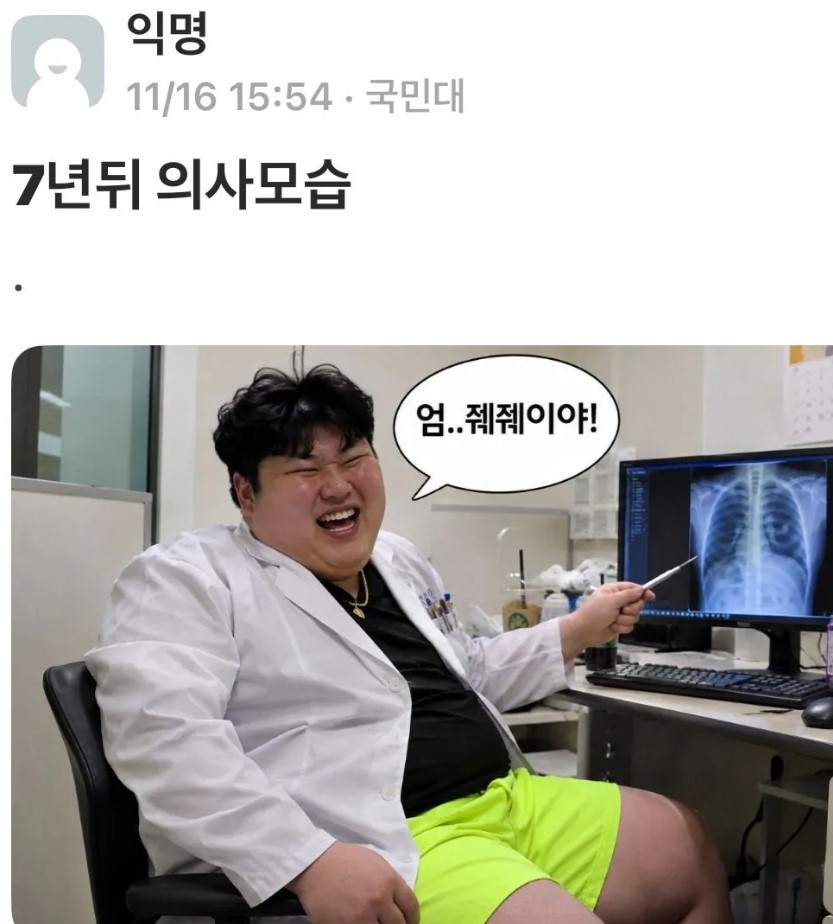
Another post, titled "What doctors will look like in seven years," also caught attention. An image that appears to have been AI-generated shows a man in a white medical coat grinning and saying "jweijweiya."
"Jweijweiya" is a recent piece of online slang derived from "GG," the gaming expression used to acknowledge the end of a match or greet an opponent. The image is widely interpreted as a dig at a future in which someone with no apparent academic credentials becomes a doctor by cheating.
Other posts circulating online include a video of gang members harassing a doctor at a hospital, captioned "future seniors and juniors at a medical school."
Reactions online have ranged from sardonic to despairing: "You were top of your class? So was I — I ran the whole school"; "AI glasses admissions track"; "This is bleak, I want to leave Korea"; and "A lifelong med student who somehow never graduates."
The anxiety over AI-assisted cheating comes as this year's CSAT is set to be the last administered under the current exam format, while competition for university places is expected to intensify further as medical school enrollment expands under a new regional physician quota system.
Industry insiders estimate that as many as 100,000 students who enrolled in university this year will sit the CSAT again — a practice known as "bansusaeng," or half-retaking. The total number of repeat test-takers, including graduates and those who passed the high school equivalency exam, reached 196,473, up about 14,000 from last year's 182,277.
Exam-site inspections and supervision are also being significantly tightened to prevent AI-assisted cheating. The government announced additional anti-cheating measures Tuesday, including placing stickers over every button on test-takers' clothing and conducting full inspections of eyeglasses before each session. Bags will be required to be stored in hallways outside classrooms, and about 8,400 additional proctors will be deployed.
Authorities also plan to send an emergency alert before the exam begins to prompt any student who has not surrendered a mobile phone to do so. Sending the highest-level emergency alert — a "critical disaster alert" — triggers an audible alarm on all phones regardless of any do-not-disturb settings.
Penalties for cheating will also be stiffened. The government is pushing to enact a special law extending the ban on retaking the exam from the current one year to 10 years. Cheating with a smart device will be treated as obstruction of official duties, carrying a maximum sentence of five years in prison or a fine of 10 million won ($7,470). Anyone confirmed to have gained university admission through cheating will have their enrollment canceled and be barred from university admission for 10 years. Students currently enrolled who are caught retaking the exam after cheating will also face expulsion.
bbo@heraldcorp.com