Report: 'Growing zombie firms and the direction of corporate restructuring'
30.3% of Kosdaq firms, 17.4% of Kospi firms classified as zombie companies
The share of zombie firms among South Korea's listed companies has nearly doubled over six years, amid deepening polarization in financial distress across industries, according to a new report. Analysts say preemptive restructuring — before insolvency materializes — is urgently needed to restore corporate value and competitiveness.
Samjong KPMG released the report Wednesday, titled "Growing Zombie Firms and the Direction of Corporate Restructuring." Zombie firms, as defined in the report, are companies that have posted an interest coverage ratio below 1 for three consecutive years — meaning their operating profit is insufficient to cover interest expenses.
Among listed companies with more than seven years of operating history, the share of zombie firms rose from 13.8 percent in 2019 to 26.5 percent in 2025, nearly doubling over the period. The total number of such firms reached 579.
The trend also extended to all companies subject to external audits. According to Bank of Korea data, the share of zombie firms among externally audited companies rose from 14.9 percent in 2021 to 19.1 percent in 2025 — the highest level since tracking began in 2010. Of the 29,468 externally audited companies in 2025, 5,632 were classified as zombie firms.
Both large corporations and small and medium-sized enterprises saw their zombie firm ratios rise. In 2025, the share stood at 15.5 percent for large companies and 20.0 percent for small and medium-sized enterprises. Among the latter, one in five had failed to cover loan interest with operating profit for three consecutive years.
However, the rise in zombie firm numbers does not necessarily signal an equivalent increase in insolvency risk. The share of high-risk firms within the zombie firm category fell for two consecutive years, dropping from 45.2 percent in 2023 to 38.0 percent in 2025.
Samjong KPMG said zombie firms should not be uniformly targeted for restructuring, but assessed individually based on their recovery potential, sector characteristics and business competitiveness. Industries facing structural crises are unlikely to recover through an economic rebound alone and will require measures such as capacity reduction, business reorganization and rehabilitation, the report said. Structural causes of distress were identified by sector: global oversupply and trade pressure for petrochemicals and steel; a liquidity crisis for construction and real estate; intensifying competition and cost pressures for low-cost carriers; and shifts in the retail distribution structure for wholesale and retail trade.
By industry, zombie firm ratios were highest in sectors characterized by global oversupply or liquidity stress. Real estate had the highest share at 43.7 percent, followed by accommodation and food services at 28.4 percent. The zombie firm ratios in metal products, wholesale and retail trade, and information and communications also rose for three consecutive years.
Measured by loan exposure, petrochemicals and wholesale and retail trade showed the sharpest increases. The zombie firm ratio in petrochemicals rose 32.7 percentage points from 2023 to reach 36.1 percent, while wholesale and retail trade climbed 13.4 percentage points to 23.8 percent. In petrochemicals particularly, a brief boom in 2021 and 2022 gave way to a structural downturn from 2023 onward, drawing major large companies with significant loan exposure into zombie firm status.
Samjong KPMG identified four business environment factors driving the expansion of corporate restructuring demand: semiconductor-concentrated growth, rising cost pressures, a pivot toward benchmark interest rate hikes, and K-shaped polarization between companies. While exports and corporate earnings have improved on the back of semiconductors, the recovery has not spread across the broader economy, widening the gap with non-semiconductor sectors, small and medium-sized enterprises and domestic demand-oriented businesses.
By market, Kosdaq showed greater vulnerability. The zombie firm ratio on Kosdaq reached 30.3 percent in 2025, roughly 1.7 times the 17.4 percent recorded on Kospi. On Kospi, traditional industries — including retail, paper and wood, textiles and apparel, machinery and equipment, and electrical and electronics — had elevated zombie firm ratios. On Kosdaq, general services posted the highest share at 50.8 percent, while entertainment and culture, retail, pharmaceuticals and IT services all exceeded 30 percent.
Corporate insolvency indicators also reflect the shifting restructuring environment. The number of corporate rehabilitation filings doubled from 661 in 2022 to 1,321 in 2025, while bankruptcy filings rose roughly 2.4 times from 955 in 2021 to 2,282 in 2025. In the first nine months of 2026, rehabilitation filings reached 1,049 — up 3.5 percent from the same period a year earlier — while bankruptcy filings totaled 1,874, a 12.5 percent increase. The faster growth in bankruptcies relative to rehabilitations suggests companies are increasingly opting for liquidation over recovery.
Samjong KPMG said delayed restructuring risks spreading distress beyond individual firms to healthy companies and the broader real economy. Rising interest rates or sector-specific shocks could erode the debt-servicing capacity of vulnerable firms, and the distress could spill over into the financial sector through credit structures heavily reliant on non-bank lenders. The report also warned that a growing number of distressed firms could suppress investment and hiring at healthy companies and ripple through to suppliers and regional economies.
Construction, wholesale and retail trade, and real estate were flagged as sectors with relatively high loan concentrations and delinquency rates, posing greater risks to financial institutions. Metal products and petrochemicals, by contrast, have seen sharp deterioration in debt-servicing capacity but account for a relatively small share of corporate lending, limiting their impact on the financial sector.
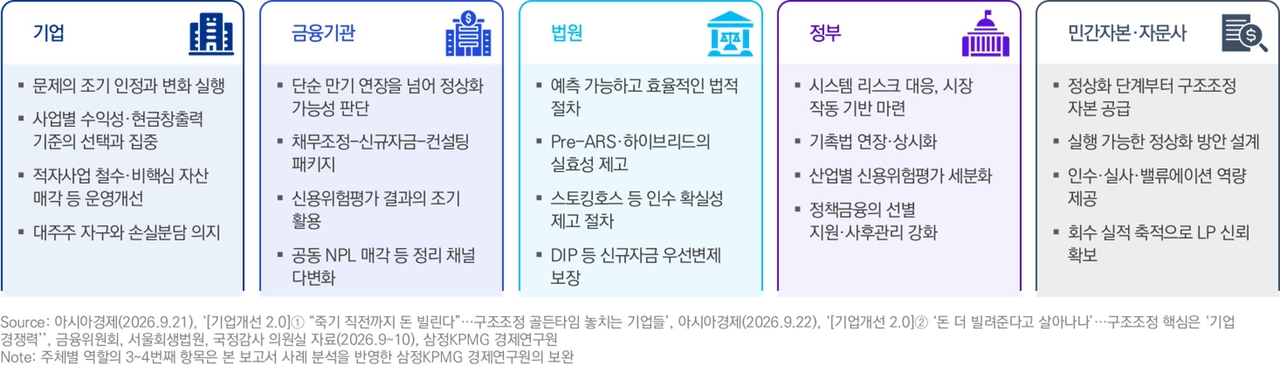
The report called for a shift away from reactive restructuring — which adjusts debt only after insolvency has materialized — toward market-driven corporate improvement that intervenes preemptively while corporate value and cash-generating capacity remain intact.
Samjong KPMG's analysis of major restructuring cases found that outcomes depended less on the specific tools used and more on three factors: early intervention, the supply of new financing, and the participation and discipline of market capital.
Companies should reassess their business portfolios based on profitability and cash-generating capacity by segment, and pursue business reorganization and operational efficiency improvements early when necessary. Financial institutions, meanwhile, should move beyond simply rolling over maturities and instead make rigorous assessments of a company's business competitiveness and recovery prospects before deciding whether to extend credit.
The roles of the government, courts and private capital are also critical, the report said. The effectiveness of relevant regulations should be strengthened to allow capital and specialized expertise to flow in from the point at which a company still has a viable path to recovery, and a market-driven restructuring ecosystem should be established.
"It is important to move away from the approach of adjusting debt after corporate value has already been destroyed, and instead intervene preemptively while corporate value and cash-generating capacity remain," said Yang Jin-hyeok, a managing director at Samjong KPMG. "Building a market-driven restructuring ecosystem — where early intervention, new financing supply and private restructuring capital form a virtuous cycle — is the core challenge."
park.jiyeong@heraldcorp.com