Launch ceremony held at Okpo Shipyard in Geoje; vessel to be delivered to Navy in late 2027
5-inch gun, KVLS, long-range anti-submarine torpedo among armaments
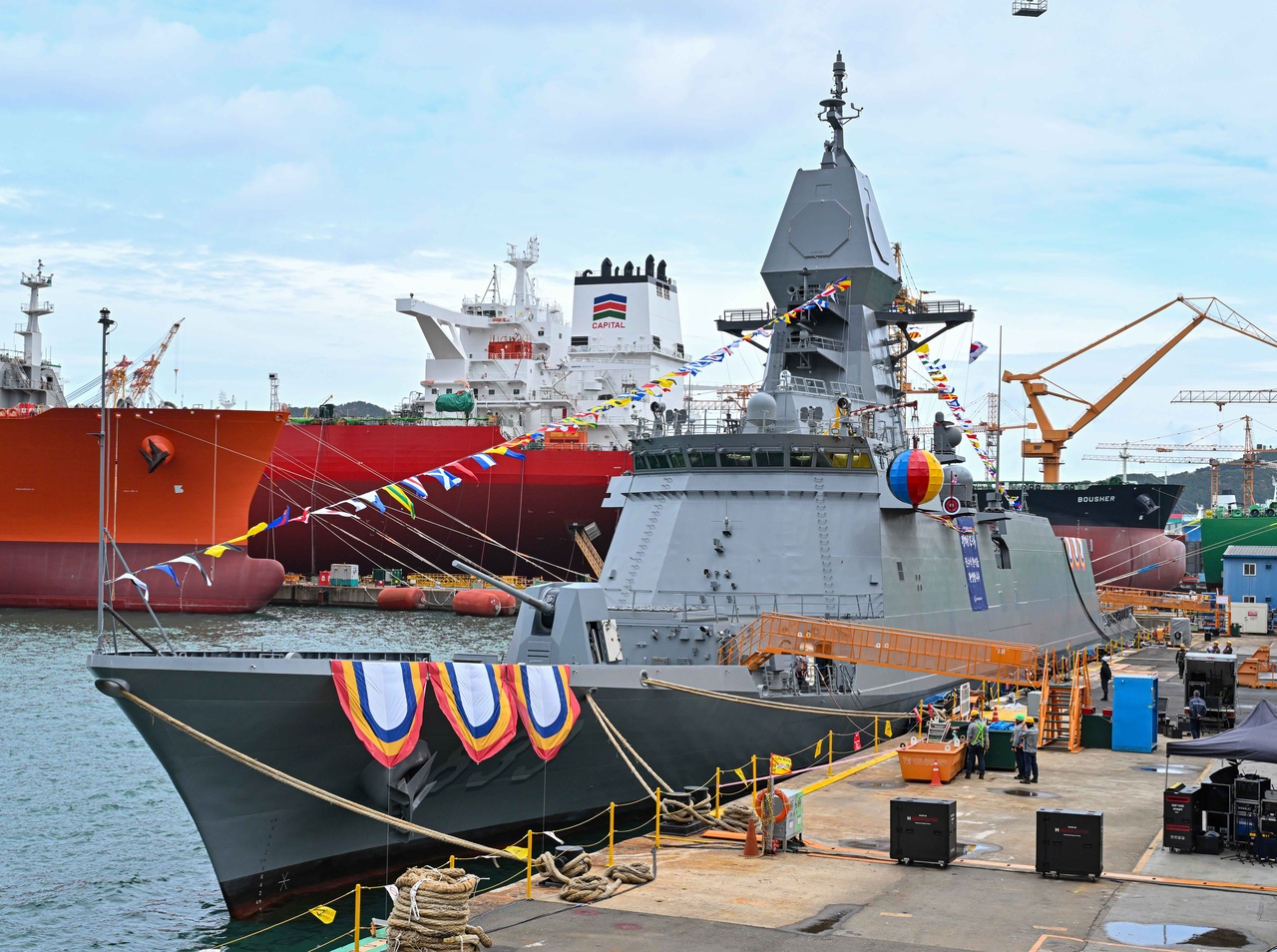
The Navy's fifth 3,600-ton frigate, the Pyeongtaek (FFG-833), was launched Wednesday. Measuring 129 meters in length, 14.8 meters in beam and 38.9 meters in height, the vessel is drawing attention as a cutting-edge naval asset equipped with a 5-inch naval gun, the Korean Vertical Launch System (KVLS), anti-ship missile defense missiles, ship-to-ship missiles, tactical ship-to-ground missiles and long-range anti-submarine torpedoes.
South Korea's Navy and the Defense Acquisition Program Administration (DAPA) held the launch ceremony for the Ulsan-class Batch-III fifth hull at Hanwha Ocean's Okpo Shipyard in Geoje on Wednesday.
The Navy named the vessel after Pyeongtaek, the city in Gyeonggi Province where the Second Fleet Command is based. It is the second time the name Pyeongtaek has been used for a Navy vessel. The first Pyeongtaek (ATS-27) was commissioned in 1996 after being transferred from the US Navy and served for about 20 years before being decommissioned in December 2016.
The ceremony drew about 150 attendees, including Defense Minister Kang Shin-chul as the guest of honor, Navy Chief of Staff Kim Gyeong-ryul, DAPA Infrastructure Forces Program Director Jeong Jae-jun and Hanwha Ocean CEO Kim Hee-chul, along with other Navy, DAPA and shipbuilding officials.
Following naval tradition, the launch was performed by Lee Hye-gyeong, wife of guest of honor Defense Minister Kang, who cut the launch rope — a ritual symbolizing the cutting of an umbilical cord to breathe life into a newly built vessel. Distinguished guests then cut multicolored ribbons with scissors and smashed a champagne bottle against the hull in a ceremony wishing the ship safe voyages.
The Pyeongtaek is fitted entirely with domestically produced equipment, including its combat management system — the ship's brain — as well as its key sensors and weapons. It carries a domestically developed four-face fixed-array Multifunctional Phased Array Radar (MFR), enabling omnidirectional detection and tracking of air and surface targets and simultaneous engagement of multiple aerial threats.
The frigate also employs a hybrid propulsion system to minimize underwater radiated noise, and operates a domestically developed hull-mounted sonar (HMS) and towed array sonar system (TASS), giving it strong anti-submarine warfare capabilities.
"The Pyeongtaek is the latest frigate embodying the best of South Korea's advanced science and technology, and a testament to the excellence of our defense science and shipbuilding capabilities," DAPA Infrastructure Forces Program Director Jeong Jae-jun said. "Built on proven technology, it is expected to make a significant contribution to future defense exports."
"The Pyeongtaek will serve as a core asset defending the West Sea and carry out its assigned missions with distinction," said Lee Gu-seong, chief of the Navy Headquarters Planning and Management Staff. "Our Navy will stand by the people as an elite force, and we will continue building an even stronger naval capability grounded in future advanced technology."
The Pyeongtaek will undergo sea trials before being delivered to the Navy in December 2027, after which it will go through an operational readiness process before being deployed.
Meanwhile, US Sen. Dave McCormick (Republican, Pennsylvania), known as a close ally of President Donald Trump, boarded the Pyeongtaek last month to personally inspect the vessel's technology.
youknow@heraldcorp.com