Mayors of Goyang, Yangju, Namyangju, Uijeongbu, Paju and Guri hold joint press conference, urge reform
Cities say index places excessive weight on distance from Seoul
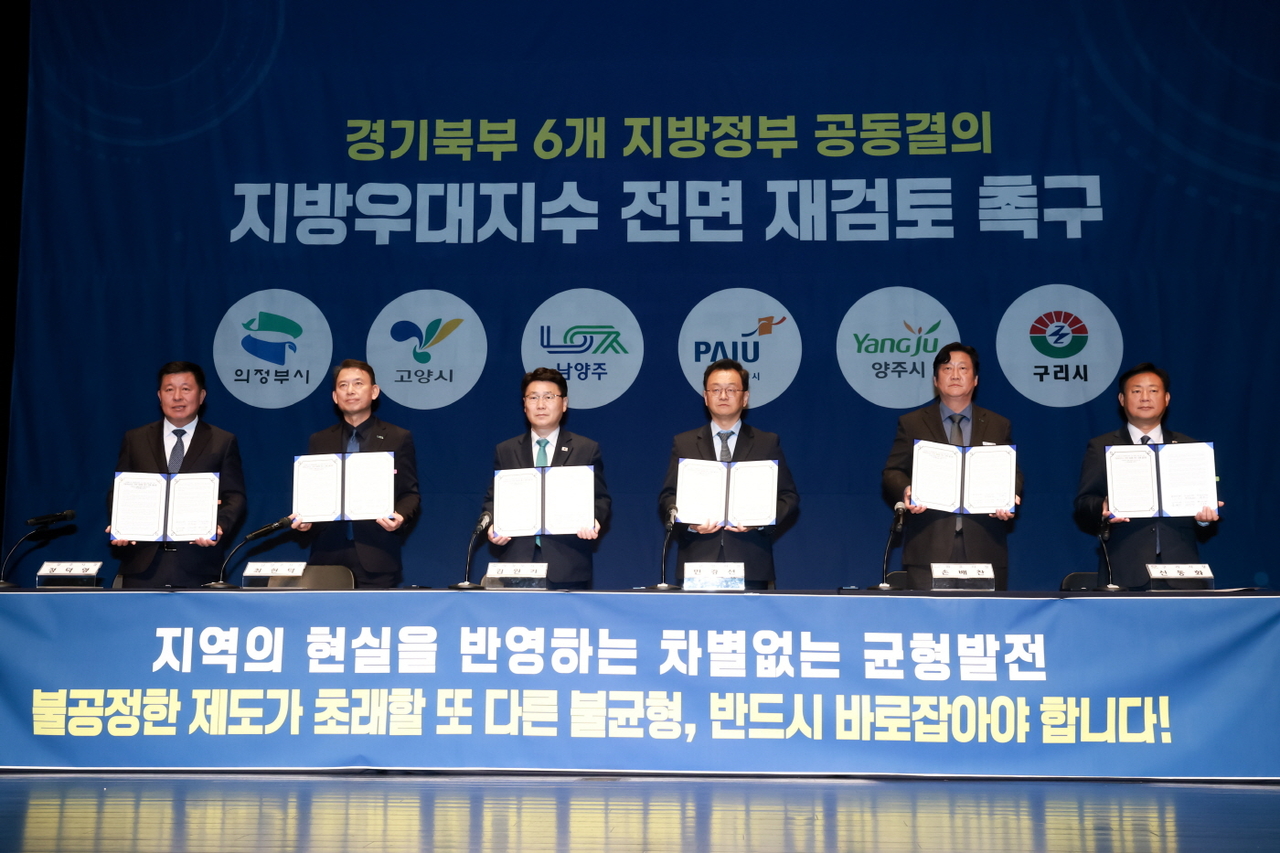
The mayors of six cities in northern Gyeonggi Province held a joint press conference at Anyang Arts Center on Tuesday, calling on the government to fully overhaul its method for calculating the "local preference index" and reform the underlying system. The mayors in attendance were Goyang Special City Mayor Min Gyeong-seon, Yangju Mayor Jeong Deok-yeong, Namyangju Mayor Choi Hyeon-deok, Uijeongbu Mayor Kim Won-gi, Paju Mayor Son Bae-chan and Guri Mayor Shin Dong-hwa.
The six mayors called for a complete review of the local preference index calculation method, which they said places excessive weight on distance from Seoul; the establishment of support criteria that reflect the essential administrative demands and fiscal burdens arising from national housing supply policies; and the introduction of meaningful differentiated support measures commensurate with the overlapping regulations and security sacrifices borne by the region.
In a joint resolution, the mayors argued that the government had decided support ratings based primarily on distance from Seoul while ignoring the actual fiscal and industrial conditions of local governments, even as it claimed to be addressing regional disparities. "Fair and reasonable evaluation criteria must be established that comprehensively take into account the distinct characteristics and actual conditions of each region," they said.
The mayors said proximity to Seoul and a large population do not necessarily mean a city has a strong self-sustaining economic base or sufficient fiscal capacity. "Northern Gyeonggi Province has faced constraints on regional development due to sacrifices made for national security and overlapping metropolitan-area regulations," they said. "Housing supply policies pursued in the greater Seoul area without expanding the industrial and employment base have increased the population and administrative demand, but local tax revenues have not kept pace."
They added that fiscal burdens from essential administrative needs — including welfare and transportation — continue to mount, yet all six cities in northern Gyeonggi Province have been classified in Zone 1, the lowest support tier. "It is plainly unfair that regions that have endured development constraints and shouldered fiscal burdens because of national policy should also receive disadvantageous treatment in national support," they said.
The mayors stressed that the local preference index calculation method, which places excessive weight on distance from Seoul, must be comprehensively reviewed, and that fair and reasonable evaluation criteria reflecting the distinct characteristics and actual conditions of each region must be established.
Goyang Special City Mayor Min said Goyang and other cities in northern Gyeonggi Province are subject to overlapping regulations — including the Seoul Metropolitan Area Readjustment Planning Act, development restriction zones and military facility protection zones — and are shouldering heavy fiscal burdens from a surge in population and essential administrative demand for welfare and transportation services driven by national housing supply policies. "The sacrifices northern Gyeonggi Province has endured for so long must be reflected in the local preference index assessment, and zone designations must be rationally reassigned," Min said.
The six cities said they would continue to act collectively and forcefully until the government corrects what they called an unreasonable method for calculating the local preference index and its zone designations.
The local preference index is an indicator the Ministry of Interior and Safety is pushing to introduce to address the risk of regional depopulation and promote balanced national development. Concerns have been raised about reverse discrimination after major local governments in northern Gyeonggi Province — including Goyang — were grouped into Zone 1 alongside Seoul, Incheon and major cities in southern Gyeonggi Province, leaving them excluded from policy support on top of the existing overlapping regulations they already face.
pjh@heraldcorp.com