- Structural battery technology could allow robot skeletons to store electricity, paving the way for next-generation commercial applications
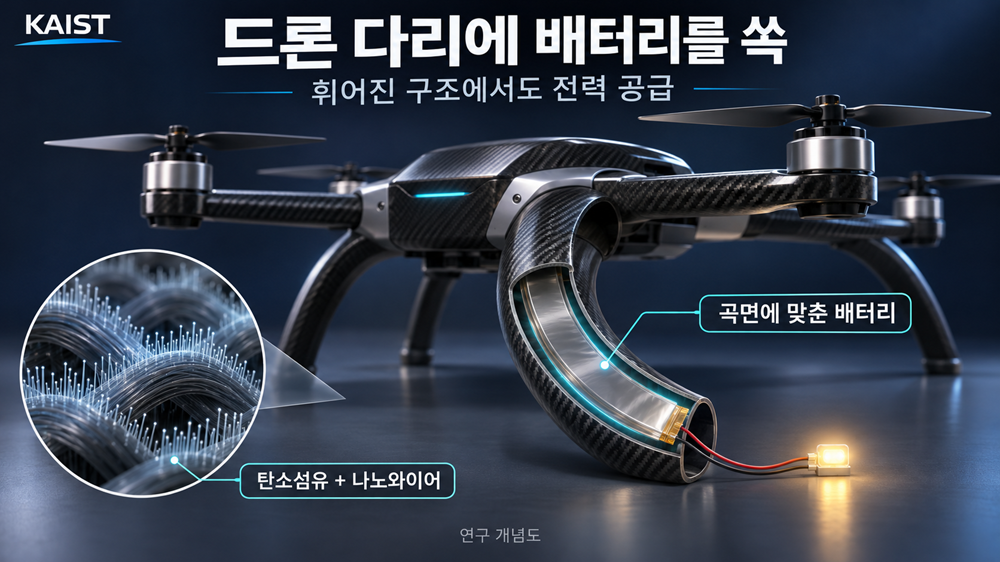
Researchers have developed technology that allows a drone's legs or a robot's skeleton to double as a battery.
KAIST announced Wednesday that a research team led by Professor Oh Il-kwon of the Department of Mechanical Engineering has developed a flexible lithium-sulfur battery cathode by growing nanowires directly on carbon fiber.
Drones and robots face inherent limits on battery capacity due to weight and space constraints. To address this, "structural battery" technology — which combines energy storage with the load-bearing components of a device — has been drawing growing attention.
Conventional batteries, however, have been developed primarily in flat form factors, making them difficult to apply to curved or hollow structures such as drone legs. Repeated bending or external impacts also caused electrode materials to detach, degrading performance.
The research team solved this problem by growing nickel cobalt selenide (NiCo₂Se₄) nanowires directly on the surface of a carbon fiber fabric.
Nickel cobalt selenide promotes the charge and discharge reactions in lithium-sulfur batteries. Rather than coating electrode materials onto the surface as in conventional methods, the team integrated the nanowires directly with the carbon fiber, designing the structure to maintain electrical pathways even when bent.
Lithium-sulfur batteries hold particular promise for their light weight and high energy storage potential, but have long been limited by sulfur's low electrical conductivity and performance degradation caused by material migration during charge and discharge cycles. The research team used the nanowire structure to address these issues while also securing the electrode's mechanical stability.
In testing, the electrode retained stable nanowire adhesion to the carbon fiber surface after more than 1,000 repeated bends at a radius of 2.5 millimeters, with no visible damage or structural collapse observed.
The team then integrated lithium-sulfur pouch cells using the electrode into oval and rectangular structures, as well as an actual drone leg frame, successfully powering light-emitting diodes. The results demonstrated that the battery can supply power normally even in non-flat structures.
The battery also performed stably under external load. When integrated into a cylindrical structure and subjected to pressure sufficient to damage the structure itself, the battery maintained 99.8 percent of its initial voltage, and the LEDs continued to operate without flickering or switching off.

However, additional research is needed before the technology can be commercialized as a structural battery capable of bearing the full load of an actual drone or robot. The team must still replace the liquid electrolyte with a structural electrolyte, minimize battery packaging to reduce weight, and verify the actual effect on extending flight time.
"Drones and robots have many curved or hollow components, so batteries fitted to those shapes must operate stably," Oh said. "This research demonstrated the potential of technology that allows drone legs or robot skeletons to store electricity while also supporting the device."
The findings were published online Oct. 1 in the international journal Advanced Composites and Hybrid Materials.
nbgkoo@heraldcorp.com