Seodaemun-gu, home to Korea's independence movement legacy, and Gwangju's Buk-gu, where the spirit of the May 18 pro-democracy uprising lives on, forge a sister-district partnership rooted in historical solidarity — expanding cooperation to youth history education, startup markets, local festivals and community governance policy
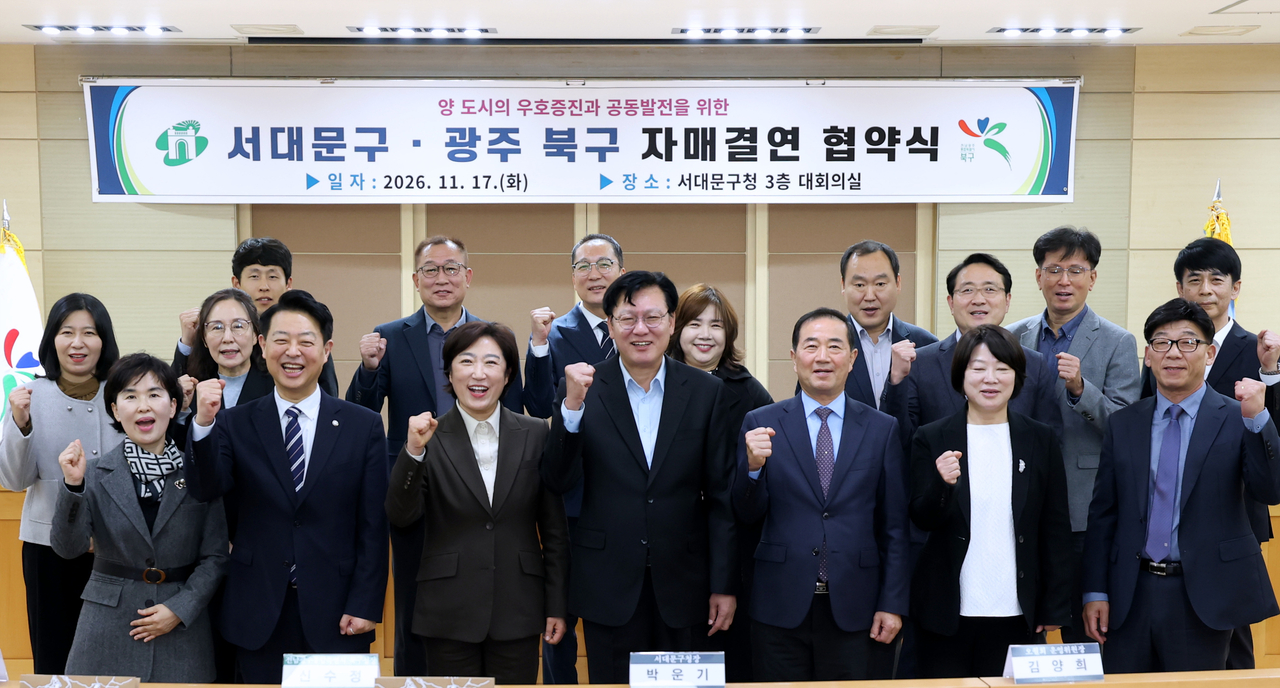
Seodaemun-gu, which holds the legacy of Korea's independence movement, and Gwangju's Buk-gu, where the spirit of the May 18 pro-democracy uprising endures, have joined forces. Drawing on the sacrifices made for independence and democracy across different eras, the two districts will deepen their ties through history education for future generations, community exchanges and regional economic cooperation.
Seodaemun-gu signed a sister-district agreement with Gwangju's Buk-gu at the district office Tuesday. About 40 people attended the signing ceremony, including the district mayors and officials from both sides.
Seodaemun-gu is home to the Seodaemun Prison History Hall and the National Memorial Hall of the Korean Provisional Government, both dedicated to commemorating the anti-Japanese resistance and sacrifices of independence activists during the colonial period. Gwangju's Buk-gu holds key sites tied to the May 18 pro-democracy movement, including the National May 18th Democratic Cemetery, Mangwol-dong Cemetery Park and the main gate of Chonnam National University.
To carry their shared historical values into education for the next generation, the two districts plan to launch a history and university exploration program in which youth from each district visit the other's city.
Young people from Gwangju's Buk-gu will visit the Seodaemun Prison History Hall and the National Memorial Hall of the Korean Provisional Government, as well as the Sinchon university district, including Yonsei University and Ewha Womans University. Their counterparts from Seodaemun-gu will travel to the National May 18th Democratic Cemetery, Chonnam National University, the Gwangju Institute of Science and Technology (GIST) and Mudeungsan National Park, gaining opportunities for both history education and career exploration.
The historical partnership will also translate into practical cooperation linking residents' daily lives and local economies.
The two districts plan to run cross-district "mutual-benefit markets" where products from youth entrepreneurs and social economy enterprises are introduced and sold in each other's area. They are also exploring the sale of Gwangju Buk-gu's local agricultural specialties — including watermelons and strawberries — at direct-trade markets in Seodaemun-gu.
In culture and sports, the districts will invite delegations to each other's flagship events, including the Seodaemun Independence and Democracy Festival and the Gwangju Biennale, while expanding exchanges in cultural performances and recreational sports.
Administrative cooperation is also on the agenda. The two districts will share experiences in resident participation and community governance policy — areas both prioritize — and plan to pursue ecological trail programs and green policy exchanges making use of urban green spaces.
Following the signing ceremony, officials from both districts visited the Seodaemun Prison History Hall and the National Memorial Hall of the Korean Provisional Government together to reflect on the history of the independence movement.
The two districts plan to work out the timing and scale of exchange programs in each area through working-level consultations.
"The history of independence that Seodaemun holds and the democratic spirit that Gwangju's Buk-gu has upheld are rooted in different eras, but they share the same value — that the people are the true owners of history," Seodaemun-gu District Mayor Park Un-gi said. "We will ensure that spirit does not remain confined to commemoration and memory, but flows into the learning of young people, the participation of residents and genuine exchange between our two communities."
seouldream01@heraldcorp.com