Ministry of Land, Infrastructure and Transport releases 2025 housing survey
Newlywed RIR hits 20.2%; youth renters also at 17.4%
Seoul renters spend 21.5% of income on rent
Share calling for housing support jumps to 45.9%, up 7.7 percentage points from a year ago
A government survey found that while the price-to-income ratio for homeowners held steady for a second consecutive year at 6.3 last year, the rent-to-income ratio for tenants rose 1.2 percentage points from the previous year.
In the Greater Seoul area, the price-to-income ratio fell 0.5 from 2024 to 8.2, while the rent-to-income ratio reached 19.7%, up 1.3 percentage points. Seoul's price-to-income ratio stood at 11.7 — down 2.2 from the previous year — while its rent-to-income ratio climbed to 21.5%, up 0.7 percentage points. The figures point to a sharp rise in rental costs across both the jeonse and monthly rent markets.
The Ministry of Land, Infrastructure and Transport released the findings Tuesday as part of its 2025 Housing Survey. The survey showed diverging trends in housing cost burdens between the home-purchase and rental markets.
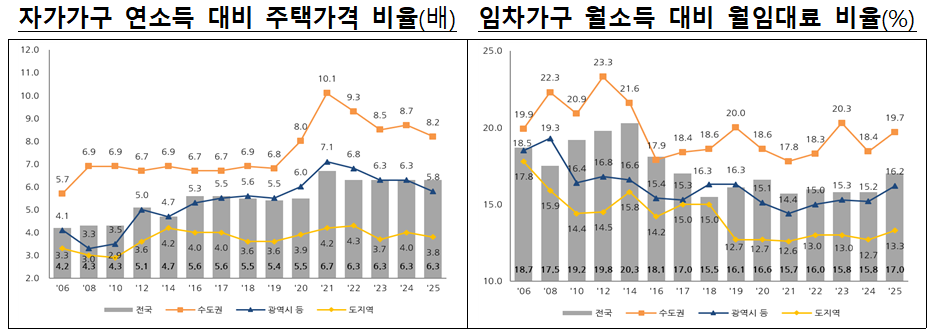
The price-to-income ratio, or PIR, measures how many years of total income — with no spending — it would take to buy a home. Nationally, the figure was unchanged from a year earlier. The metric is based on median values, so regional comparisons may differ. The Greater Seoul area saw its PIR fall from 8.7 to 8.2, while metropolitan cities dropped from 6.3 to 5.8 and provincial areas from 4.0 to 3.8.
The rent-to-income ratio, or RIR, measures the share of a tenant's monthly income spent on rent, with jeonse deposits converted using the jeonse-to-monthly-rent conversion rate. Based on median values, the ratio rose across all regions. Nationally, it increased 1.2 percentage points from 2024. The Greater Seoul area's RIR reached 19.7%, up from 18.4% the previous year, while metropolitan cities rose from 15.2% to 16.2% and provincial areas from 12.7% to 13.3%.
Starting with this year's survey, the calculation method was revised to apply region-specific jeonse-to-monthly-rent conversion rates by city and province, replacing a single national standard. Despite the methodological change, the overall upward trend in rental burden was evident.
Youth and newlywed renters hit hardest; newlywed RIR tops 20%
Among demographic groups, the RIR increase was most pronounced for young households, who are more likely to rent. Some 80.6% of youth households were renters, and their RIR jumped from 16.0% to 17.4%, a rise of 1.4 percentage points. The PIR for youth homeowners fell to 5.6 from 6.0 the previous year.
Newlywed couples also faced a heavier housing cost burden. The RIR for newlywed renter households surged 2.5 percentage points, from 17.7% to 20.2%, meaning they now spend more than a fifth of their monthly income on rent. When asked which housing-related factor most influenced their decision on whether to have children, newlyweds cited housing costs as the top concern, scoring them 3.30 out of 4.
For elderly households, the PIR for homeowners fell from 9.1 to 7.6, and the RIR for renters eased from 25.4% to 24.7%, suggesting some relief on paper. However, elderly renters still recorded the highest RIR of any household type — a reflection of their lower incomes, which push the ratio up even as the actual amounts they pay remain relatively low.
First-time homebuyers take 8 years to save; demand for financial and rental support surges
As rental and other housing costs weighed more heavily on households, the share of respondents saying they needed government housing support programs jumped to 45.9%, up 7.7 percentage points from 38.2% the previous year.
The most-needed programs, in order, were home-purchase loan support (31.2%), jeonse loan support (21.8%), long-term public rental housing supply (12.2%) and monthly rent subsidies (11.8%).
By income level, lower-income households ranked jeonse loan support (23.1%) and monthly rent subsidies (20.1%) highest, while upper-income households most frequently cited home-purchase loan support (47.6%).
The time it takes a household head to buy a home for the first time after forming a household stretched to 8.0 years, slightly longer than the 7.9 years recorded the previous year.
Homeownership rate rises; share of substandard housing falls
The homeownership rate rose 0.6 percentage points from the previous year to 62.0%, meaning 62 out of every 100 households own their home. In the Greater Seoul area, the rate edged up from 55.6% to 56.0%.
The home-occupancy rate — the share of households living in a home they own — also increased, rising 0.7 percentage points from 58.4% in 2024 to 59.1%. The Greater Seoul area's rate of 53.1% was well below the 68.2% recorded in provincial areas.
The share of respondents who said owning a home is necessary stood at 85.6%, but the figure has been on a steady downward trend: it was 89.6% in 2022, 87.3% in 2023 and 86.8% in 2024. Among upper-income households, 93.4% said homeownership was necessary, compared with 78.6% among lower-income households.
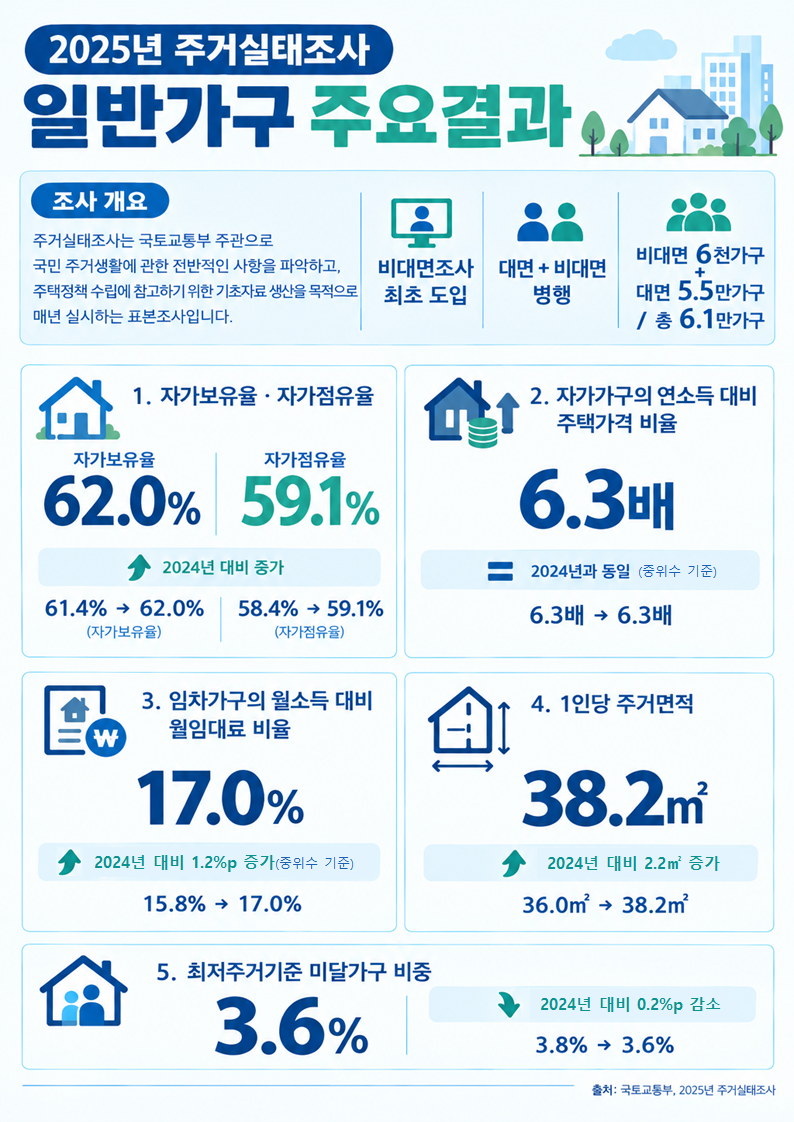
The share of households living in substandard housing fell to 3.6%, down from 3.8% the previous year. The figure has remained at a similar level since dropping below 4% in 2022.
Per-capita residential floor space increased to 38.2 square meters from 36.0 square meters the previous year, and the average floor space per household also grew, from 68.1 square meters to 71.5 square meters. The average length of residence held steady at 8.4 years, the same as the previous year, while the figure for the Greater Seoul area was 7.1 years.
Residents' satisfaction with their homes averaged 3.06 out of 4, and satisfaction with their residential environment averaged 3.05, up 0.03 points and 0.04 points, respectively, from the previous year.
The Housing Survey is an annual sample survey conducted to assess the overall state of the nation's residential conditions and to inform housing policy. The Korea Research Institute for Human Settlements calculated figures such as the homeownership rate using data as of June last year.
smh@heraldcorp.com