Answer sheets past 1-year retention limit gone — scores alone insufficient to prove AI use
Regular headcount up on paper but down in practice — about 89% of exam supervisors are outside contractors
Public Policy Bureau, Labor Ministry, budget office left out of TF — next year's qualification testing budget cut by 14.31 billion won
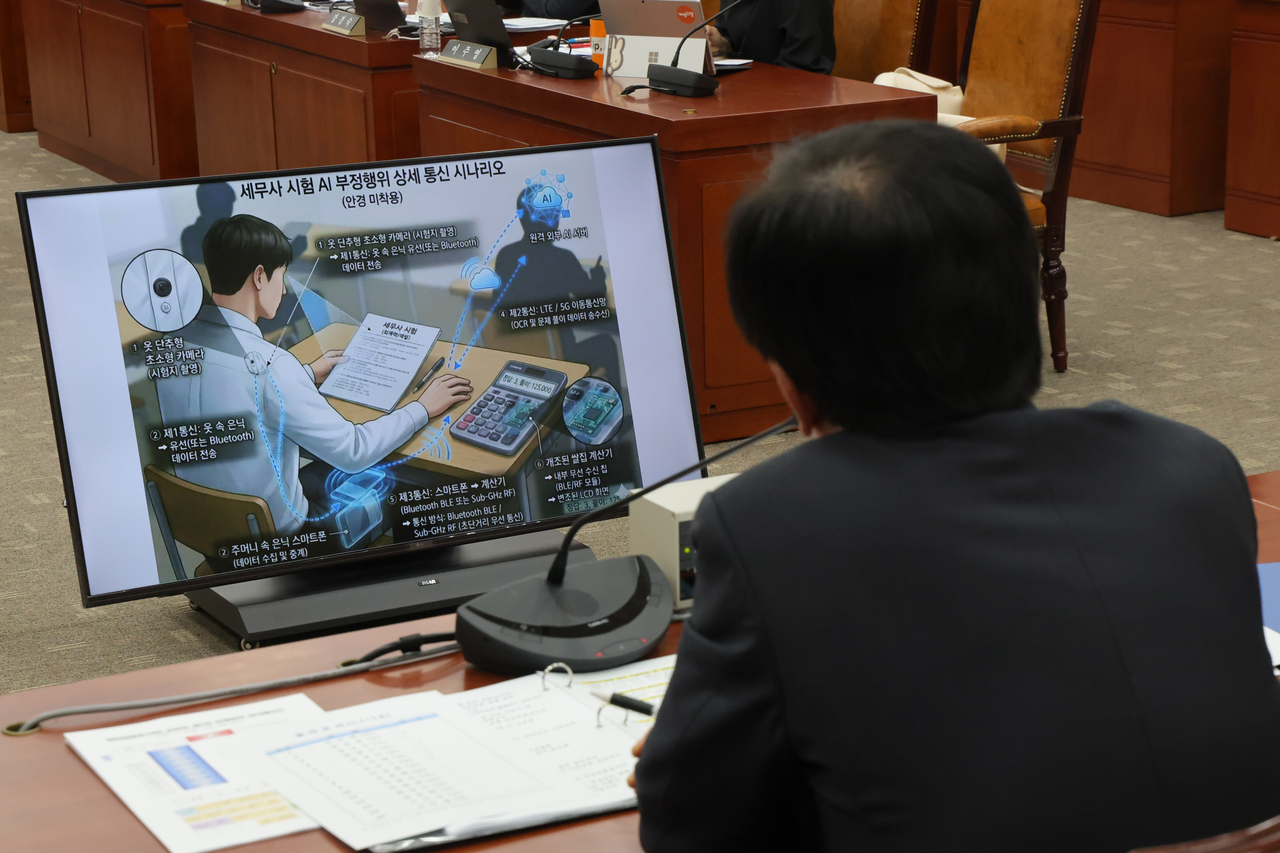
The Ministry of Economy and Finance has announced plans to re-examine the scores of tax accountant exam passers from the past three to five years as part of its response to a cheating scandal — but it has yet to present any plan to expand the staffing or budget of the Human Resources Development Service of Korea, the public agency that administers the exam on its behalf.
Answer sheets from the second-stage written exam are kept for only one year. It remains unclear how many original or digital copies from years past still exist, and there is no stated plan for verifying cases where those materials are unavailable. Critics say the government has pledged to revisit past scores without providing the verification data, personnel or funding needed to back that up or prevent a recurrence.
The Ministry of Economy and Finance said Monday it had formed a task force with the National Tax Service and the Human Resources Development Service to re-examine the distribution of individual and subject-by-subject scores among final passers over the past three to five years. Officials said the review would flag cases showing sharp score disparities in specific subjects — similar to the pattern seen in the recently confessed cheating case — for closer investigation.
However, answer sheets older than one year no longer exist. Even if anomalies are found in the scores, there are no answer sheets left for experts to review. A ministry official said in a phone interview that the intent was to look at three to five years of data to identify candidates who showed unusual results this year and then check their answer sheets. That means this year's answers can be examined, but past exam cheating cannot be verified by the same method.
Even when suspicious cases are identified, proving AI-assisted cheating is difficult. The ministry has said that identifying AI cheaters would be hard even when answer sheets are available. The Ministry of Employment and Labor, by contrast, cited expert opinion that AI use tends to produce similar answer patterns, and that standardized responses in the subjective second-stage exam could be detectable.
Identifying suspicious characteristics in an answer and proving actual AI use are two different things. If the ministry itself acknowledges that AI cheating is hard to detect even with answer sheets in hand, it would be even harder to do so from scores alone when the sheets no longer exist. The government has in effect conceded that a score review alone cannot reliably identify AI cheaters.
A more fundamental solution would be to secure adequate staffing at the Human Resources Development Service and provide the budget needed for supervision, equipment and training. The task force proposed strengthening supervisor training, expanding closed-circuit television coverage at exam venues and introducing radio-frequency detectors — but it did not specify how many additional staff would be hired or how the costs would be covered.
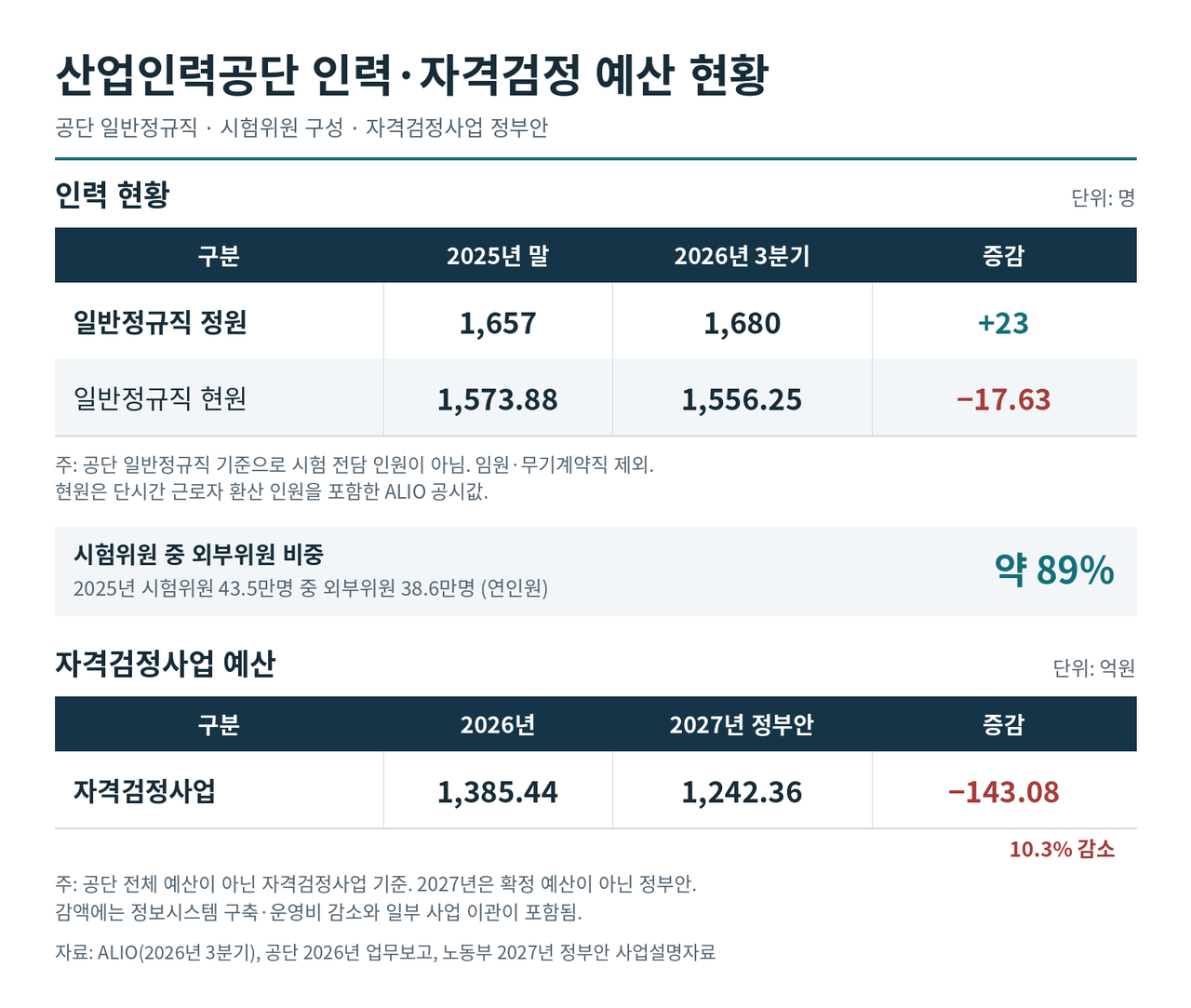
The Human Resources Development Service has seen its authorized headcount for regular full-time employees rise while its actual headcount has fallen. According to the public institution management information system ALIO, the authorized number of regular full-time positions increased from 1,657 at the end of last year to 1,680 in the third quarter of this year, a gain of 23. Over the same period, the actual headcount fell from 1,573.88 to 1,556.25, a drop of 17.63. These figures are calculated on a part-time-adjusted basis and cover the agency's entire regular full-time workforce, not exam-dedicated staff alone.
The vast majority of exam supervisors are outside contractors. According to the agency's 2026 business report, of the cumulative 435,000 exam supervisors counted last year, 386,000 — about 89 percent — were external. The agency itself has acknowledged the need to strengthen management of its supervisor pool, including tailored job training for outside supervisors and improvements to its training and evaluation framework. Expanding supervisor training will require the agency to secure both the internal staff and the funding to run and manage those programs.
The Ministry of Employment and Labor also said the agency's current headcount is insufficient to conduct a full review of all 528 national qualification exam categories this year, and that it is considering adding personnel. With a large-scale retroactive investigation now layered on top of regular exam operations, the agency needs not only new hires but also a plan to fill already-authorized positions that remain vacant.
Yet the ministries and offices that would need to address those issues were left out of the publicly announced task force lineup. The head of the Ministry of Economy and Finance's Tax and Customs Office leads the TF, but the ministry's own Public Policy Bureau — which handles headcount and grade adjustments for public institutions — is not participating. The Ministry of Employment and Labor, which oversees the Human Resources Development Service, and the Ministry of Planning and Budget, which controls budget allocations, were also excluded. The government has prioritized expanding the scope of the score review while leaving the staffing and funding questions unresolved.
A senior Ministry of Economy and Finance official said the task force is expected to discuss extending the current one-year answer sheet retention period, though no specific new duration has been set. Any extension would require additional budget and personnel for storage space, digitization and records management. Lengthening the retention requirement does not by itself build the capacity to use those records for verification.
Poor management of national qualification exams is a longstanding problem. The Human Resources Development Service was subjected to a special audit by the Ministry of Employment and Labor in 2023 following an incident in which answer sheets from practical exams for industrial technician certifications were shredded, and the agency received an official institutional warning over its continued record of exam-related failures.
Despite that history, the budget for the qualification testing program has been cut in the government's proposal for next year. According to the Ministry of Employment and Labor's 2027 program budget documentation, the agency's qualification testing budget will fall from 138.54 billion won ($104 million) this year to 124.24 billion won next year, a reduction of 14.31 billion won, or 10.3 percent.
The National Assembly is discussing budget increases to fund the introduction of radio-frequency detectors and the deployment of specialized personnel. However, the Ministry of Economy and Finance's task force announcement contained no concrete plan for how the necessary staffing and funding would be secured or how the relevant ministries would be brought into the process.
fact0514@heraldcorp.com