24 teams advance to finals
Employees develop work programs using generative AI
Applications span tire design, vehicle acceleration analysis
Three top prizes awarded
Top entries to be reviewed for workplace adoption
Google Cloud among technology sponsors
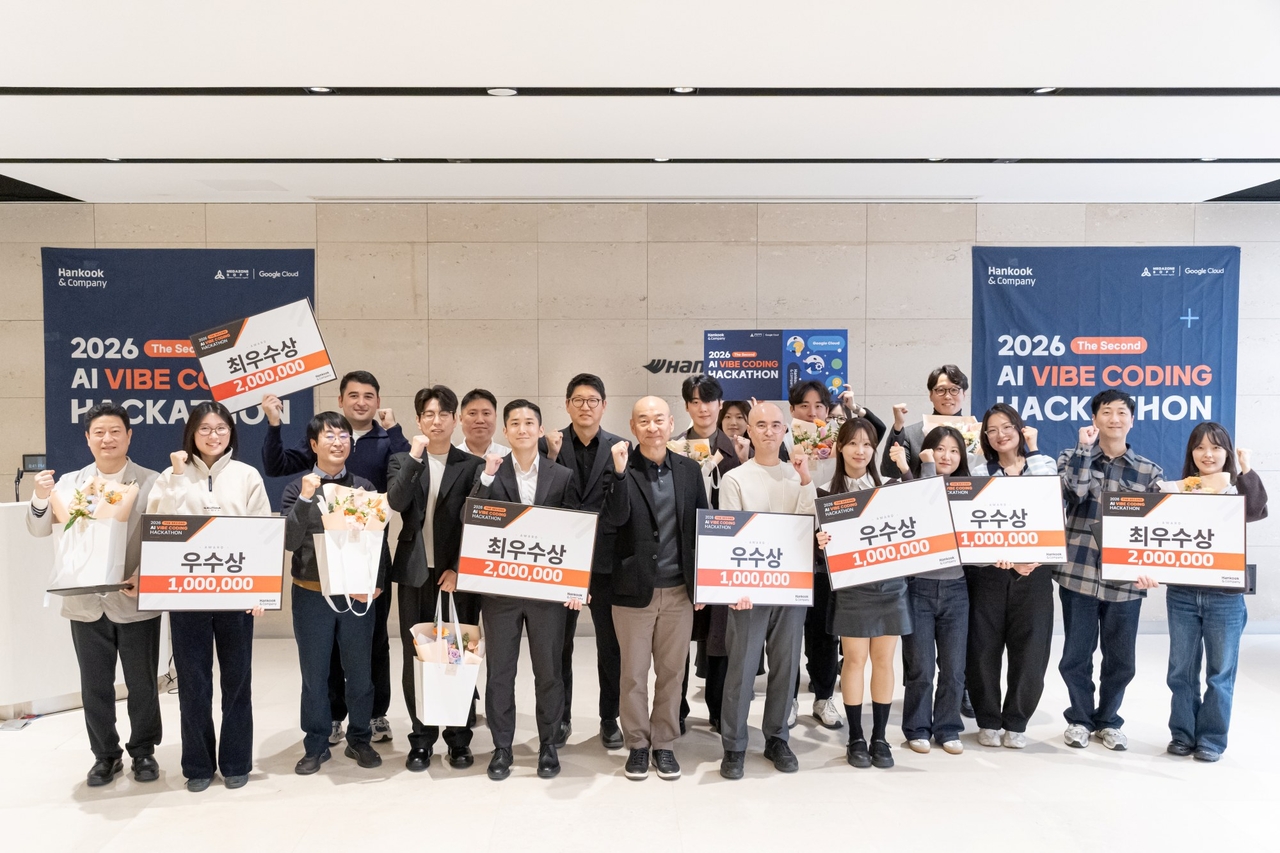
Employees of Hankook & Company Group used generative AI to build workplace programs covering everything from tire design to vehicle performance analysis and manufacturing quality control. The company plans to review top entries for potential adoption in actual operations.
Hankook & Company Group announced Tuesday that it held the awards ceremony for its AI Vibe Coding Hackathon 2026: The Second on Monday at Technoplex, its headquarters in Pangyo, Seongnam, Gyeonggi Province, selecting three grand-prize winners and four runner-up teams.
The competition was held for the second time this year, following a first edition in June. While the company's previous in-house Business Intelligence contest focused on analyzing and visualizing data, this edition challenged participants to build functional workplace programs using generative AI.
The finals, held Nov. 3 at Google's startup campus in Gangnam-gu, Seoul, drew 24 teams and 48 employees from across the group. Participants developed and deployed workplace services using the AI development tool Google Antigravity and the AI model Gemini 4 Argon.
The three grand prizes went to entries in tire design, vehicle acceleration analysis, and quality and manufacturing data utilization.
The "D-AI" team from the Marketing Division's Design Innovation Studio presented a "Tire Design Modeler" intended for use in the tire development process. The program renders design concepts as images and allows users to compare multiple design options side by side, with the goal of supporting the ideation and review stages of new tire design.
The "Road Twin" team from the Research and Development Innovation Division built a program that analyzes vehicle acceleration. It combines road severity analysis results with an AI model to assess vehicle acceleration data — both lateral and longitudinal — and identify vehicle characteristics under different driving conditions. The findings can feed directly into tire research and development.
The "Q-TwinPilot" team from the Quality Division developed a chatbot called TwinPilot-Q that lets users easily query and analyze quality data from the manufacturing floor. The tool pairs digital twin technology — which recreates real manufacturing environments in a virtual space — with an AI chatbot interface.
When a user asks a question in plain language, the AI retrieves relevant quality and manufacturing data and delivers an analysis. The system is designed to reduce the burden of manually searching and processing complex datasets, helping staff make faster decisions.
Four projects received runner-up prizes, including a digital learning platform for visual inspection tasks and a program that estimates raw material prices to analyze the profitability of original equipment tires for new vehicles.
Also among the runner-up winners were "PACTORY," which automates package design, and "T-Plex," which centrally manages transfer pricing for overseas subsidiaries. Six teams received encouragement awards and 11 teams took home best-challenge prizes.
The judging panel included not only internal experts but also representatives from Google Cloud and Megazone Soft. Evaluators assessed both the practicality of each idea and whether the program had been fully built and functioned as intended.
Google Cloud participated as a sponsor for the second consecutive time, having also backed the inaugural competition in June. Together with Megazone Soft, it provided pre-competition training for participants and technical mentoring throughout the development process.
Hankook & Company Group plans to share all programs produced at the competition with employees across the company. Entries judged to have strong potential for real-world use will be reviewed for on-site deployment.
Through this initiative, the group aims to build a corporate culture in which not only dedicated IT developers but also staff in design, research and development, and quality management actively use AI in their day-to-day work.
"The rapidly evolving AI technology will be an opportunity to enhance the group's capabilities and create growth momentum," said Lee Sang-hoon, president and chief executive of Hankook Tire & Technology. "We will provide swift and broad support at the highest level in the industry so that our employees can lead the AI transformation and grow their capabilities."
kwater@heraldcorp.com