From comedian on 'Sseurirang Couple' to current-affairs host — over 40 years in broadcasting
A couple who truly listen to each other, a village where art meets farming — finding happiness together
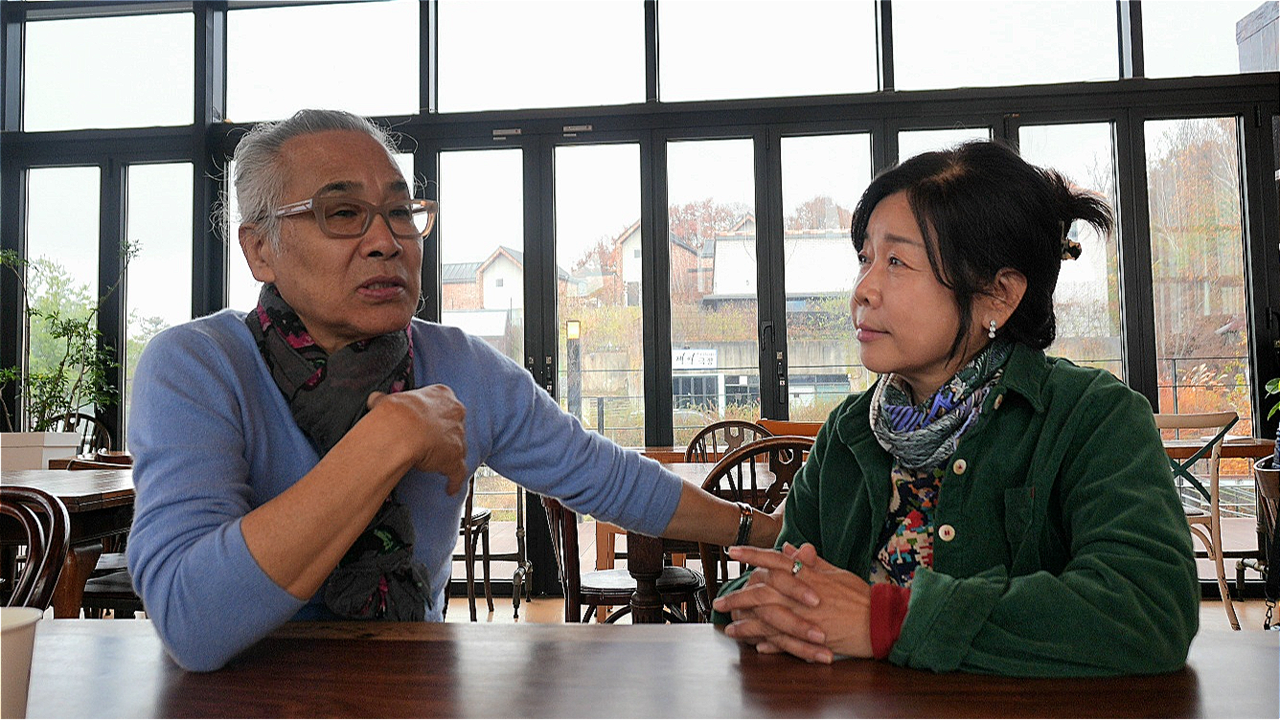
Broadcaster Kim Mi-hwa made audiences laugh with her signature straight-browed character "Sunakjil Yeosa" and kept listeners informed on the world through radio. Now, more than 40 years into her broadcasting career, the conversations she holds closest are about the happiness of the people around her.
Kim made her debut in 1983 and won wide affection in 1987 through "Sseurirang Couple," a comedy act she performed alongside Kim Han-guk. In 1990, she became the first woman to win the KBS Comedy Grand Prize. The character "Sunakjil Yeosa" — a sharp-tongued, uncompromising housewife — was the role that made her name.
From 2003, she expanded her reach by hosting MBC Radio's current-affairs program "The World and Us." Having moved between the comedy stage and the current-affairs microphone, she has now built another chapter in her life: Kim Mi-hwa Village, which she tends together with her husband, former Sungkyunkwan University professor Yoon Seung-ho.
The couple sat down for an interview Friday at Kim Mi-hwa Village in Wonsam-myeon, Yongin, Gyeonggi Province. They opened by saying they had only ordinary stories to share — but those stories held early-morning piano sessions, cups of coffee, time spent listening to each other, and years of work done alongside their neighbors.
Kim's day begins with a cup of coffee her husband brings to her bedside. Yoon rises before dawn, feeds their pets, tidies up and then heads to the cafe. He said sitting at the piano with a coffee is the happiest part of his day — and because he worries about waking his still-sleeping wife if he plays at home, he keeps that time for himself at the cafe before returning to bring her coffee.
Kim moves to her own rhythm, heading out before dawn or late at night depending on her broadcasting schedule, and sleeping in on days when she has nothing planned. The two live at different speeds, yet they share each other's mornings in their own way.
Whether at home, at the cafe or on the road to a distant shoot, the two are often together. Yoon said that while he was still teaching, juggling his university schedule with his wife's filming commitments could be stressful, but since retiring he has enjoyed the freedom to use his time as he pleases. Kim said he has almost always been the one behind the wheel when she travels far for a shoot.
Kim described herself as someone driven by curiosity. She said she once told the same story to both a friend and her husband to see who listened more closely — and Yoon kept responding with "And then?" and "Really?" She said that even after years together she feels at ease with him, and that she feels loved in the way he focuses on what she is saying.
"It feels like he understands me 120 percent and cheers me on."
While continuing her broadcasting work, Kim also became a mature-age student, studying social welfare at Sungkyunkwan University — and that period of study led to her connection with Yoon. According to Kim, the two first met when she was asked to emcee a university event before she enrolled. Singer Hong Seo-beom, a close friend of Yoon's, and Cho Gap-gyeong, a close friend of Kim's, were a married couple who knew them both. After the two families became acquainted, Hong and Cho encouraged them to pursue a serious relationship.
When Kim began thinking about marriage, her first thought was of the children. Could two people, each raising their own kids, come together and build a family that would thrive? Alongside the hope of starting over, there was fear. What she saw at that moment was Yoon's devoted care for his children.
"It started from my belief that he was the kind of person who could raise the children well even if I weren't there."
Yoon said that over several years of watching Kim, he had come to see her as someone he could trust. The two married in 2007. Looking back on the years they have shared, Yoon said he has come to understand how quickly time can pass when you are happy.
After the wedding, Yoon found himself watching up close as his wife's every move became news. Kim, who had stepped beyond the familiar comedy stage to take on current-affairs programs, faced difficulties surrounding her broadcasting work. Yoon recalled that through that period he felt he had to be there to keep her from falling apart.
For Kim, that time was also a process of discovering what her husband truly was. She said she wonders whether she could have handled things as calmly as she did without him by her side during those hard years. Before marriage she had worried that living together might reveal sides of each other they had not seen — but the man she came to know in daily life was exactly the person she had always known.
"He is a wonderful companion in life and someone who guides me so I can handle things well. He is a little more mature than I am."
There were moments when their care for each other did not quite land as intended. Kim recalled an early period in their marriage when her husband received a warning about a potentially serious illness. He told her that if the diagnosis turned out to be grave, he would want to go abroad alone. Kim said she understood later that he had not wanted to show her his suffering — but at the time she felt hurt. She added that it turned out to be a misdiagnosis, yet the shock of his words stayed with her.
Kim was equally candid about expressing her own feelings. When asked how a couple stays happy, she said you have to be "selfish" about yourself — and she illustrated the point with birthday flowers.
"Every year on my birthday, I want to receive flowers. I love flowers."
She said she tells her husband plainly when she wants flowers, rather than waiting for him to read her mind and letting disappointment build. Her reasoning: the other person may have no idea what is making you unhappy, and if you suffer in silence and let resentment grow, you end up hurting yourself. Saying what you want also gives the other person a chance to come through for you.
Her idea of happiness also made room for her husband. Kim said caring for Yoon is bound up with her own happiness — he needs to be happy for her to be happy, and she needs to be happy for him to be happy. She said she wants to cheer him on as he builds a second chapter in life, finding joy in music and new pursuits.
Yoon spoke about the joy of giving. He said that in his experience, expecting something in return for what you have done for someone is a source of conflict. He described the kind of love he tries to practice in their marriage this way:
"Joy comes from giving."
That spirit of listening to each other's wishes and supporting what the other loves has also shaped the way they have built Kim Mi-hwa Village. The couple brought connections made through broadcasting into performances held there, and set up a market where visitors could buy produce harvested by local farmers.
Kim said that even during her busiest years hosting current-affairs programs, she was commuting between Yongin and the broadcasting studios in Yeouido. Traffic through Gangnam could add an hour and a half to the journey, so she reasoned that if the commute was going to take that long anyway, she might as well live close to nature. At night, stars appeared that the city's lights had always hidden. She said she found deep satisfaction in the clean air, fresh water and the changing seasons.
Later, when her broadcasting work ran into difficulties, the couple talked about what they could do from where they were. Yoon proposed creating a cultural playground together with the local farmers — a way to share Kim's years of meeting people and spreading laughter with their neighbors. They turned that idea into a cafe and a performance space.
The cafe they opened was called "Homi" — taking the "Ho" from Yoon Seung-ho and the "Mi" from Kim Mi-hwa. The name also carried the meaning of a homi, the traditional Korean hand plow: starting something new by working the ground. The couple called the blend of art and farming they were creating "ye-nong munhwa," or arts-and-agriculture culture.
Kim spoke of the colleagues who took the stage because they believed in what the couple was trying to do. Performers including Hong Seo-beom, Cho Hang-jo and Lim Hyung-joo took part without accepting a fee. Word of weekend performances drew visitors from the city, and farmers brought their harvests to a market set up alongside the shows. People who came for the music left with fresh produce, and the stage and the fields met in one place.
Local students also took part. Yoon said students from the horticulture club at Wonsam Middle School helped set up and clean up after events, and the admission fees collected were donated to the school for use in its gardening program. The students used the money as seed funding to grow crops, then brought their harvests to sell at the market. Enjoying a performance became a hands-on lesson in farming.
What Kim remembers most vividly is the sight of neighbors who had been working in the fields changing into their best clothes to come and watch a show. She said she was moved to see farmers who had been out in the paddies arrive neatly dressed the moment they heard a performance was on. She also found meaning in watching neighbors gain confidence as their produce sold.
"I thought: we really are doing something good here. We did the right thing."
Families came to make kimchi together. There were days for planting and digging up potatoes and sweet potatoes side by side. Visitors tried their hand at farm work and went home with food grown by their neighbors. Kim Mi-hwa Village, as the couple describe it, is built as much from these encounters as from any performance.
To learn better ways of running the place, they traveled to Japan to stay at rural exchange spaces and observe how visitors came from afar to experience country life, and how those encounters fed energy back into the community. Kim was careful to say, however, that they had not managed anything on the scale of transforming the whole village — the meaning, she said, was in having created a space where neighbors could come together well.
Talking about Kim Mi-hwa Village, she kept returning to stories about the people who live nearby. When an elderly resident has a birthday, neighbors gather to boil noodles and prepare food. When the roadside grass needs cutting, everyone pitches in. Kim said that kind of life still carries the spirit of "dure" — the traditional Korean practice of communal labor and mutual aid.
Among their neighbors, the two are known less as a broadcaster and a professor than as a trusted older sibling and a younger one. Sharing meals and working side by side, Kim said she feels "the smell of people living" — the warmth of human community. For the couple, the appeal of rural life lies as much in those relationships as in the natural surroundings.
Maintaining and improving the space has come with real financial strain. Yoon said he took on debt acquiring the land and buildings, and that some of that debt remains. Even as surrounding development has pushed up land prices, he said it is hard to feel entirely at ease watching residents move away and the natural environment change. Both expressed regret at seeing the rural setting they had chosen gradually give way to urbanization.
The performances and exchange activities came to a halt during the COVID-19 pandemic and have not resumed with the same energy since, but the couple said they want to start again someday. Yoon said he is working on new ideas to make better use of the space for more people, though he declined to share details, noting that planning and permit procedures are still ahead.
What the two most want to share from this place going forward is the experience they have gathered from their own lives — rebuilding a family after loss, raising children, leaving the city to put down roots in the countryside. These are things both of them spent long years working through. Yoon also spoke about the difficulties and questions he faced raising a son with a disability, and said it took time to learn how to accept things that do not go as planned.
Drawing on those experiences, they said they want to meet in person with people standing at similar crossroads and talk with them. The aim is not to hand out answers. Yoon was clear that he cannot offer practical solutions, but said he hoped that by listening and thinking things through together, they might ease someone's pain, even a little.
The moments when Kim has felt most loved by her husband are the moments he listens to her seriously. The couple said they want to share that kind of time with others — to keep meeting people at the place where they once watched performances and shared produce, listening to each other's stories and offering one another strength.
They have also decided to stop putting off time for themselves. In the past, they would decline invitations from friends, saying they were too busy; now they make the effort to go. On Sunday, the day before the interview, they had just returned from Jeju — a trip with no particular agenda, just time spent with friends over a glass of makgeolli. Yoon said he feels more keenly with each passing day how precious the time they can share together truly is.
Since leaving the lecture hall, Yoon said he is living the life of a musician — early-morning piano, plans for a new space, conversations he wants to have with people. Kim explained why she cheers him on:
"He has to be happy for me to be happy, and I have to be happy for him to be happy."
Yoon said he wants to spend more new and joyful time together. When asked to sum up his marriage, he kept it short.
"Being able to love someone is a great joy."
Kim Mi-hwa, who has spent decades making people laugh, now speaks of her own happiness in the same breath as the happiness of her husband and her neighbors. On days with broadcasting commitments she heads to the studio; at the village she welcomes whoever comes. One thing she said about their life together lingers long after the interview ended.
"We're just living and having fun."
wssong@heraldcorp.com