
Concerns over AI-assisted cheating on national exams are mounting after the top scorer on this year's tax accountant licensing exam confessed to using artificial intelligence during the test. Amid the growing alarm, a worker at a state-run utility has gone viral online by volunteering to use company equipment to catch cheaters at the College Scholastic Ability Test, or CSAT.
On Monday, a user identified as an employee of the Korea Electrical Safety Corporation posted on Blind, an anonymous workplace community app, under the title "We'll catch all AI cheating at the CSAT."

"We have 3,000 employees across offices nationwide, and each person carries one thermal imaging camera," the user wrote. "No other organization handles this equipment as routinely as we do."
The user added that each employee also carries an electroscope for measuring electromagnetic fields. "Please use us. We will work for the country. We will catch them all," the post read, and went on to say, "Anyway, we're the ones who do all the safety inspections at CSAT venues."
In practice, the Korea Electrical Safety Corporation conducts annual electrical safety inspections at exam sites nationwide ahead of the CSAT. Last year, it inspected electrical facilities at 1,282 exam sites across the country and checked uninterruptible power supply units on broadcast equipment to prepare for potential power outages during the English listening section.
The thermal imaging cameras the corporation uses are industrial devices designed to detect abnormal heat in electrical equipment. They sense infrared radiation to produce visual maps of surface temperatures and heat distribution, and are used to identify overheating in power infrastructure such as wiring and circuit breakers.
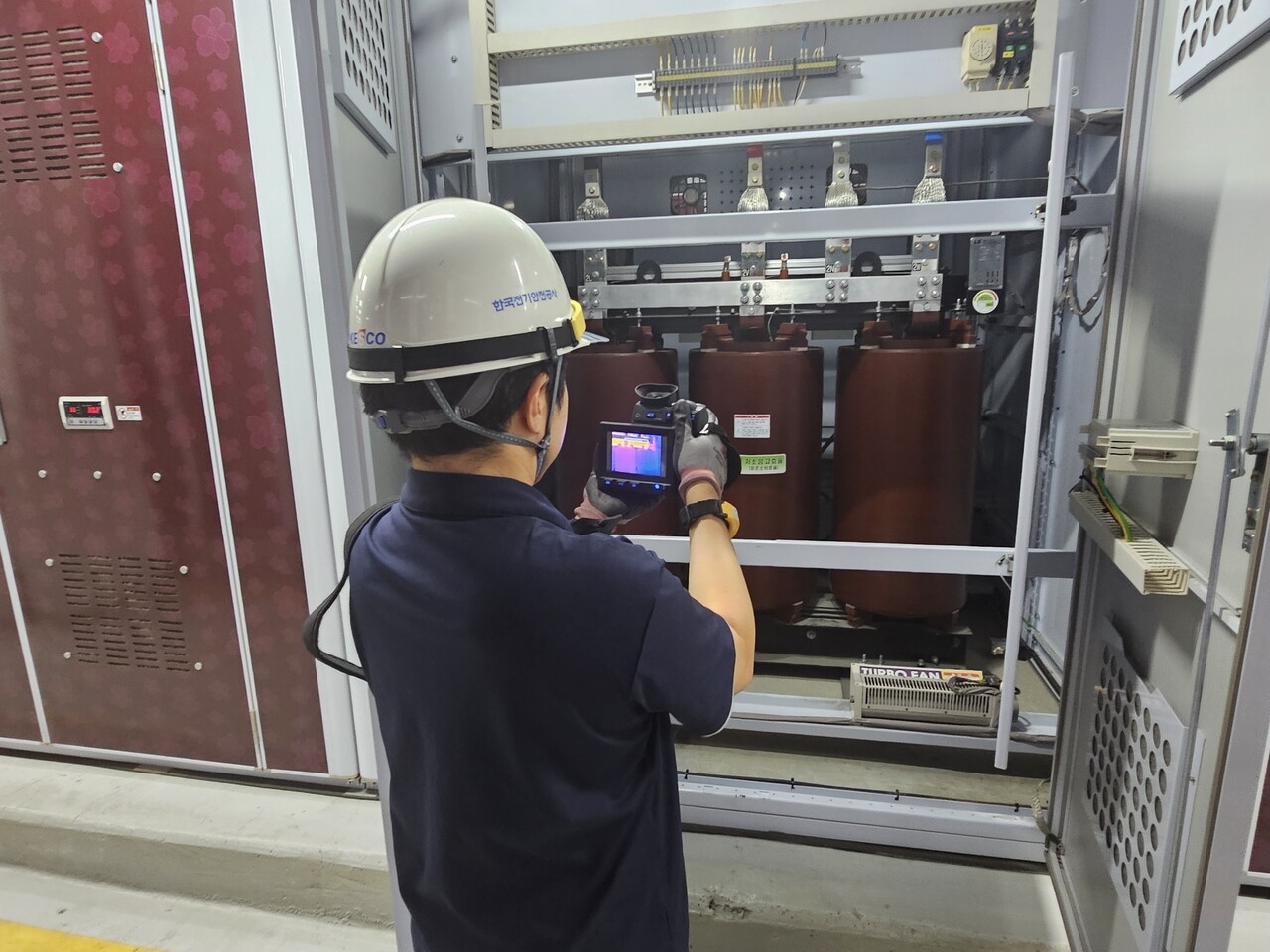
Some have speculated that deploying such equipment at exam venues could help detect heat emitted by active miniature electronic devices — particularly if a battery or communications module is running, which could reveal a device hidden on a person's body or clothing.
Others, however, note that ultra-small cameras consume so little power that they would be difficult to detect. When concealed under clothing or against the body, the heat they generate may not reach the outer surface.
"If a device runs hotter than body temperature due to battery heat, detection could be possible depending on conditions — but something like a micro earpiece that fits inside the ear would be very hard to pick up," an industry official said.
The electroscope, meanwhile, is a tool for checking whether voltage is present in electrical equipment and is used to assess electrical hazards — not to detect wireless signals. Catching Bluetooth, Wi-Fi or other radio-frequency transmissions would require a separate radio-frequency detector.
Even so, online reaction to the unexpected offer has been largely enthusiastic. Comments on the post included: "Just announcing thermal cameras and electromagnetic detection would probably deter most people from even trying"; "Let's pay 1 million won ($749) per case caught as a reward"; "They deserve a budget — S-grade performance review this year"; and "Perfect candidates for CSAT proctors."
bbo@heraldcorp.com