Samjong KPMG publishes report on e-commerce market restructuring and new competitive strategies
Beyond discounts, platforms chase customer lock-in through memberships, private labels and grocery
AI and creators reshape shopping as recommendation-driven commerce rises
South Korea's e-commerce market is maturing, and with growth slowing to single digits, companies are pivoting their competitive strategy from a "scale race" to an "ecosystem race" — one built on organically connecting customers, partners and global markets, according to a new analysis.
Customer lock-in through memberships and delivery, AI-driven innovation across shopping, logistics and advertising, and reverse-import infrastructure supporting overseas sales of Korean consumer goods are all expected to emerge as the key competitive advantages determining sustained growth for e-commerce companies.
Samjong KPMG published a report Tuesday titled "E-commerce Market Restructuring and New Competitive Strategies," finding that as the domestic e-commerce market enters a mature phase, the competitive landscape is rapidly reshaping around profitability, customer touchpoints and global markets.
Domestic online shopping transaction volume reached 274.94 trillion won ($206 billion) in 2025, up 4.8 percent from the previous year, with online penetration of the domestic retail market reaching 52.8 percent that year. This year, the growth rate of online shopping transactions has shown signs of recovery, maintaining roughly 5 to 13 percent growth in the first half.
The competitive landscape is also shifting alongside market maturation. Market concentration continues around Coupang Inc and Naver, while mid-tier players are focusing on improving profitability rather than expanding scale, carving out survival strategies through specialized categories such as grocery, fashion and beauty, or through alliances with global platforms.
Chinese e-commerce players such as AliExpress and Temu are also accelerating localization efforts — moving beyond ultra-low-price cross-border shopping to onboard domestic sellers and secure logistics footholds — creating a competitive environment in which domestic and foreign operators now go head-to-head simultaneously.
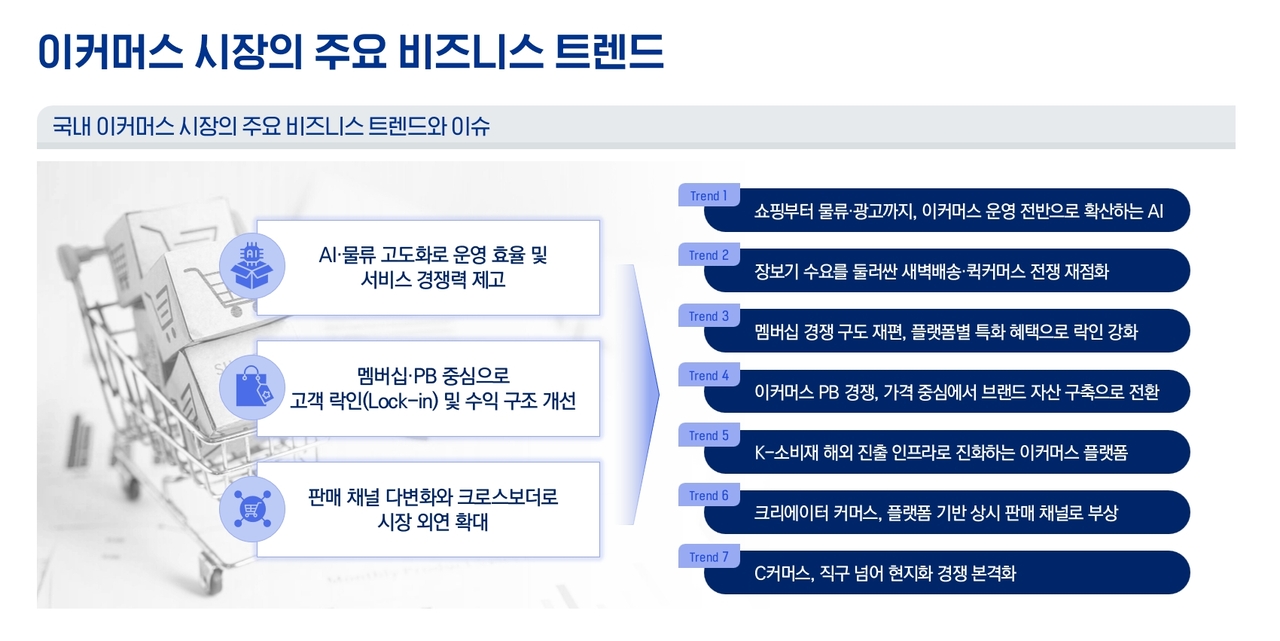
Samjong KPMG identified seven major trends driving the domestic e-commerce market: AI spreading across shopping, logistics and advertising; dawn delivery and quick-commerce competition for grocery demand; a reshaping of the membership landscape; private-label brands evolving from price-focused products to platform brand-building assets; platforms evolving into export infrastructure for Korean consumer goods; creator commerce emerging as a permanent sales channel built on platform infrastructure; and Chinese e-commerce players moving beyond cross-border shopping into localization competition.
AI is expanding beyond product search and recommendations into broader e-commerce operations including logistics and advertising. The emergence of "agentic commerce" — where AI supports product discovery, comparison, recommendations and payment — is also changing how people shop. Naver has converted its shopping AI agent into a full commercial service, while Kakao has integrated external partner services. AI and robots are also being applied to demand forecasting and inventory placement at fulfillment centers, as well as to advertising operations, with the scope of use expanding rapidly.
The business viability of dawn delivery is being reassessed amid the spread of third-party logistics, Oasis's sustained profitability and Kurly's return to profit, reigniting competition in the segment. Grocery shopping, with its high repeat-purchase frequency, is considered a core area for building customer habits and strengthening platform lock-in. Coupang is upgrading its in-house logistics, while partnerships among platforms, retailers and logistics firms — including Naver-Kurly and SSG.com-CJ Logistics — are also expanding.
A personal data breach at an e-commerce platform in late 2025 triggered a full-scale competition to capture defecting customers, prompting a wave of new membership launches and overhauls across major platforms. As discount and delivery benefits have converged upward, strategies to secure loyal customers by leveraging each platform's distinct strengths are becoming increasingly important. Coupang, Naver, SSG.com, G-market and Kakao are each differentiating through specialized memberships that combine their respective strengths in delivery, content, grocery and external partnerships.
Private-label competition is also evolving beyond simple low-cost products toward building platform brand equity. Major platforms are expanding their private-label categories and premium products while also nurturing independent brands, deploying a range of private-label strategies. Coupang's Hanundamda, Kurly's beauty brand Duera and Musinsa's Oddtype are among the most prominent examples. Private labels drive product differentiation and repeat purchases while securing in-house margins, making them a tool for both customer lock-in and profitability improvement.
South Korea's reverse-import market grew 32.2 percent year-on-year last year to 2.37 trillion won. As demand for Korean consumer goods expands, domestic e-commerce platforms are broadening their role from simple sales channels to export infrastructure covering marketing, logistics, customs clearance, settlement and customer service. Coupang, 11Street and G-market are partnering with global platforms to help domestic brands and sellers expand overseas, seeking new growth engines.
Creator commerce is establishing itself as a permanent, platform-based sales channel beyond one-off content-driven sales. As platforms standardize everything from product partnerships and link generation to performance tracking and settlement, participation is expanding beyond professional influencers to small-scale content operators and general users. Naver, Coupang, Musinsa and Kurly each operate programs tailored to their platform's characteristics, using content to help consumers discover and purchase products within their ecosystems.
Chinese e-commerce players such as AliExpress and Temu are accelerating localization efforts — leveraging domestic sellers, inventory and logistics — beyond ultra-low-price cross-border shopping. Temu's local-to-local program, its expansion into fresh food sales, and JD.com's construction of domestic logistics centers are among the most notable moves. As Chinese e-commerce players extend their reach into domestic seller onboarding, corporate partnerships and logistics infrastructure, competition with domestic operators is expected to broaden from price alone to product, logistics, seller and customer experience.
As a result, the line between domestic and foreign operators in South Korea's e-commerce market is becoming increasingly blurred. Going forward, competition is expected to unfold across multiple dimensions — not just price, but logistics capabilities, seller acquisition, product competitiveness and customer experience.
Samjong KPMG said e-commerce companies seeking sustained growth should focus on three priorities: growth strategies that simultaneously secure customer lock-in and profitability; building export infrastructure for Korean consumer goods as a new growth engine; and transitioning to recommendation-driven shopping powered by AI and creators.
The report said platforms should move beyond universal benefits such as discounts and free delivery to build their own lock-in structures by combining high-frequency demand categories like grocery with members-only services and private labels. On membership, it said performance should be managed around member activity rates, cross-usage rates and customer lifetime value rather than subscriber counts alone. For logistics, it said that as third-party logistics and coalition models expand, the most efficient approach is to internalize core capabilities while supplementing non-core areas through strategic partnerships.
The report also said companies should respond to the growth of the reverse-import market by securing local exposure and marketing capabilities through alliances with global platforms, while building export infrastructure covering logistics, customs clearance, settlement and customer service. On Chinese e-commerce players' localization push — including expanding domestic inventory and fresh food offerings — it said companies should strengthen delivery and quality competitiveness while also exploring strategies to use Chinese e-commerce players' global sales networks as overseas distribution channels for Korean consumer goods.
The transition to "recommendation-driven shopping" using AI and creators was also highlighted as a key challenge. The report said companies should systematize data on product attributes, reviews and images to prepare for the spread of agentic commerce, and use AI-powered advertising automation solutions to simultaneously improve advertising efficiency for sellers and advertising revenue for platforms. It also said creator commerce should be standardized across product partnerships, link generation, performance tracking and settlement to develop it into a permanent sales channel.
"The competitive center of gravity in the e-commerce market is shifting from scale to the capability to connect customers, partners and global markets," said Park Hong-min, a managing director at Samjong KPMG. "Companies must secure customer lock-in through memberships, grocery and private labels, improve profitability through strategic alliances, respond to recommendation-driven shopping powered by AI and creators, and build export infrastructure for Korean consumer goods to secure new growth engines."
Meanwhile, Samjong KPMG, which operates on a March fiscal year, posted operating revenue of 905.6 billion won for the current fiscal year running April 2025 through March 2026, up about 3.4 percent from the previous year, crossing the 900 billion won threshold for the first time.
arete@heraldcorp.com