Case involving Lee Soon-ja and Chun family referred from prosecution office
Chun aide Heo Hwa-pyeong case also moved to new agency
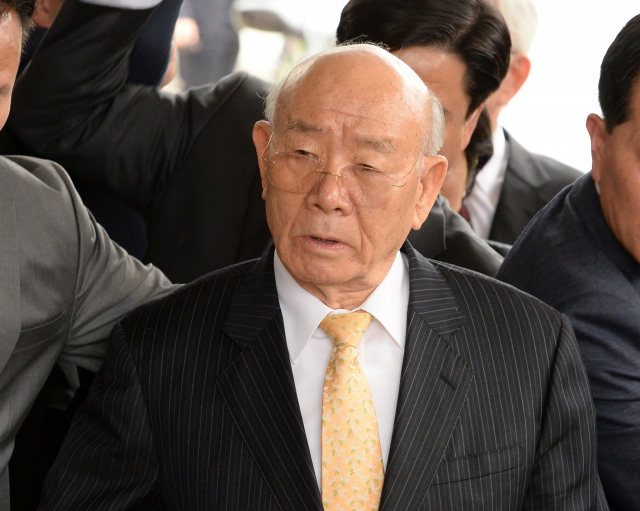
The Serious Crimes Investigation Agency has taken over a slush fund probe into the family of late former President Chun Doo-hwan, assigning the case to its criminal proceeds investigation division, it has been confirmed.
The criminal proceeds investigation division of the Seoul Serious Crimes Investigation Agency recently received the case from the criminal proceeds recovery unit of the Seoul Central Prosecution Office — the successor to the former Seoul Central District Prosecutors' Office — and is reviewing the files. The case involves allegations of violating the Act on Regulation and Punishment of Criminal Proceeds Concealment against members of the Chun family.
Chun was convicted in 1997 by the Supreme Court on charges of leading an insurrection and accepting bribes under the Act on the Aggravated Punishment of Specific Crimes, receiving a life sentence along with a surcharge order of 220.5 billion won ($165 million). He was slow to pay, and drew public outrage in 2003 when he declared he had liquid assets of no more than 291,000 won. Chun died in November 2021 with hundreds of billions of won in unpaid surcharges still outstanding. As of August that year, the unpaid amount stood at 96.6 billion won; some additional recovery followed, but about 86.7 billion won is believed to remain outstanding.
The slush fund allegations resurfaced in March 2023, when Chun's grandson Jeon Woo-won claimed on SNS that family members were running businesses and living lavishly on hidden funds. Jeon alleged that his uncle Jeon Jae-man was operating a winery in California's Napa Valley, calling it "a business no one could enter without an astronomical amount of money."
In response, a civic group called the People's Livelihood Committee filed a complaint that same month with the Seoul Central District Prosecutors' Office against Chun's wife Lee Soon-ja, his sons Jeon Jae-guk, Jeon Jae-yong and Jeon Jae-man, and his daughter Jeon Hyo-seon, on charges of violating the criminal proceeds concealment act, evading compulsory execution and obstruction of business. The Seoul Central District Prosecutors' Office assigned the case to its criminal proceeds recovery unit for review. After the prosecution office was dissolved and replaced by the new prosecution office and the Serious Crimes Investigation Agency on Oct. 2, the case was recently forwarded to the new agency.
The criminal proceeds recovery unit of the Seoul Central Prosecution Office also transferred to the Seoul Serious Crimes Investigation Agency last month a separate case involving Heo Hwa-pyeong, a former senior presidential secretary for political affairs who was a close aide to Chun. Heo was accused by a former security chief of the Army Special Warfare Command of using Chun's slush funds to build up and conceal assets through a foundation called the Mirae Hanguk Foundation.
The criminal proceeds recovery unit of the Seoul Central Prosecution Office is separately pushing to wrap up its investigation into slush fund allegations against the family of late former President Roh Tae-woo before the end of the year. Investigators conducted a search and seizure in August at the home of Roh's wife Kim Ok-suk and at the East Asia Culture Center, where Roh's son Roh Jae-heon — South Korea's ambassador to China — served as chairman. Last month, key figures including former Cheong Wa Dae protocol secretary Lee Byeong-gi were summoned as witnesses for questioning.
The prosecution office is permitted to conduct investigations into cases inherited from the former prosecutors' office for a transitional period of 90 days after its launch. Any case not concluded within that window must be transferred to the relevant investigative agency as prescribed by presidential decree. The investigation team is understood to be aiming to complete the Roh family case within that 90-day grace period.
bell@heraldcorp.com