All 4 open-ended questions presuppose establishment; no for-or-against question included
Naval Academy seniors unable to respond due to training cruise, groups say
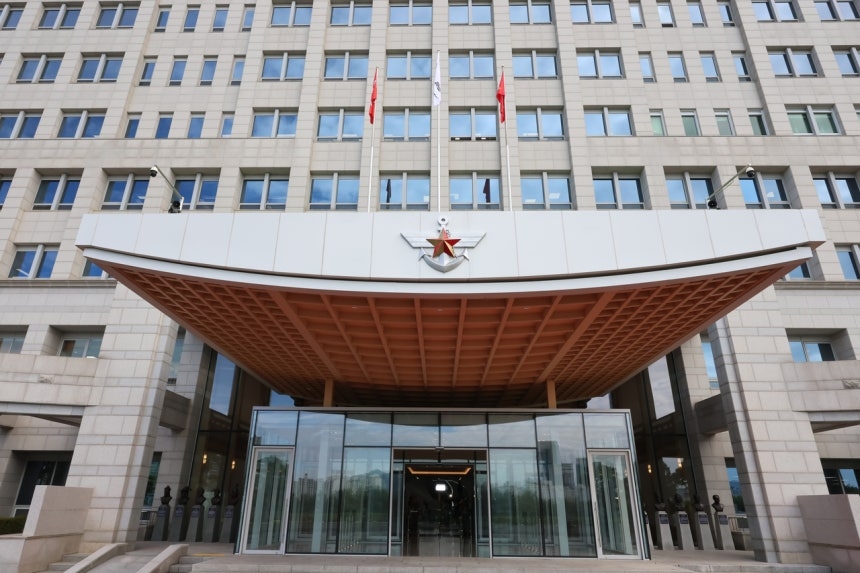
The alumni associations of the Army, Navy and Air Force academies have condemned the Defense Ministry's survey on the establishment of a unified military academy, calling it a "biased survey that treats the creation of a unified Korea Armed Forces Academy as a foregone conclusion" and demanding it be halted immediately.
The three associations held a press conference at the National Assembly on Monday, issuing a statement that questioned whether a survey that does not even ask cadets — the most directly affected stakeholders — whether they support or oppose the consolidation could be considered fair. They called on the ministry to "conduct a fair and objective process for gathering public opinion."
The Defense Ministry has been surveying approximately 2,350 cadets from the Army, Navy and Air Force academies from Friday through Tuesday. The ministry has said the survey is intended to gather cadets' views in order to refine its basic plan for establishing a unified Korea Armed Forces Academy.
The alumni groups' sharpest criticism is directed at the survey's structure. The questionnaire consists of four open-ended questions covering ways to strengthen the educational capacity of military academies, factors needed to preserve each service branch's traditions and expertise, opinions on establishing a graduate school, and considerations for the creation of a unified academy. Absent are any questions asking whether respondents support or oppose the consolidation, or whether maintaining the current three-academy system is preferable.
The associations said a survey that asks only about implementation methods and supplementary measures — without asking whether the consolidation should proceed at all — "cannot be considered a proper process for gathering opinions." They also raised concerns about the all-open-ended format, warning that it makes it difficult to objectively calculate the ratio of support to opposition and that analysts could arbitrarily classify responses as for or against. "If the criteria for interpretation and classification are not made public, it will be difficult to verify the reliability of the results," they said.
The representativeness of the survey's respondent pool also emerged as a point of contention. The associations said approximately 143 fourth-year Naval Academy cadets are effectively unable to respond because they are on a navigation training cruise. They also demanded the ministry explain why cadets from the Korea Armed Forces Nursing Academy — who are not direct stakeholders in the consolidation — were included, while cadets from the Korea Army Academy at Yeongcheon were excluded.
Anonymity concerns were also raised. The survey requires respondents to enter their academy, year, academic track and student identification number. The Defense Ministry has said that KIDA will collect the results and then delete personally identifiable information. The associations, however, argued that "given the hierarchical nature of military organizations, cadets cannot help but worry that their opinions will become known to superiors or that they will face disadvantages," adding that an assurance to delete personal data alone is insufficient. They called for independent outside experts to participate in the survey process and the analysis of results.
The associations put forward five demands: immediate suspension of the current survey and a full review of its questions and methodology; a new survey that presents all options on equal footing — including support for or opposition to consolidation, and options for maintaining or improving the current system; equal opportunity for all cadets to respond with guaranteed protection of their identities; full disclosure of the original questionnaire, survey design, response rates, school-by-school results and analytical criteria; and the establishment of a verification process that broadly incorporates the views of active-duty and reserve personnel, military education experts, alumni, parents and the general public.
The associations added that "the survey must genuinely reflect cadets' honest opinions, as the Defense Minister publicly pledged at a meeting with cadets that he would listen to them," and that "a survey lacking fairness and objectivity cannot serve as the basis for policy decisions."
rimsclub@heraldcorp.com