Police release results of intensive cyber sexual violence crackdown
Police detected 3,267 cases of cyber sexual violence — including child sexual exploitation material and AI-generated deepfake videos — and arrested 3,430 suspects over the past year, detaining 148 of them.
The National Investigation Headquarters of the Korean National Police Agency announced Monday that it had conducted an intensive crackdown on cyber sexual violence from Nov. 17 last year through Oct. 31 this year.
Investigators focused on apprehending operators of sexual exploitation material distribution sites, which are typically difficult to track and shut down. As a result, police arrested 38 suspects identified as site operators and detained 16 of them. Authorities also traced criminal proceeds — including advertising revenue — and secured 3.35 billion won ($2.51 million) in pre-indictment confiscation and collection preservation orders. For more than 70 illegal sites whose key operators were arrested, police either destroyed original videos or shut down operations through international cooperation.
The crackdown also netted a large number of suspects involved in producing, selling and purchasing deepfake videos. A man in his 20s was arrested for posting advertisements on SNS from 2023 through February this year, offering to create deepfake videos using photos of acquaintances, then compositing the submitted images into sexual content for sale. Another 112 suspects — all men — who had seen the advertisements, sent photos of victims and purchased the resulting videos were also arrested.
In August, a man in his 20s was arrested for producing child and youth sexual exploitation material targeting minors he had met through online chat. During the investigation, authorities uncovered an additional charge of possessing more than 2,000 pieces of child and youth sexual exploitation material.
In May, a man in his 20s was arrested on stalking charges for repeatedly distributing photos of a former partner to people in the victim's social circle. During the investigation, police identified additional charges of possessing child and youth sexual exploitation material and illegally filmed content, and the suspect was detained.
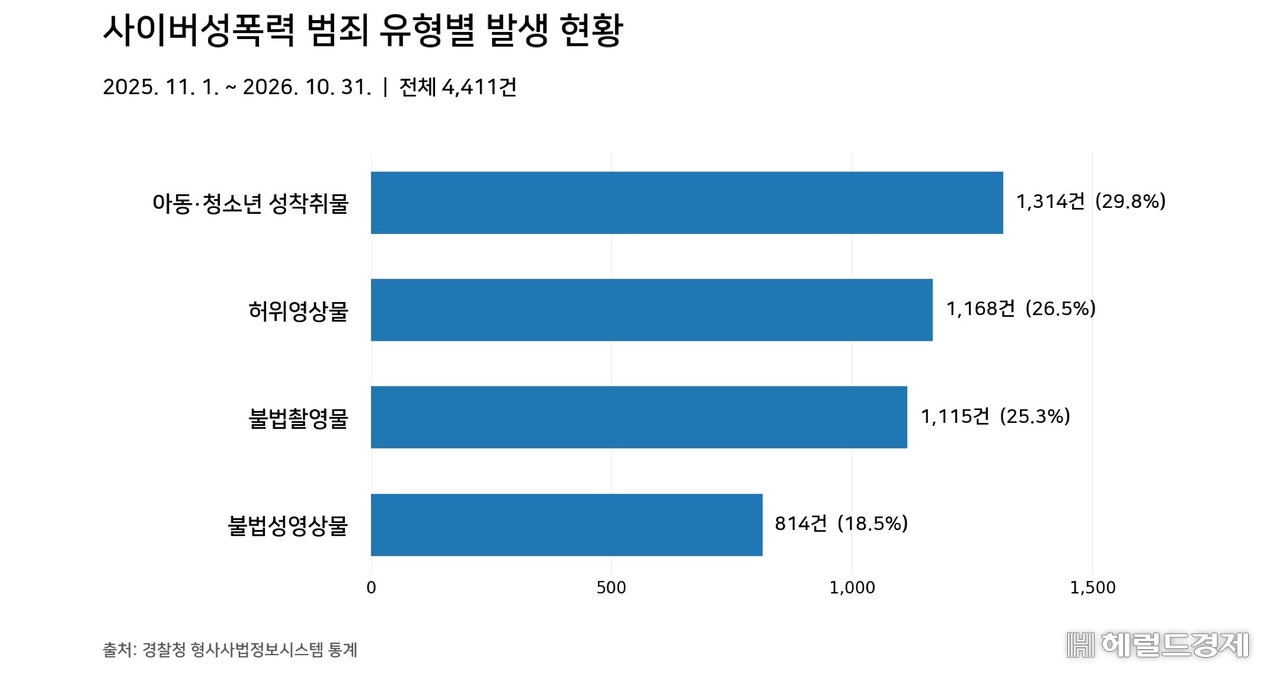
Over the past year, 4,411 cyber sexual violence cases were reported — roughly the same level as the previous year. By type, child and youth sexual exploitation material accounted for the largest share at 1,314 cases, or 29 percent. Deepfake videos followed at 1,168 cases (26 percent), illegal filming at 1,115 cases (25 percent) and other illegal sexual videos at 814 cases (18 percent).
Deepfake sex crimes, which surged from 2024, fell 26 percent to 1,176 cases in the January–October period this year, down from 1,603 cases in the same period last year. Police attributed the decline to tougher penalties for new forms of sexual exploitation and a pan-government response.
By age group, teenagers accounted for the largest share of suspects at 44 percent, followed by those in their 20s (31 percent), 30s (14 percent), 40s (6 percent) and 50s or older (3 percent). In deepfake crimes and child and youth sexual exploitation material cases particularly, suspects in their teens made up more than half — 59 percent and 55 percent, respectively.
Because teenagers make up a large proportion of both suspects and victims in cyber sexual violence cases, police plan to strengthen prevention education and outreach targeting students and parents. School police officers will visit schools to conduct educational sessions, and promotional materials using online content familiar to young people will be produced.
During the crackdown period, police conducted 879 undercover operations, arresting 877 suspects and detaining 32 of them. The number of undercover operations launched increased about 243 percent compared with last year.
Intelligence-led investigations also expanded significantly. Drawing on leads obtained through cooperation with overseas agencies including the US National Center for Missing and Exploited Children, police opened 165 intelligence-led investigations from March through last month, resulting in the arrest of 70 suspects linked to child and youth sexual exploitation material.
To block the distribution of illegal videos, police are also stepping up efforts against overseas service providers that support illegal sites. Dedicated investigation teams targeting illegal sites have been established at police agencies in Seoul, Busan, South Gyeonggi and South Jeolla Province, concentrating resources on arresting operators and deleting original videos. Authorities also plan to use a pan-government transnational task force to intensively track site operators based abroad and pursue their extradition to South Korea.
The National Investigation Headquarters said it would "cut off the online sexual exploitation structure by intensively cracking down on everyone from producers and operators of cyber sexual violence distribution networks to distributors and consumers, with the goal of simultaneously eliminating both supply and demand." It added that it would "work with relevant agencies to prevent the distribution of sexual exploitation material and do its utmost to protect victims."
arin@heraldcorp.com