Debt ratio hits 237.5% in first half; public rental losses reach 1.47 trillion won as land sale revenue dries up
Debt projected to reach 372.8 trillion won by 2030 as organizational split looms
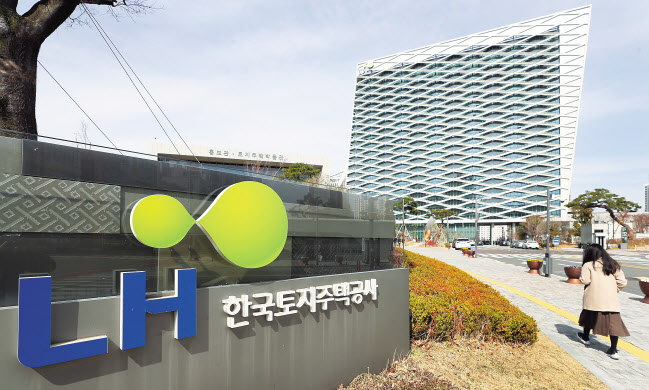
The debt of Korea Land and Housing Corporation, the state agency at the center of the government's public housing drive, surpassed 185 trillion won ($139 billion) in the first half of this year, rising more than 20 trillion won in a single year. With the government pressing ahead with a target of supplying 1.19 million public housing units by 2030, LH's financial burden is expected to grow each year.
According to a first-half fiscal report for fiscal year 2026 that LH submitted to its board of directors Monday, LH's total assets stood at 263.91 trillion won as of June 30, with liabilities at 185.7 trillion won and equity at 78.2 trillion won. The debt-to-equity ratio reached 237.5 percent.
The pace of debt accumulation has been steep. Compared with the 165.02 trillion won recorded at the end of the first half of last year, debt rose 20.68 trillion won in 12 months. Even against the most recent year-end figure of 173.66 trillion won, liabilities climbed 12.05 trillion won in just six months. The debt ratio, which stood at 230.8 percent at the end of last year, rose roughly 7 percentage points in the same period.
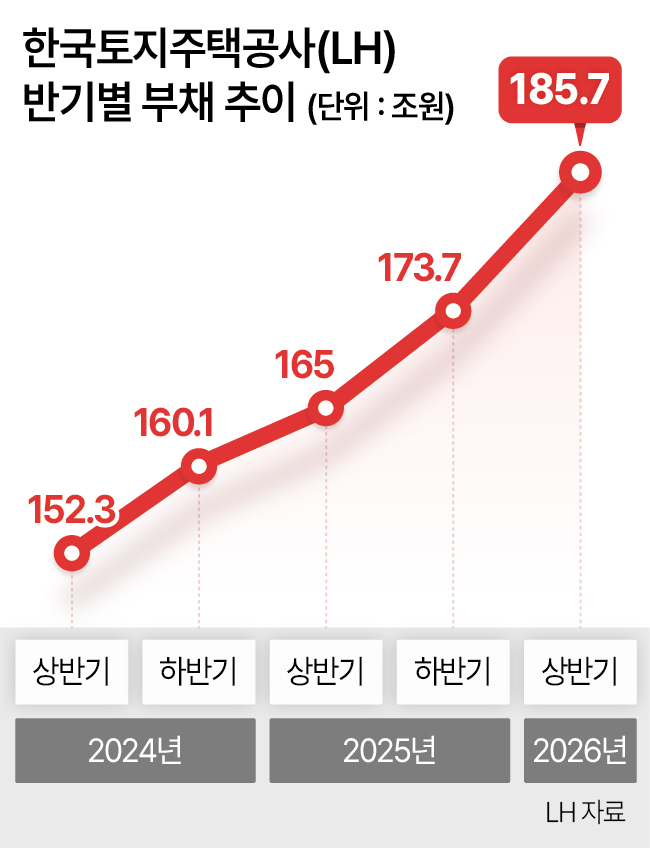
The surge is closely tied to the funding demands of the public housing supply program. LH bears a substantial share of the costs for developing new housing sites, breaking ground on new units and acquiring homes for rental, and those financing needs are a key driver of rising borrowings.
Losses from operating rental housing are compounding the strain. According to data LH submitted to the National Assembly's Land, Infrastructure and Transport Committee, the gross loss in LH's public rental housing segment reached 1.47 trillion won in the first half of this year. Revenue came to only 931.3 billion won while the cost of sales reached 2.4 trillion won — nearly double the loss of 804 billion won recorded in the first half of 2022.
On top of that, LH has lost the revenue stream it long used to offset those deficits. Under the government's housing supply measures announced last year on Sept. 7, LH will no longer sell residential land it develops to private builders, instead developing the sites itself. LH had relied on proceeds from such land sales to cross-subsidize losses in its public rental and residential welfare operations, and the end of those sales has made it far harder to recoup costs.
The financial pressure is set to intensify. The government's housing stability plan, announced in September, calls for supplying 1.188 million public housing units between 2026 and 2030 and expanding the stock of long-term public rental units — those available for 10 years or more — from 1.931 million units in 2024 to at least 2.5 million by 2030. Of the units to be built by 2030, public rental housing will account for 80 percent, or 945,000 units, comprising 350,000 construction-based rentals, 313,000 purchased rentals, 230,000 jeonse rentals and 52,000 privately built units with public support.
The Ministry of Economy and Finance's medium-term financial management plan for public institutions covering 2026 to 2030 projects LH's debt will climb to 372.8 trillion won by 2030, reflecting the expanded public housing push. LH's share of total public-institution debt is also set to grow: the plan projects combined liabilities across 37 public institutions will rise from 778.3 trillion won in 2026 to 997.4 trillion won in 2030, an increase of 219.1 trillion won, with LH accounting for roughly 80 percent of that growth. The debt ratio of the remaining 36 institutions, excluding LH, is actually projected to fall from 196.8 percent to 176.2 percent over the same period.
As its financial burdens mount, LH also faces a looming organizational split. The government announced Sept. 3, through its public institution functional reform plan, that LH would be divided into two entities: a tentatively named Housing and Urban Development Corporation to handle land development and housing construction, and a Housing and Urban Asset Corporation to focus on residential welfare and land banking. The split would come 17 years after LH was formed in 2009 through the merger of Korea Land Corporation and Korea National Housing Corporation. How assets and liabilities would be allocated between the two new entities, and how the cross-subsidy structure between revenue-generating and rental operations would be maintained, has yet to be worked out.
Experts say that before the organizational split and the expansion of public housing supply can proceed smoothly, the government must first clarify how debt will be divided and how funding for the loss-making rental business will be secured.
"The government has announced a plan to supply 1.19 million public housing units, but has not presented any concrete plan for financing a program of that scale," said Ko Jun-seok, a professor at Yonsei University's Sangnam School of Management. "In practical terms, there is virtually no option other than issuing bonds or injecting tax revenue, so a realistic financing plan needs to be established first."
hwshin@heraldcorp.com