- POSTECH uses semiconductor process to develop next-generation battery cathode
- Storage performance more than triples under ultra-fast 1-minute charging conditions
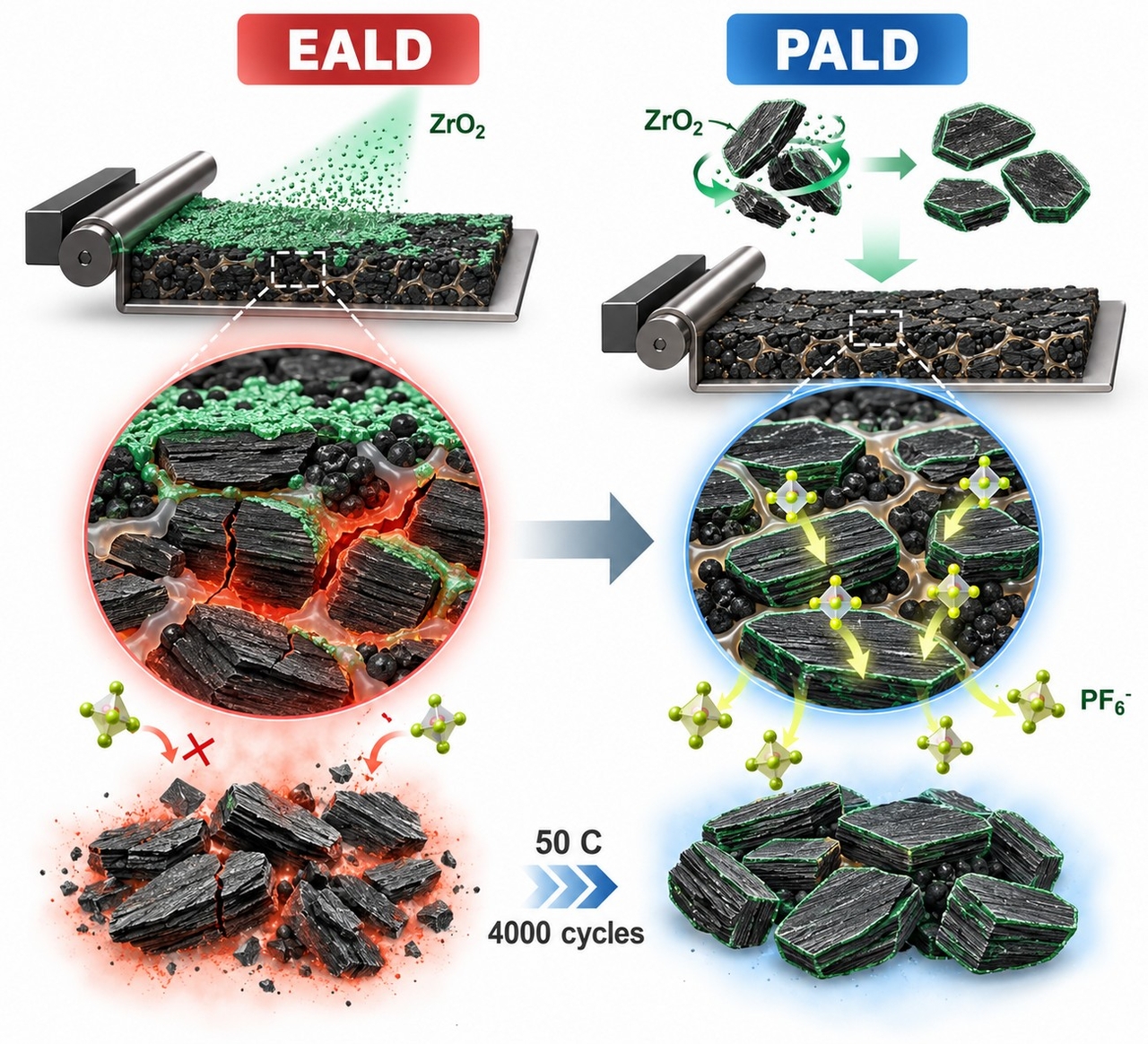
South Korean researchers have developed a technology that allows batteries to charge quickly while lasting far longer. The team coated inexpensive graphite particles with an ultrathin protective layer just 5 nanometers thick, enabling the battery to withstand 4,000 charge-discharge cycles under roughly 12-minute fast-charging conditions.
POSTECH announced that a joint research team — led by chemistry professor Park Su-jin and mechanical engineering professor Ahn Ji-hwan at POSTECH, together with professor Ryu Jae-geon of the Department of Chemical and Biomolecular Engineering at Sogang University — has developed a graphite cathode for dual-ion batteries that improves both charging speed and cycle life.
In a dual-ion battery, anions in the electrolyte migrate into the graphite structure during charging to store energy. The technology offers fast charging speeds and low material costs, but repeated charging had caused rapid capacity degradation — a key barrier to commercialization.
Graphite has a layered structure made up of stacked sheets. Each time the battery charges, large anions force their way between the layers, causing the graphite to expand; it then contracts again upon discharge. Repeated cycles crack and collapse the graphite structure, degrading battery performance. At voltages above 4.5V, electrolyte decomposition also occurs, accelerating the deterioration.
The research team found a solution in atomic layer deposition (ALD), a semiconductor manufacturing technique that builds ultrathin protective coatings one atomic layer at a time.
Rather than coating the surface of a finished electrode — the conventional approach — the team applied a zirconium oxide (ZrO₂) protective layer to each individual graphite particle before assembling the electrode. The coating is just 5 nanometers, or one billionth of a meter, thick.

The protective layer keeps the graphite structure intact as it expands and contracts through repeated charge-discharge cycles. It also allows anions to move rapidly into the graphite interior, boosting charging performance.
In experiments, coated graphite delivered more than three times the charge-storage capacity of uncoated graphite under ultra-fast charging and discharging conditions equivalent to about one minute.
The durability gains under roughly 12-minute fast-charging conditions were particularly notable. The coated graphite maintained its performance through 4,000 charge-discharge cycles, compared with fewer than 1,000 cycles for uncoated graphite.
Compatibility with existing battery manufacturing processes is another advantage. The team confirmed that coating the graphite powder before electrode fabrication can be integrated into conventional electrode manufacturing workflows.
The technology is expected to find applications in electric vehicles and large-scale ESS by reducing reliance on expensive metals while improving both charging speed and battery life.
The research is also significant for applying a precision coating technique from semiconductor manufacturing to a powdered battery material. The team said the approach could be extended to other battery cathode and anode materials, as well as to a range of energy materials including fuel cells and water-electrolysis catalysts.
"This will serve as a new design principle for making batteries that charge quickly and last long using inexpensive graphite," Park said.
The findings were published online in Advanced Functional Materials, an international journal covering materials science.
nbgkoo@heraldcorp.com