Contract capacity set at 230 MW; power supply to begin in 2029
TVA board approval secures energy infrastructure for Project Crucible
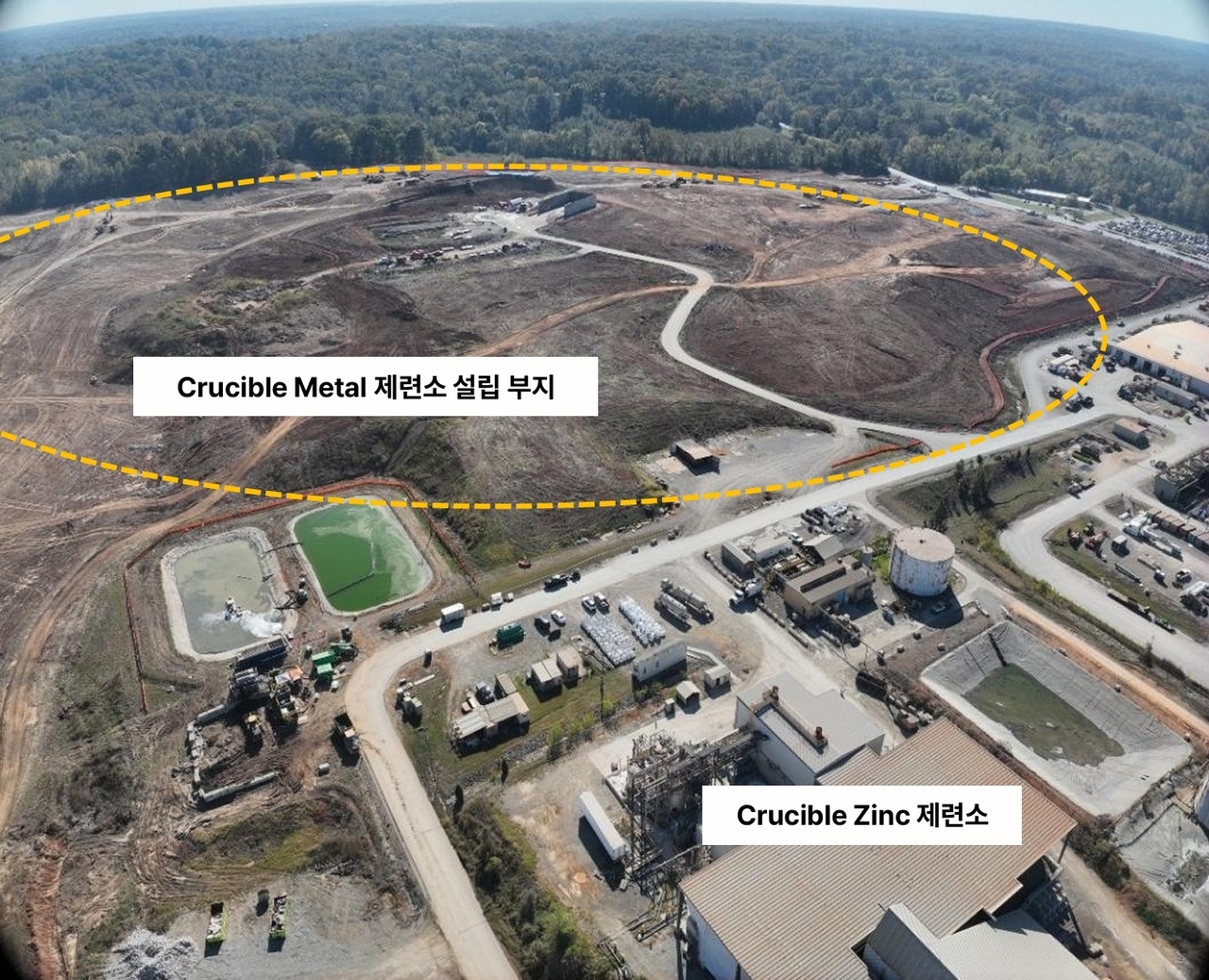
Korea Zinc's Project Crucible — a roughly $7.4 billion integrated critical-minerals smelting complex planned for Tennessee in partnership with the US government — has secured large-scale power approval from the local electricity provider, giving the initiative fresh momentum. The project had already been placed on the federal fast-track permitting regime FAST-41 and cleared a final environmental assessment; securing the power supply infrastructure needed to operate the integrated smelter marks another significant milestone.
Korea Zinc said Sunday that the Tennessee Valley Authority board held a meeting Tuesday (local time) and approved a power-use request from its subsidiary Crucible Zinc. The approved request covers large-scale electricity consumption exceeding 100 MW. Project Crucible's contracted power capacity stands at 230 MW, with TVA set to begin supply in 2029.
TVA is a federal public corporation responsible for power generation, supply and transmission-grid operations across the southeastern United States, serving more than 10 million residents across seven states and ranking as the country's largest public power provider. It draws on a mix of nuclear, hydroelectric and natural gas sources, and its industrial electricity rates are lower than those paid by more than 90 percent of customers among the top 100 US power companies.
Korea Zinc has worked closely with TVA to keep Project Crucible on track. In May, Korea Zinc Chairman Choi Yun-beom met with TVA board chair Mitch Graves to stress the importance of securing early-stage power demand and building a stable power supply network for the smelter, and to request TVA's active cooperation.
Project Crucible has drawn broad support from the US federal government, state authorities and related agencies. In April, the Federal Permitting Improvement Steering Council designated the project for inclusion under FAST-41, the federal expedited permitting regime — the first such designation after Tennessee and the council signed an MOU.
In September, the project also cleared the US government's Final Environmental Assessment. The US Department of Defense, acting under the National Environmental Policy Act, conducted a comprehensive review covering air quality, greenhouse gas emissions, water resources, biological and cultural resources, waste, hazardous materials, transportation, and socioeconomic impacts, before issuing a Finding of No Significant Impact. The final assessment serves as a reference document for TVA in evaluating power infrastructure support and for federal and state authorities in reviewing subsequent permits.
Project Crucible aims to build and directly operate a large-scale integrated smelter in Tennessee, drawing on more than 50 years of smelting expertise and operational know-how that Korea Zinc has accumulated at its Onsan smelter in Ulsan. The facility is planned to produce 12 non-ferrous metals — including 11 critical minerals designated by the US government — as well as semiconductor-grade sulfuric acid. Korea Zinc plans to break ground in 2027 and begin commercial production of some products in 2029, with the project expected to create more than 400 new jobs in Tennessee.
"With TVA's approval of Crucible Zinc's power request, the conditions for stable operation of the Tennessee integrated smelter have been put in place," a Korea Zinc official said. "We will accelerate preparations for the smelter's ground-breaking and work closely with the US government and local agencies to bring Project Crucible to a successful completion."
Meanwhile, Korea Zinc prevailed in a legal dispute over a 527.2 billion won ($396 million) rights offering it had pursued as part of a strategic partnership with Hyundai Motor Group. A court recognized the legality of the new share issuance on business grounds, overturning a first-instance ruling that had sided with Youngpoong.
The Seoul High Court's Civil Division 18-3, presided over by judges Jin Hyeon-min, Wang Jeong-uk and Park Seon-jun, dismissed the appeal Friday in a lawsuit filed by Youngpoong seeking to nullify the share issuance, reversing the lower court's ruling in favor of the plaintiff.
The court found that the share issuance was carried out within the scope necessary to achieve the company's business objectives and was permissible under its articles of incorporation, and therefore could not be deemed invalid.
likehyo85@heraldcorp.com