Share of non-regular workers among youth is 7.5 percentage points above the overall rate; 67.6% of companies prioritize job experience in hiring; youth employment falls for 48 consecutive months; labor participation rate hits 11-year low for October
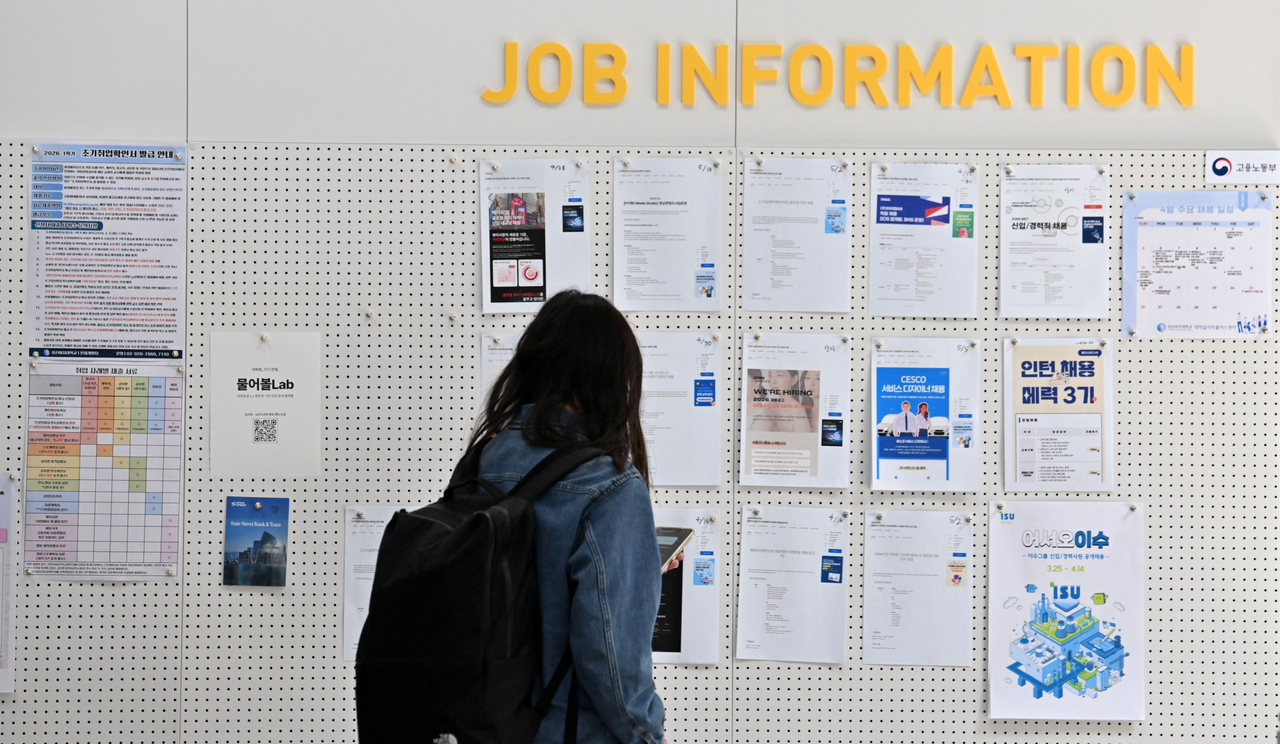
South Korea's youth job market is caught in a double bind of shrinking employment and growing job insecurity. Nearly half of young wage workers hold non-regular positions, even as the total number of employed youth has fallen for 48 consecutive months.
As companies increasingly favor candidates with prior work experience and expand rolling recruitment over mass hiring, young people entering the labor market for the first time are finding it harder to land stable jobs.
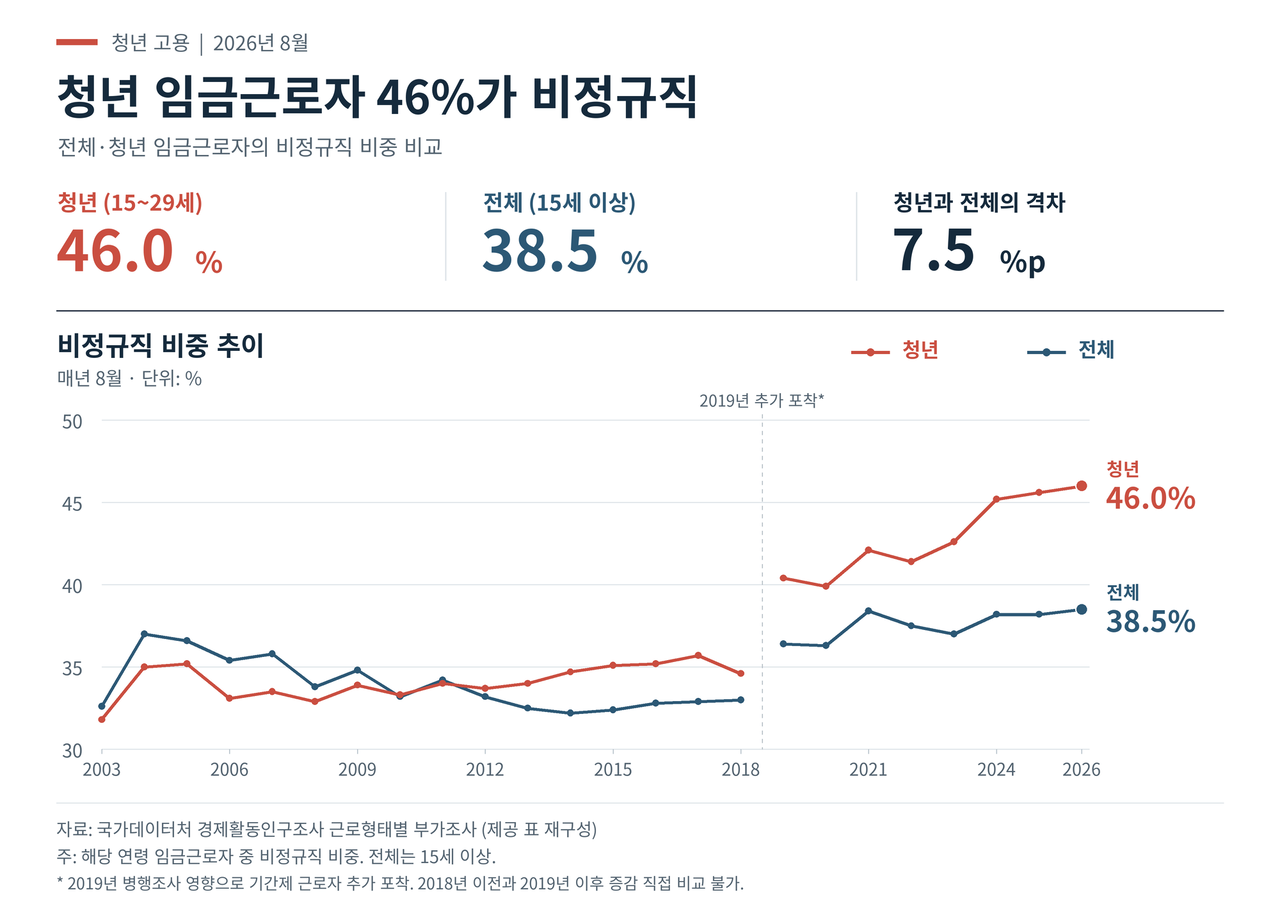
According to a supplementary survey on employment types under the economically active population survey, released Sunday by the Ministry of Statistics, non-regular workers accounted for 46.0 percent of wage workers aged 15 to 29 as of August — the highest level since the data series began in 2003. The figure was 7.5 percentage points above the 38.5 percent non-regular share recorded among all wage workers.
The youth non-regular share has risen consistently in recent years, climbing from 42.6 percent in 2023 to 45.2 percent in 2024, 45.6 percent last year and 46.0 percent this year. Over the same period, the non-regular share among all wage workers rose from 37.0 percent to 38.5 percent. The three-year increase for youth, at 3.4 percentage points, more than doubled the 1.5-percentage-point rise seen across the broader workforce.
Breaking down the figures by age, non-regular workers made up 43.8 percent of wage workers in their 20s, with regular workers accounting for the remaining 56.2 percent — meaning more than four in 10 workers in their 20s hold non-regular positions. Among those aged 15 to 19, the non-regular share reached 89.4 percent.
Job experience has become the defining criterion in corporate hiring. In the Korea Enterprises Federation's "2026 New Hire Recruitment Survey" of 500 companies with 100 or more employees, 67.6 percent of respondents ranked "job-related work experience" as the most important of seven evaluation criteria. Companies increasingly prefer candidates who can contribute immediately rather than those developed through on-the-job training after joining.
The share of young people pausing their studies to prepare for employment has also grown. In a supplementary youth survey conducted in May this year, 30.5 percent of college graduates who had taken a leave of absence cited "job or certification exam preparation" as their reason — the highest level on record and a sharp increase from 14.7 percent when the data series began in 2007. Among female respondents, for whom military service leaves do not apply, the figure reached 60.8 percent.
The industry breakdown of first jobs has also shifted. As of May this year, 15.9 percent of those aged 15 to 29 who had graduated or dropped out of school and had work experience said their first job was in the accommodation and food service sector — the largest share among the 13 industries tracked in the survey. The mining and manufacturing sector accounted for 12.0 percent. When the data was first compiled in 2013, mining and manufacturing led at 16.9 percent.
Worsening conditions in the accommodation and food service sector — long a primary entry point for young workers — are further narrowing employment opportunities. The number of employed youth fell for 48 consecutive months through last month compared with the same month a year earlier.
Some indicators suggest the decline goes beyond demographic shrinkage. The youth employment rate stood at 42.9 percent last month, down 1.7 percentage points from a year earlier. It has now fallen below the year-earlier level for 30 consecutive months since May 2024, and for October it was the lowest since 2020, when the COVID-19 shock pushed the rate down to 42.3 percent.
The youth labor force participation rate — the share of the youth population either employed or actively seeking work — also fell to 45.2 percent, down 1.9 percentage points from a year earlier. For October, it was the lowest since 44.6 percent in 2015, an 11-year low. The decline reflects not only fewer young people in work but also a broader retreat from the labor market, including among those looking for jobs.
Bin Hyeon-jun, director general of social statistics at the Ministry of Statistics, said the October employment data showed "a significant drop in the accommodation and food service sector, which had previously employed a large share of young workers." He added that "the spread of a culture favoring experienced hires over new graduates, along with a shift from large-scale recruitment drives to rolling hiring, is contributing to the continued decline in youth employment."
fact0514@heraldcorp.com