Token optimization technology unveiled Thursday; full commercial rollout set for next year
AX technology validated — costs cut 90%, efficiency up fourfold
Infrastructure, model, routing and harness layers target lower costs for customers
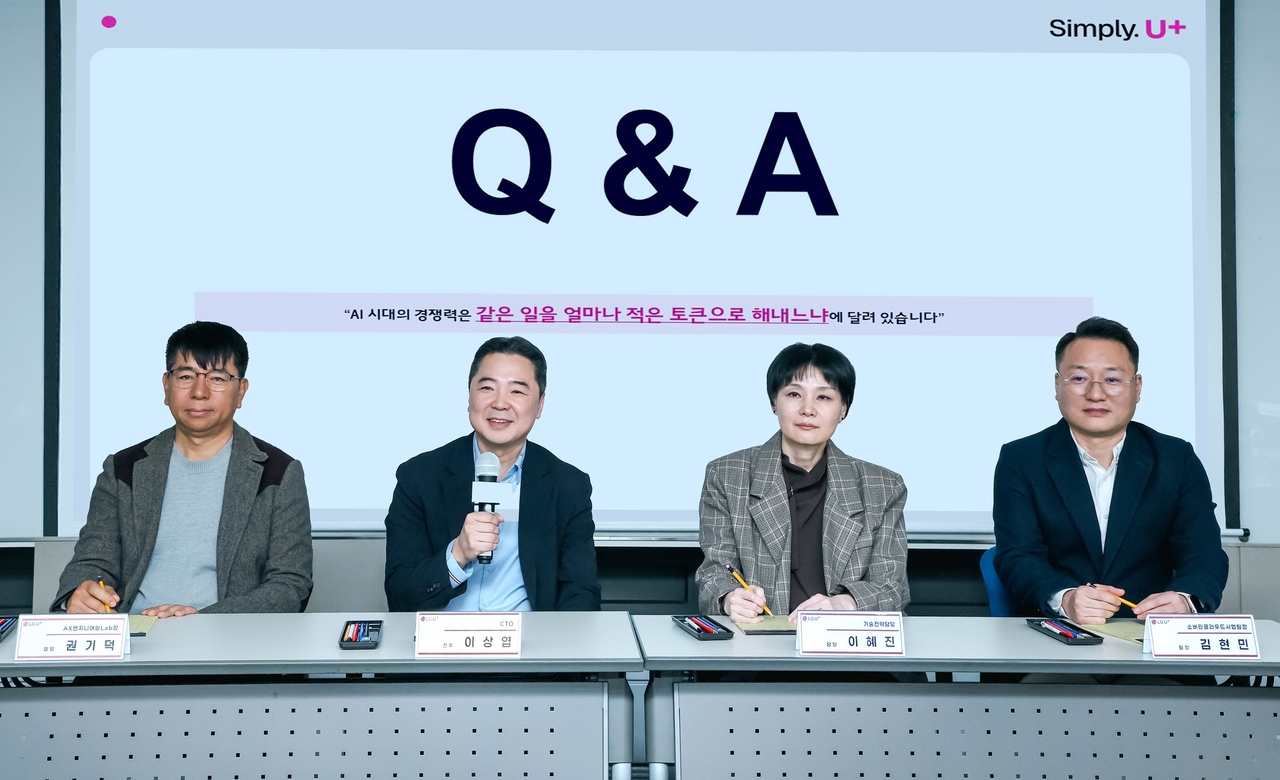
LG Uplus plans to enter the business-to-business AI market next year with a strategy built around token optimization — aiming to boost AI agent performance while dramatically cutting token costs to gain an edge in the B2B space.
As AI agents become part of everyday operations and token cost reduction emerges as a key industry concern, competition among companies to dominate the B2B token optimization market is expected to intensify.
Chief Technology Officer Lee Sang-yeop outlined the strategy Thursday at the company's AI Token Optimization Study session held at a venue in Seodaemun-gu, Seoul, saying token optimization "will become the core moat for a sustainable AI business."
The push comes as the rapid spread of AI agents has made token cost reduction a pressing issue. Even when AI model unit prices are low, costs can balloon if agents repeatedly perform unnecessary searches and analyses.
LG Uplus pursued token optimization through internal proof-of-concept testing, continuously tuning the balance between its proprietary AI model and Exaone. The approach separates tasks requiring high-performance AI from lighter workloads, processing each accordingly to keep costs down.
Internal validation showed that operating costs in coding — one of the most token-intensive areas — fell by as much as 90 percent compared with standard models. The company also improved how its AI model handles computation, pushing processing efficiency to roughly four times that of the same infrastructure running conventional methods.
LG Uplus also unveiled a semiconductor-based optimization strategy alongside "routing," which selects the most suitable AI model depending on the query. The approach allows the company to deploy different chips based on computational demand and usage frequency.
Kwon Ki-deok, head of the AX Engineering Lab, explained that compute-heavy prefill operations are handled by Nvidia graphics processing units, with the resulting KV cache passed to AMD GPUs for decoding, where memory efficiency is paramount.
Kwon added that under a "mixture of experts" model, frequently used experts can be assigned to Nvidia GPUs while less active ones are handled by older-generation GPUs or NPUs from Furiosa AI.
CTO Lee described the overall approach as "technology that improves the processing efficiency of the model itself, encompassing model lightweighting, optimization and routing."
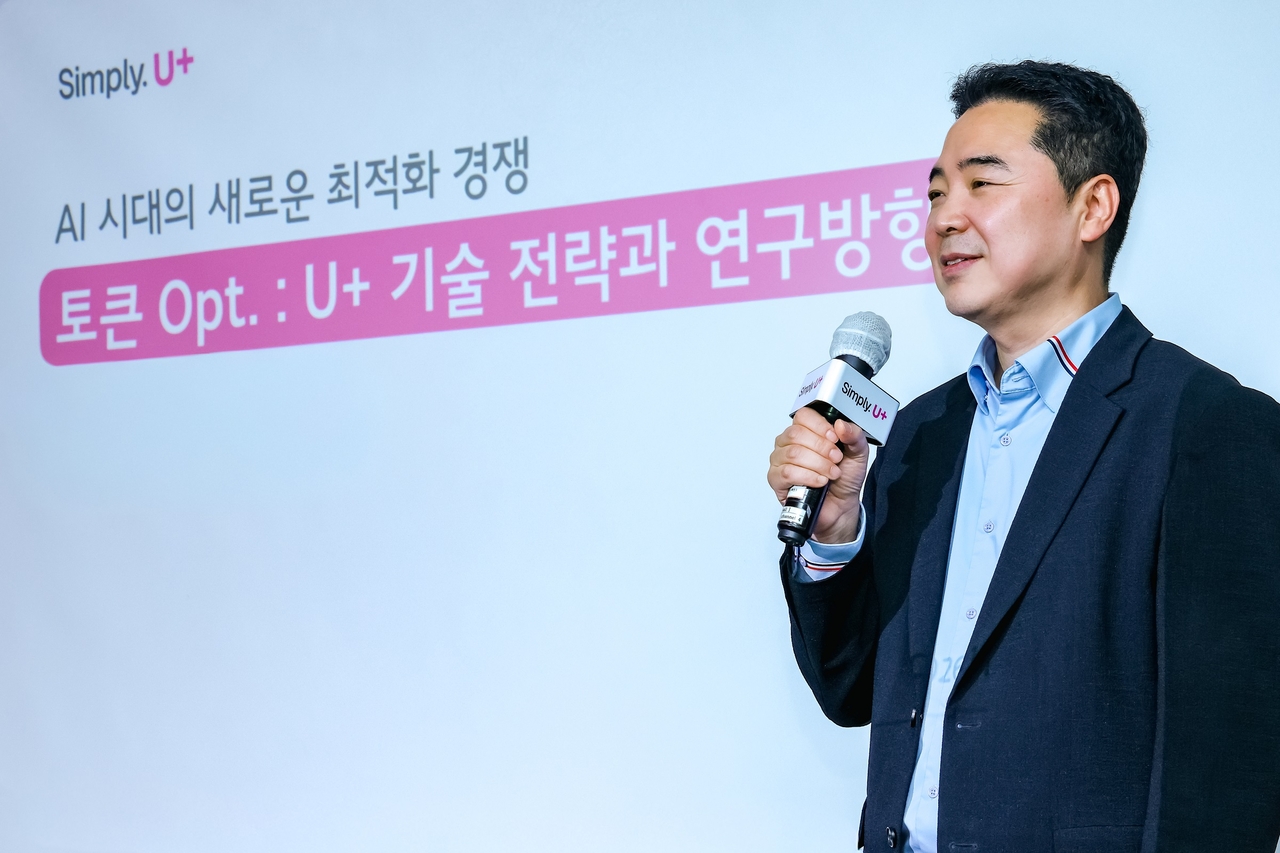
With AI adoption now widespread globally, the central challenge for businesses has become maintaining AI model performance while bringing costs down — a dynamic driving telecom carriers and a growing range of companies to pursue token optimization.
The balance is difficult to strike. Lee Hye-jin, head of technology strategy, said that "focusing too hard on cutting costs can degrade performance, and when performance drops and an agent repeats or adds steps, costs go back up," adding that "raising task success rates and reducing the cost of failures is directly tied to lowering token costs."
Lee went on to say that "companies have adopted AI expecting it to reduce headcount, but in some cases costs have actually risen," and that "token optimization plays a critical role in deploying AI agents in real operations — agents that generate value commensurate with what is invested in them."
LG Uplus will formally enter the token optimization business next year, drawing on its full-stack capabilities and partnerships with major technology companies.
Kim Hyun-min, head of the sovereign cloud business team, said the company would "secure competitive token unit costs and reduce total token usage expenses from the perspective of customer total cost of ownership," adding that it would pursue the business "through partnership arrangements with collaborators as well as direct build-out models."
CTO Lee stressed that optimization must span "the entire chain — from the network line, infrastructure, model, routing and harness orchestration — taking into account even the customer's intent," and said the company would "collaborate with big tech firms, including using their agent solutions alongside our own models in internal AX operations."
ko@heraldcorp.com