Resident review panels to be incorporated into selection process for eup, myeon and dong chiefs
Local governments free to choose recruitment type and review format based on regional conditions
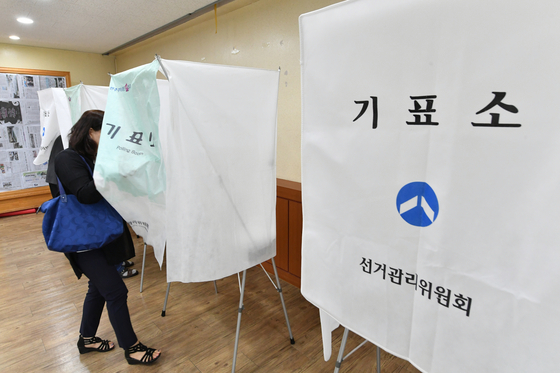
The Ministry of Interior and Safety announced Sunday that it has drawn up a master plan for a pilot program — the "Resident-Selected Eup/Myeon/Dong Chief Appointment System" — giving residents a direct role in selecting the local administrative chiefs responsible for grassroots governance. The pilot is set to launch in 2027.
The initiative is part of the national policy agenda to strengthen decentralization and improve residents' quality of life.
Some local governments have previously run similar programs, such as open recruitment for eup, myeon and dong chiefs, but those efforts faced persistent shortcomings: limited representativeness of resident review panels, questions about the fairness of candidate vetting, and insufficient incentives for participation.
In response, the ministry drew up the master plan with a focus on improving the representativeness and fairness of resident participation and strengthening the assessment of candidates' competencies, drawing on existing case studies and feedback from the field.
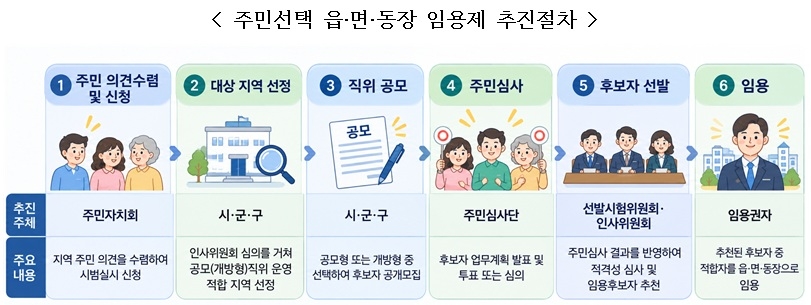
Under the pilot, local resident autonomy councils will gather community input and submit applications to their city, county or district government. Each local government may then choose, based on its own conditions, between two recruitment models: a civil servant track, which fills positions through open recruitment from among civil servants meeting set eligibility criteria, and an open track, which extends open recruitment to both civil servants and candidates with relevant private-sector experience.
Resident review panels will participate in candidates' work-plan presentations and question-and-answer sessions, then evaluate candidates through either a vote or a deliberative review. The results feed into the eligibility assessment conducted by the selection examination committee and are also factored into the recommendation and appointment of finalists.
Both the deliberative and voting formats will operate on an open-recruitment basis for panel members as a general rule.
Deliberative panels will include set proportions of resident autonomy council members alongside representatives and executives of major local institutions and civic organizations. Voting panels will be assembled through random sampling that accounts for gender, age, occupation and neighborhood, ensuring a fair selection process.
Meanwhile, the ministry plans to award bonus points in local government innovation evaluations to participating local governments and present commendations to standout performers, with the aim of encouraging broad uptake of the system. It will also identify and share best practices based on operational results and field feedback, working toward a standard operating model.
Interior and Safety Minister Yun Ho-jung said the pilot "is an attempt to elevate resident self-governance to a new level, as residents will participate directly in the process of choosing the eup, myeon and dong chiefs who will be responsible for local administrative services." He added that the ministry would "actively support the pilot so that residents' choices and voices are reflected in local administration and genuine resident self-governance can be realized."
thlee@heraldcorp.com