Property values have soared, but gift and inheritance tax thresholds have barely moved
A guide for homeowners weighing whether to sell or pass on their one asset
Proceeds from a sale can be converted into a tax-free lifetime income stream
A guaranteed payout period ensures heirs receive at least the principal if the owner dies early
Whole-life insurance is another way to prepare for an inheritance tax bill in advance
South Koreans pay an average of 5.15 million won in insurance premiums per year, according to the Korea Insurance Development Institute's 2025 figures. This series — "Iboso" — is about making every won of those premiums count.

Lee Jeong-suk (pseudonym, 67) bought an 84-square-meter apartment in Songpa-gu, Seoul in 2001, overriding her husband's objections and registering it solely in her own name for 500 million won ($375,000). She has lived in the same unit for 25 years. It is now worth 3.2 billion won.
The apartment's value has risen more than sixfold, but the household's finances remain modest. The couple brings in about 3 million won a month combined, including national pension payments, and holds roughly 100 million won in savings. Their son, 40, owns an apartment in Pangyo; their daughter, 37, still rents on a jeonse lease.
Lee's worries began last summer when news broke about proposed tax reforms. Headlines warned of a "tax bomb" for retirees with homes in Gangnam. Around the same time, she heard that an elderly neighbor in the same complex had been admitted to a nursing home with dementia — and that the family could not sell the apartment, leaving the children shuttling back and forth to court.
"Should we sell now and move to a smaller place in Gyeonggi Province, or hold on and leave the apartment to the children? And if we do leave it to them, can we do it without everything falling apart?" Lee's questions are ones that many parents in Seoul who own a single home are quietly asking themselves.
When Lee bought the apartment in 2001, inheritance tax felt like a concern for the wealthy. But over the past 25 years, while property prices and the cost of living climbed steadily, the deduction thresholds for inheritance and gift taxes barely moved. With the average Seoul apartment price now approaching 1.7 billion won, inheritance tax has become something middle-class families must plan for — much like income tax or property tax.
Disputes over inherited assets are also on the rise. According to the Supreme Court, the number of inheritance-division adjudication claims filed — cases where families ask a court to rule on how an estate should be split — reached 3,612 last year, 4.7 times the 771 recorded in 2014. If property prices keep rising, the problem will only grow over the next 10 to 20 years.
Lee faces two distinct challenges. The first is protecting her assets from real estate taxes and inheritance and gift taxes as the reform takes effect. The second is ensuring that the estate does not tear the family apart when the time comes to divide it. She decided to consult a specialist in inheritance, gift planning and asset succession.
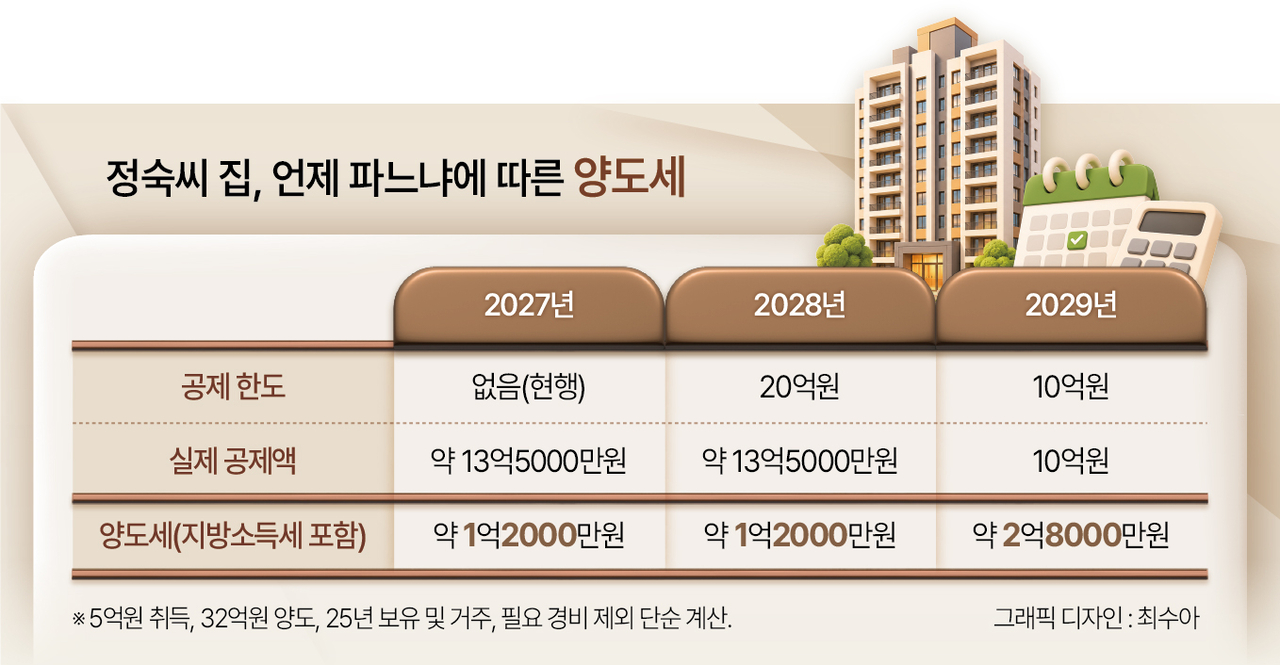
① Tax reform: is there any rush to sell?
Q. Every news report warns of a property-tax bomb. Should I sell quickly just to avoid the taxes?
A. If you own one home and live in it yourself, there is no need to rush. The government's proposed tax reform raises the comprehensive real estate tax deduction threshold for owner-occupiers who own a single home from a published price of 1.2 billion won to 1.4 billion won (a market value of about 2 billion won). The tax credit that previously rewarded long ownership will also be restructured — the new standard will be how long the owner has actually lived in the home, not merely how long they have held it.
As a result, owner-occupiers of homes with a market value of around 3 billion won will in many cases see their comprehensive real estate tax stay roughly the same or even fall. The sharp increases will hit properties valued at 4 billion won or more, or homes that are rented out rather than owner-occupied.
That said, anyone who plans to sell at some point should pay close attention to changes in capital gains tax. Under the current rules, a long-term special deduction applies to owner-occupiers who have both owned and lived in a single home for an extended period: up to 80 percent of the capital gain can be excluded from taxable income, with no ceiling on the deductible amount.
The reform replaces this with a long-term residency deduction and introduces a cap on the deductible amount. For sales from 2028, the cap will be 2 billion won; from 2029, it drops to 1 billion won. The 80 percent deduction rate stays the same, but there will now be a ceiling on how much can actually be excluded.
Consider Lee's situation. She bought the apartment for 500 million won and would sell it for 3.2 billion won after 25 years of ownership and occupancy. Because a single home is exempt from capital gains tax on proceeds up to 1.2 billion won, the taxable portion of the total gain of 2.7 billion won is approximately 1.69 billion won — the share of the gain attributable to the amount above 1.2 billion won.
From 2029, selling the same apartment at the same price just one year later would roughly double the tax bill. The reform does include a benefit — raising the basic annual deduction for long-term owner-occupiers of homes priced below 3 billion won from 2.5 million won to 25 million won — but Lee's apartment, valued at 3.2 billion won, falls above that threshold and would not qualify.
In short, if Lee intends to sell at some point, the window closes at the end of 2028. For homes with gains large enough that the deductible amount would exceed 2 billion won, the tax increase kicks in from 2028, effectively moving the deadline to the end of 2027. The decision — sell within that window, or hold and pass the property on — needs to be made before then.
② If you sell: turning a lump sum into a lifetime income
Q. What if I sell the apartment and live off the cash in retirement?
A. After selling for 3.2 billion won, paying capital gains tax and agent fees, buying a new home worth 1.5 billion won and covering the acquisition tax, you would be left with roughly 1.5 billion won. That is a substantial sum, but simply leaving it in a bank account creates two problems for retirement planning.
The first is discipline. A large sum sitting idle without a clear purpose tends to shrink faster than expected — requests for children's business capital, grandchildren's overseas tuition and high-return investment pitches have a way of arriving one after another. The second is time. If you live to 90 or 100, it becomes very difficult to judge how to spread 1.5 billion won across the years ahead.
If you have decided to sell, the first step is to convert a substantial portion of the proceeds into an income stream that will never run out. The most straightforward vehicle for this is a whole-life annuity insurance policy.
Q. How is a whole-life annuity insurance policy different from an ordinary savings insurance plan?
A. The key difference is tax treatment. With a savings insurance plan, the investment gain — the amount received above what was paid in — is tax-exempt only if the policy is maintained for 10 years or more, and for lump-sum contributions the tax exemption applies only to the first 100 million won per person. Put in 1.5 billion won and the interest earned on everything above 100 million won will be taxed.
A whole-life annuity policy that meets the requirements set out in Article 25, Paragraph 4 of the Enforcement Decree of the Income Tax Act is fully tax-exempt regardless of the amount contributed. There are five conditions: the policyholder must receive the benefit as an annuity from age 55 until death; the benefit must be taken only as an annuity and not in any lump-sum form; the annuity fund must be extinguished upon the policyholder's death; the contractor, insured and beneficiary must be the same person, and the policy cannot be surrendered after annuity payments begin; and the annual annuity amount must not exceed a prescribed limit.
Q. If I die early while receiving the annuity, do I just lose the money I put in?
A. This is the most common reason people are reluctant to choose a whole-life annuity. Under the third condition — that the annuity fund is extinguished upon death — someone who contributes 1.5 billion won and dies after just one year of payments would receive less than 100 million won, with the rest simply disappearing.
The law has already addressed this concern, however. The enforcement decree permits a "guaranteed period." The annuity payment can be guaranteed in advance for a number of years up to the life expectancy for the policyholder's age and sex, as published in the national life tables compiled by the Ministry of Statistics. With a guaranteed period in place, if the policyholder dies within that period the remaining payments continue to be made to the surviving family — and the tax-exempt status of the policy is preserved.
Lee, a 67-year-old woman, has a life expectancy of around age 88. With a 20-year guaranteed period, she would receive annuity payments for life, and if she dies early her family would still receive at least 20 years' worth of payments. The longer she lives, the more she receives; and even if she dies early, a defined minimum amount is guaranteed.
Q. Can I put all the remaining money into an annuity? And what should I do with whatever is left over?
A. Putting everything into a whole-life annuity at once is not advisable. As noted above, once a whole-life annuity policy is in force, the funds can only be received as annuity payments and the policy cannot be surrendered. It is important to set aside a separate emergency fund for unexpected large expenses.
That emergency fund should be kept in an account that is accessible at any time, but placing it in a trust adds a layer of protection for unforeseen circumstances. Some insurance company trusts — with no separate management fee — function like a high-yield demand deposit in normal times, allowing free deposits and withdrawals with daily returns, while also serving as an inheritance trust. When the account holder dies, the funds are paid out to a pre-designated person in a pre-specified manner.
Why does this matter? Once an estate is opened, funds held in the deceased's accounts can only be withdrawn with the consent of all heirs. Even funeral expenses can be difficult to access if a single sibling withholds agreement. With an inheritance trust in place, the designated heir can access the funds immediately without needing the consent of the other heirs.
There are also trusts designed for situations where the account holder can no longer manage their own finances due to dementia or a similar condition. These execute payments for hospital bills and care costs according to pre-agreed terms. In normal times the account operates without restrictions on deposits and withdrawals; once dementia is diagnosed, a pre-designated person can use the funds for care and treatment.
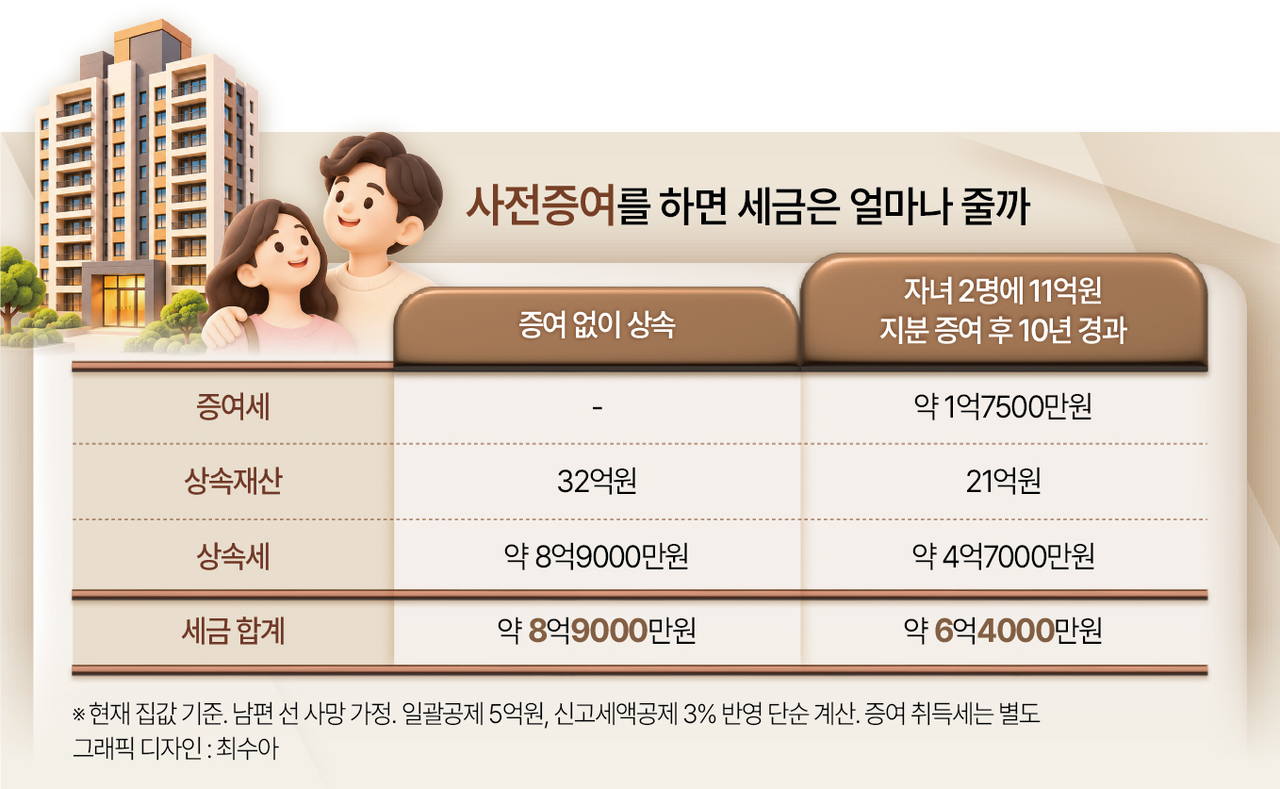
③ If you hold: inheritance tax instead of capital gains tax
Q. What happens if I keep the apartment and never sell?
A. If you do not sell, capital gains tax is not a concern. Capital gains tax applies to the difference between the purchase price and the sale price — no sale, no tax.
When the children inherit the apartment, their acquisition cost for tax purposes will not be the original 500 million won paid 25 years ago but the appraised value at the time of inheritance. If they later sell, capital gains tax will apply only to the gain above that inherited value — not above the original 500 million won. In effect, the 25 years of appreciation accumulated during the parents' ownership escapes capital gains tax entirely.
Instead, inheritance tax becomes the issue. Assuming the husband dies first and Lee follows, the inheritance tax under current rules would be approximately 890 million won — a rough calculation based on a property value of 3.2 billion won, a lump-sum deduction of 500 million won and the filing tax credit. That figure is based on today's property value; if the apartment is worth more when the estate is opened, the inheritance tax will be higher still.
If the inheritance occurs 20 years from now, when Lee is 87, and the property appreciates at just half the rate seen over the past 25 years — an average of about 3.85 percent per year — the apartment would be worth roughly 2.1 times its current value, or 6.8 billion won. The inheritance tax on that would rise to about 2.6 billion won, nearly three times the current figure. Property values rise, but inheritance tax rises even faster.
The problem is that an inheritance tax bill of 900 million won — or potentially more than 2 billion won — must be reported and paid within six months of the end of the month in which the estate is opened. If the children do not have that much cash on hand, they will likely have to sell the inherited property in a hurry or take out a large loan.
Q. Is there any way to reduce the inheritance tax in advance?
A. There is in effect one way to reduce the inheritance tax itself: transferring part of the estate in advance through gifting. This serves two purposes.
The first is the tax rate. Inheritance tax is levied on the entire estate at once, pushing the total into higher rate brackets. Transferring assets in smaller amounts over multiple occasions allows each transfer to be taxed at a lower rate. The second is future appreciation. Transferring an asset expected to rise in value before it does so means that any subsequent increase belongs to the recipient from the outset.
However, gifting an apartment worth more than 3 billion won in a single transfer would trigger the top gift tax rate of 50 percent, which defeats the purpose of advance gifting. The solution is to gift the property in shares over time.
Gift tax is calculated per recipient in 10-year intervals. Adult children receive a deduction of 50 million won every 10 years, and a tax rate of up to 20 percent applies to the taxable amount — after the deduction — up to 500 million won. This means transferring a share worth 550 million won to each child every 10 years keeps the gift tax to about 90 million won per child (about 87 million won after the filing tax credit).
If Lee gifts shares worth 550 million won each to her son and daughter — a combined 1.1 billion won — the total gift tax for both comes to about 175 million won. Once 10 years have passed since the gift, those shares are excluded from the taxable estate. The inheritance tax on the remaining 2.1 billion won would fall to about 470 million won, and even adding the gift tax already paid, the total tax burden would be reduced by roughly 250 million won.
Even if the inheritance occurs within 10 years of the gift, the outcome is not unfavorable. The gifted shares are added back into the taxable estate, but at the value they held at the time of the gift — and the gift tax already paid is deducted. Any appreciation in the property's value after the gift is effectively sheltered from inheritance tax.
One important caveat is timing. Gifting to the same person again within 10 years means the earlier gift is combined with the new one and the tax rate is recalculated from scratch, so the full benefit requires a 10-year gap between transfers. For Lee, that realistically means two opportunities: one now, and one at age 77. With only two chances, it is better to transfer a meaningful amount — even if it means accepting a higher gift tax bill — rather than keeping the gifted amount low to minimize the immediate tax, only to leave the children with a larger inheritance tax liability later.
Q. I have heard that gifting a share of the apartment to a child triggers a very high acquisition tax?
A. Receiving a gift of a home worth 300 million won or more at the standard assessed value in a designated adjustment zone such as Seoul does attract a heavy acquisition tax surcharge of 12 percent. With local education tax and other levies added, the effective rate is 12.4 percent — or 13.4 percent for units larger than 85 square meters, which also attract a special rural development tax.
There is an exception, however. Article 28-6, Paragraph 2 of the Enforcement Decree of the Local Tax Act excludes from the surcharge cases where a single-home owner-occupier gifts their home to a spouse or a direct lineal descendant — a child or grandchild. If the parent gifting the share qualifies as a single-home owner-occupier, the child receiving the share pays the standard gift acquisition tax rate of 3.5 percent (about 3.8 percent including surcharges), regardless of the property's value. On a share worth 550 million won, that brings the acquisition tax down from about 68 million won to just over 20 million won.
Q. So should I just go ahead and gift the shares now?
A. There is one thing you must check first. Even a very small ownership share counts as one full home for the purposes of calculating how many properties a person owns. The son, who already owns a home in Pangyo, would become a two-home owner. That could cost him the single-home capital gains tax exemption when he eventually sells the Pangyo apartment, and the value of the gifted share would also be added to his comprehensive real estate tax calculation. The daughter, who currently rents, would lose her status as a non-homeowner — potentially forfeiting apartment subscription points and first-time homebuyer benefits.
There is a special provision that excludes a minority share received through inheritance from the homeownership count, but no such consideration applies to shares received as a gift. Furthermore, if the child does not actually live in the apartment, the proposed reform means the child would likely be unable to claim the long-term residency deduction when selling later. Decisions about who receives a gift, when and how much should therefore be made with each child's own housing plans clearly in view.
Q. Even after gifting, there will still be an inheritance tax bill. How do you prepare for that?
A. That is correct. Given the 10-year aggregation rule and the tax rate brackets, there are limits to how many times and how much can be transferred through advance gifting. Whatever remains in Lee's name at the end will be subject to inheritance tax. One way to prepare for that bill in advance is through a whole-life insurance policy.
A whole-life policy pays a fixed death benefit in cash whenever the insured dies, regardless of when that occurs or how much has been paid in premiums up to that point. Because insurance designed to provide death coverage typically pays out more than the total premiums paid, it is more efficient than simply holding the equivalent amount in cash. Above all, no one knows when an inheritance will occur. Saving steadily in a deposit account and then having the inheritance open earlier than expected could leave the heirs short of the cash needed to pay the inheritance tax.
Who pays the premiums also matters. If Lee takes out a whole-life policy on herself and pays the premiums directly, the death benefit her children receive will be included in the taxable estate and subject to inheritance tax. Even so, because the benefit exceeds the total premiums paid, it is still more advantageous than holding the equivalent amount in cash.
Alternatively, if the children are both the policyholders and the beneficiaries — with Lee as the insured — and they pay the premiums from their own income, the death benefit will not be included in the taxable estate. The critical point in this arrangement is that the children must pay the premiums from their own earnings. If the parents pay on their behalf, the payments become subject to inheritance or gift tax.

won@heraldcorp.com