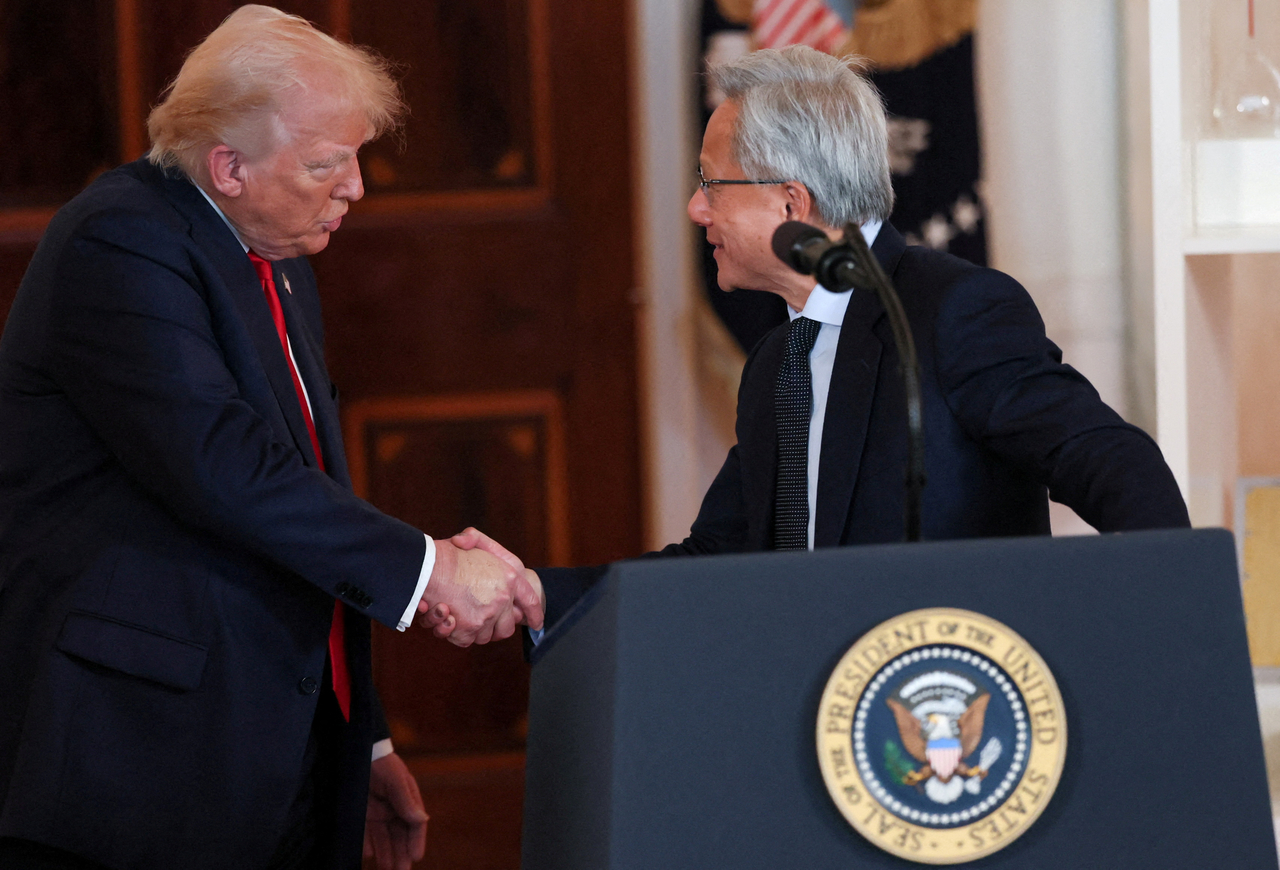
Despite allegations that China deployed a female spy to target Nvidia CEO Jensen Huang and smuggle out AI chips banned from export to China, President Donald Trump has focused on defending Huang and avoiding friction with Beijing. Critics warn that Trump's refusal to challenge Chinese espionage that has reached into the private sector will only encourage China to conduct bolder intelligence operations going forward.
The New York Times reported Wednesday (local time) that Trump has declined to treat the matter as a problem, even as allegations emerged that China had identified Huang as a target and used a female operative to illicitly obtain Nvidia chips prohibited from export to China.
On Monday, after Huang acknowledged an affair with the woman in question, Trump told reporters he had no plans to raise the issue with Chinese President Xi Jinping. Trump defended Huang, calling him "a great man," and said Huang would accompany him on a trip to China the following week.
Trump indicated he would bring Huang along on his visit to China for the Asia-Pacific Economic Cooperation summit in Shenzhen on Wednesday and Thursday — as he has done on previous trips — and would not raise the matter in his meeting with Xi. Trump has previously played down reports of Chinese espionage and cyberattacks against the United States, arguing that the US does the same.
That stance contrasts sharply with the approach taken by the Joe Biden administration, which lodged a formal protest with China in early 2023 after a Chinese surveillance balloon was spotted over the continental United States. The incident effectively froze US-China dialogue for several months.
Concerns are growing that Trump's posture — shielding both Huang and China even after the affair scandal emerged as a suspected product of Chinese intelligence operations — will give Beijing the confidence to pursue even more aggressive espionage in the future.
Christopher K. Johnson, a former US government intelligence officer and president of the risk consultancy China Strategies Group, said the scandal was an unsurprising outcome. "When China declares something a whole-of-society national strategic priority, as it has with semiconductors and AI, that means using every tool available to work for it, buy it and steal it," he said.
Dennis Wilder, a former US intelligence analyst on China and a senior fellow at Georgetown University, described Trump's response as a "permissive attitude" toward Chinese espionage broadly, saying it "gives China confidence that the political blowback from spy operations will be manageable." Wilder added that Trump had "repeatedly dismissed Chinese espionage by saying everyone does it," and warned that "the problem is no country can inflict the damage that China can and does."
China has in recent years mounted an expansive intelligence campaign against the United States — attempting to tap the phones of presidential candidates, recruiting US Navy sailors, and planting malware in American power grids and water systems. The political standing of China's main intelligence agency, the Ministry of State Security, has also risen sharply. Xi elevated the ministry's director to the Politburo — the 24-member body of the Communist Party's top leaders — in 2022, and has provided sweeping support in areas including budget and AI. With the ministry's capabilities and profile growing, and the US showing little reaction to espionage targeting private citizens, experts expect China's intelligence operations to grow bolder still.
kate01@heraldcorp.com