Korea Cement Association verifies safety through KCL testing; Gongju National University professor finds no harmful heavy metals detected
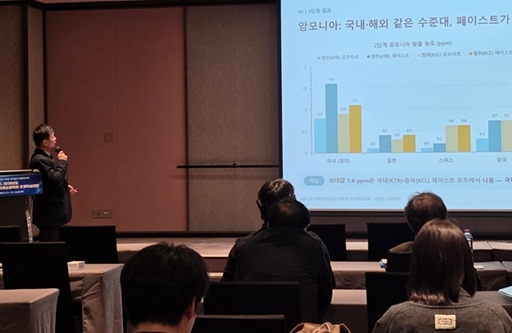
Cement produced using recycled waste materials has been found to pose no health hazard, according to findings presented Thursday.
The cement industry has long used waste tires, combustible waste and coal ash as partial substitutes for conventional fuel and raw materials, a practice credited with both cutting production costs and helping manage waste disposal. The industry has nonetheless faced more than two decades of public controversy over what critics have called "garbage cement."
The findings were presented at the cement session of the fall academic conference of the Korean Society of Waste Management and Resource Circulation, held at Sono Calm Gyeongju. The Korea Cement Association had earlier commissioned the Korea Conformity Laboratories (KCL) to verify the safety of cement made with recycled materials.
Kim Jin-man, a professor at Gongju National University who presented the results, said concerns that cement manufactured using recycled waste emits harmful substances, degrades indoor air quality and causes odors are unfounded. "The fact that recycled materials were used alone cannot be grounds for concluding the product is hazardous," Kim said.
Kim said most odor-causing substances and indoor pollutants were not detected in the cement samples. "Harmful heavy metals — including hexavalent chromium, lead, cadmium and arsenic — were not detected in any of the samples," Kim said. Copper was found in trace amounts in some samples, but at levels below 3 percent of the applicable reference threshold, meaning no hazard was confirmed.
The investigation also examined whether a higher proportion of recycled materials in the manufacturing process — ranging from 16 to 27 percent — was associated with greater emissions of odors or pollutants. No such correlation was observed, Kim said, adding that some substances, including ammonia, actually showed a statistically negative correlation, meaning levels fell as the recycled content share rose.
The probe was conducted using the same methodology as a joint public-private investigation committee under the Ministry of Climate, Energy and Environment. It covered the full product range from all seven domestic general-cement production factories and compared them against products from three countries — Japan, China and Switzerland — as a control group.
The Korea Cement Association said the investigation concluded that cement made with recycled materials is not harmful. "As in Europe and Japan, we will replace natural raw materials such as bituminous coal, clay, iron ore and silica with recycled resources, contributing to greenhouse gas reduction and the realization of a resource-circulating society," the association said.
freiheit@heraldcorp.com