Ministry of Land, Infrastructure and Transport and LH to apply reduced rate to zones applying by end of next year
Privately driven projects also eligible if they apply for public redevelopment candidate status
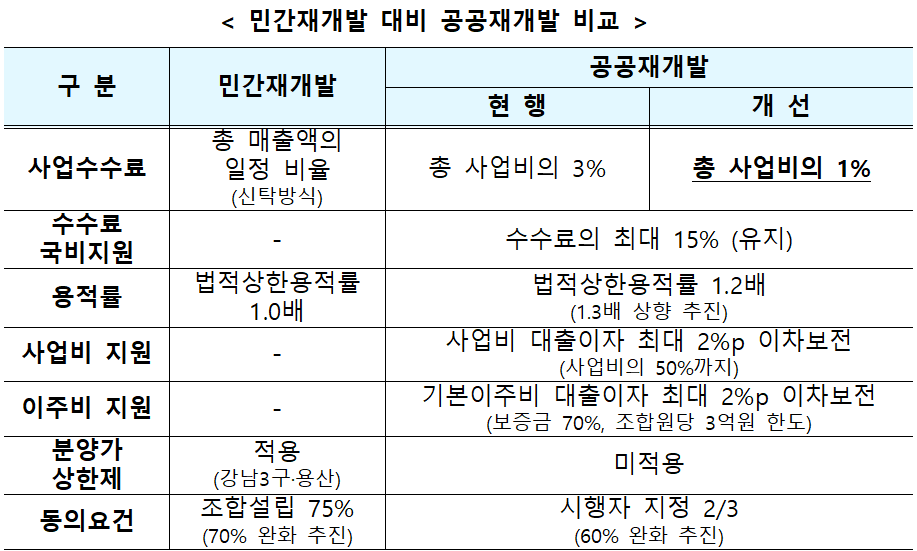
The government is moving to accelerate housing supply by promoting public redevelopment, cutting the fee charged by public project operators — who step in for redevelopment associations — from 3% to 1% of total project costs. The reduced rate will apply only to zones that newly apply for candidate designation by the end of next year.
The fee burden per redevelopment zone is expected to fall by about 13 billion won ($9.73 million). Projects that had been proceeding under a private model may also apply for public redevelopment candidate status to benefit from the lower rate.
The Ministry of Land, Infrastructure and Transport and Korea Land and Housing Corporation said Thursday they have finalized the fee reduction as part of public redevelopment promotion measures under the "rapid housing supply plan" announced Aug. 13, and will begin actively identifying new candidate sites.
Under the public redevelopment system, public enterprises such as LH take on the role of project operator in place of associations, directly overseeing the entire process — from permits and design review to construction cost estimation and site management. In return, the operator receives a fee of about 3% of total project costs, which include construction and service expenses.
The fee savings from this measure are expected to average about 13 billion won per zone.
For example, a project supplying 2,200 units with total costs of 720 billion won would pay 21.6 billion won in fees at the 3% rate, but only 7.2 billion won at 1%. When combined with a 15% government subsidy on fees for projects completed within eight years of operator designation — announced in last year's Sept. 7 measures — the fee burden falls further, from 18.4 billion won to 6.1 billion won.
The total effective fee rate would drop from 3% to 0.85%.
A ministry official said the average savings figure was calculated based on total project costs across zones where LH serves as project operator.
Since the public redevelopment system was introduced in 2021, a total of 39 sites have been designated as redevelopment zones, with LH selected as project operator at 22 of them. The Sinseol 1 zone — a 299-unit project where LH is the operator — has entered the management and disposal plan approval stage and is expected to be the first to break ground, potentially as early as next year.
The ministry said that despite the fee cut, LH's specialist staff will continue to directly oversee the full scope of work, including design review, construction cost estimation and site management. The reduced rate will apply to zones that newly apply for candidate designation by the end of 2027, and projects previously pursuing a private model may also apply for public redevelopment candidate status to receive the same rate.
Zones interested in public redevelopment may apply to LH for preliminary consulting. If at least 10 percent of landowners and rights holders consent, LH will analyze a rough project plan and estimated cost-sharing burden.
Zones that proceed with redevelopment under the public model are eligible for four benefits: a floor-area ratio allowance of 1.2 times the legal ceiling, exemption from the price ceiling on new apartments, the option to apply a private brand, and interest rate subsidy support. A pending amendment to the Act on the Improvement of Urban Areas and Residential Environments — set to go before a plenary session of the National Assembly — would raise the floor-area ratio allowance to 1.3 times the legal ceiling.
The interest rate subsidy covers project financing loans and resident relocation loans: when the rate exceeds 1.8 percent, the excess is subsidized by up to 2 percentage points. A single-homeowner who takes out a basic relocation loan of 300 million won at an annual rate of 4.8 percent would save about 6 million won in interest per year.
The ministry is also pursuing a plan to ease the resident consent requirement for operator designation from two-thirds of landowners and rights holders to 60 percent, which would further lower the barrier to entering the public redevelopment system.
Yun Young-jung, the ministry's housing improvement policy director, said the fee cut would ease the burden on residents looking to pursue public redevelopment. "We will work actively with relevant agencies to ensure that public redevelopment — where the public sector takes responsibility for managing projects — becomes a genuine alternative in the redevelopment market," Yun said.
smh@heraldcorp.com