Corporate tax revenue of 127.8 trillion won in first nine months exceeds annual budget by 26.5 trillion won
Central government debt reaches 1,369.4 trillion won, up 101.3 trillion won from end of last year
A surge in corporate tax revenue driven by improved company earnings narrowed South Korea's fiscal deficit by more than 70 trillion won ($52.1 billion) in the first nine months of this year compared with the same period last year. Corporate tax collections exceeded 36 trillion won in September alone, swinging the monthly fiscal balance from deficit to surplus. However, national debt has risen by more than 100 trillion won from the end of last year, keeping fiscal pressures in place.
The managed fiscal balance for January through September came to a deficit of 32 trillion won, according to the November issue of the Monthly Fiscal Trends report released Thursday by the Ministry of Planning and Budget. That marks an improvement of 70.5 trillion won from the 102.4 trillion won deficit recorded in the same period last year.
The cumulative deficit, which stood at 43.1 trillion won through August, shrank to 32 trillion won after September posted a monthly surplus of 11.1 trillion won. In September last year, the monthly balance had shown a deficit of 14.1 trillion won.
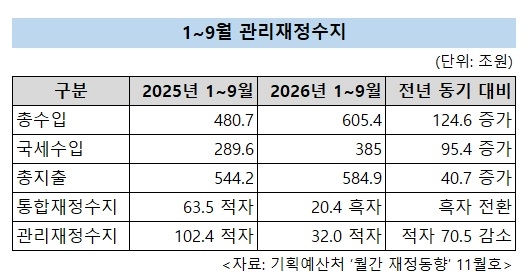
National tax revenue for the first nine months totaled 385 trillion won, up 95.4 trillion won from the same period last year. The year-on-year increase in tax revenue, which had been 69.1 trillion won through August, widened to the 95 trillion won range in September. By the end of September, 92.7 percent of the supplementary budget's annual national tax revenue target of 415.4 trillion won had been collected.
By tax category, corporate tax revenue for January through September reached 127.8 trillion won, up 51.9 trillion won from a year earlier, accounting for more than half of the total increase in tax receipts. Collections have already exceeded the annual budget target of 101.3 trillion won by 26.5 trillion won. Corporate tax revenue for September alone came to 36.2 trillion won, up 23.6 trillion won from a year earlier, a direct result of improved corporate earnings feeding through into tax receipts.
Income tax revenue also rose 15.7 trillion won to 110.8 trillion won, boosted by performance bonuses and increased real estate transactions. Value-added tax grew 7.4 trillion won on the back of higher import values and stronger private consumption. Securities transaction tax and the special rural development tax rose by 7.5 trillion won and 10.3 trillion won, respectively, driven by higher share trading volumes and the restoration of the securities transaction tax rate.
Total revenue, including non-tax revenue and fund receipts, reached 605.4 trillion won, up 124.6 trillion won from the same period last year. Total expenditure over the same period came to 584.9 trillion won, an increase of 40.7 trillion won. The significantly larger rise in revenue compared with expenditure drove the improvement in the fiscal balance. The revenue execution rate against the supplementary budget stood at 86.4 percent, while the expenditure execution rate was 77.7 percent.
The consolidated fiscal balance, which includes the four major social security funds such as the national pension, posted a surplus of 20.4 trillion won, swinging from a deficit of 63.5 trillion won in the same period last year. However, the managed fiscal balance — which excludes the 52.4 trillion won surplus from social security funds and more accurately reflects the government's underlying fiscal position — remained in deficit despite the improvement in tax revenue.
Central government debt stood at 1,369.4 trillion won ($1.02 trillion) at the end of September, down 2.7 trillion won from the end of August. While debt fell month on month, it was 101.3 trillion won higher than the year-end level of 1,268.1 trillion won. The outstanding balance of treasury bonds rose 101.1 trillion won from the end of last year, and the balance of foreign exchange stabilization bonds increased 3.5 trillion won. The outstanding balance of national housing bonds, however, fell 3.1 trillion won. Local government debt is tallied separately once a year.
fact0514@heraldcorp.com