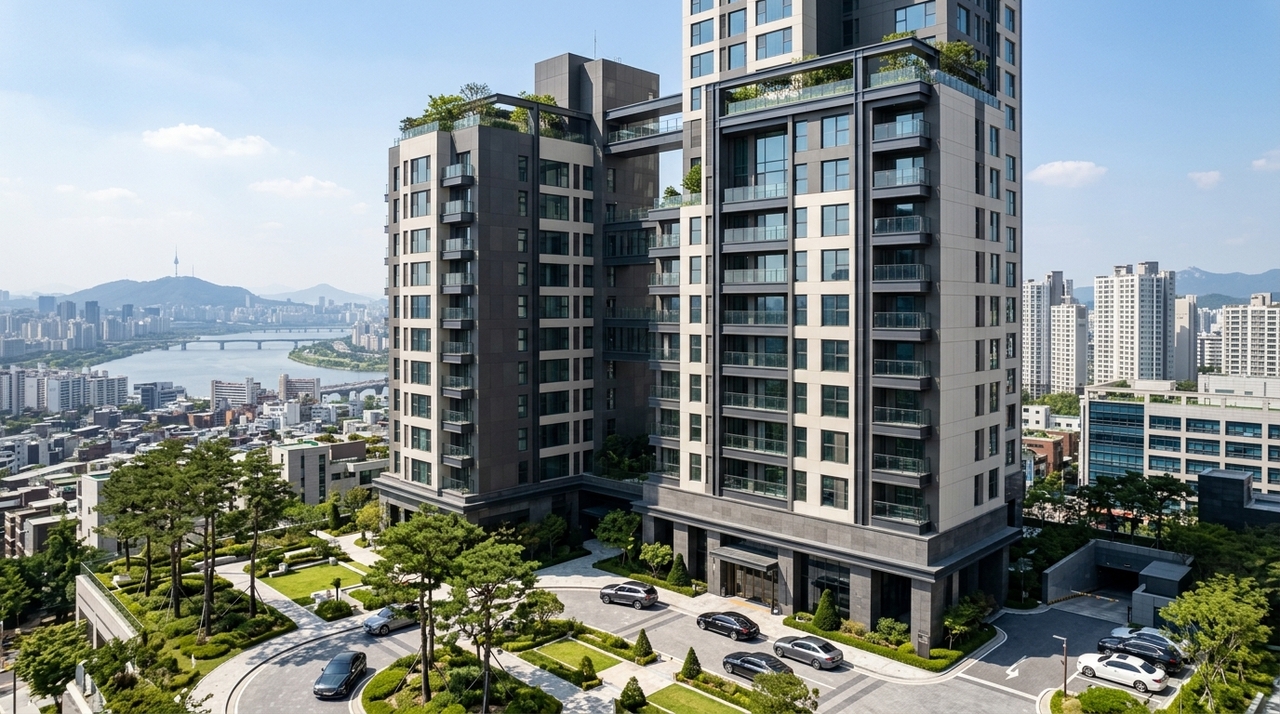
Solar building materials brand Solu:en launches with 25 BIPV products
Generation efficiency rises from 16% to 20% compared with conventional glass-type panels
Zero-energy building demand targeted with full installation and after-sales support
Hyundai L&C, a building materials affiliate of Hyundai Department Store Group, is entering the solar building materials market. The company plans to target the zero-energy building sector with building-integrated photovoltaic products that generate electricity directly from exterior walls.
Hyundai L&C announced Thursday it is launching a solar building materials brand called Solu:en and beginning full-scale sales operations. Its debut product is a BIPV exterior panel that combines solar power generation with facade cladding. The lineup comprises 25 products in total — 20 solid-color variants in gray, beige and green, and five design-oriented options replicating the look of marble, granite and wood.
Colors and patterns can be custom-ordered to suit individual buildings. Product dimensions are also made to order, ranging from panels as small as 0.1 meters on each side to units measuring 3 meters wide by 2 meters tall.
Hyundai L&C said it applied a ceramic nano-deposition technology to the color-type products, boosting power generation efficiency by about 25 percent compared with conventional glass-type BIPV panels. Under the company's benchmark conditions — receiving 1,000 watts of solar energy per square meter — existing products generate 160 watts of electricity, while Solu:en's color-type panels produce 200 watts, lifting efficiency from 16 percent to 20 percent, a gain of 4 percentage points.
To improve durability, the encapsulant protecting the internal solar module uses polyvinyl butyral, the same material used in automotive laminated glass and safety glass for high-rise buildings.
Hyundai L&C's move into the solar building materials market comes as the government has tightened standards for zero-energy buildings — structures that reduce energy consumption through insulation and other measures while drawing on renewable sources such as solar power. Unlike rooftop solar panels, BIPV systems use exterior walls as generation surfaces, a key advantage for urban construction.
The company plans to target the housing market first, leveraging the network of construction companies and redevelopment and reconstruction associations it has built through its existing window and engineered stone businesses. It will then expand its customer base to offices, commercial facilities and public institutions.
"We are expanding our product portfolio in line with government policy and architectural trends," said Lee Dong-seop, executive director of Hyundai L&C's window division. "Following windows and engineered stone, we will add solar exterior materials and grow into a global comprehensive building materials company covering the full range of construction products."
Meanwhile, the Ministry of Land, Infrastructure and Transport has applied tightened energy performance standards equivalent to zero-energy building Grade 5 to newly built private apartment complexes of 30 units or more since June last year.
hong@heraldcorp.com