Ministry accepts fifth-round E-9 new employment permit applications through Nov. 27
Manufacturing leads with 4,510 slots; farming and fishing account for 1,851
Workplaces completing human rights and labor law training to receive bonus points
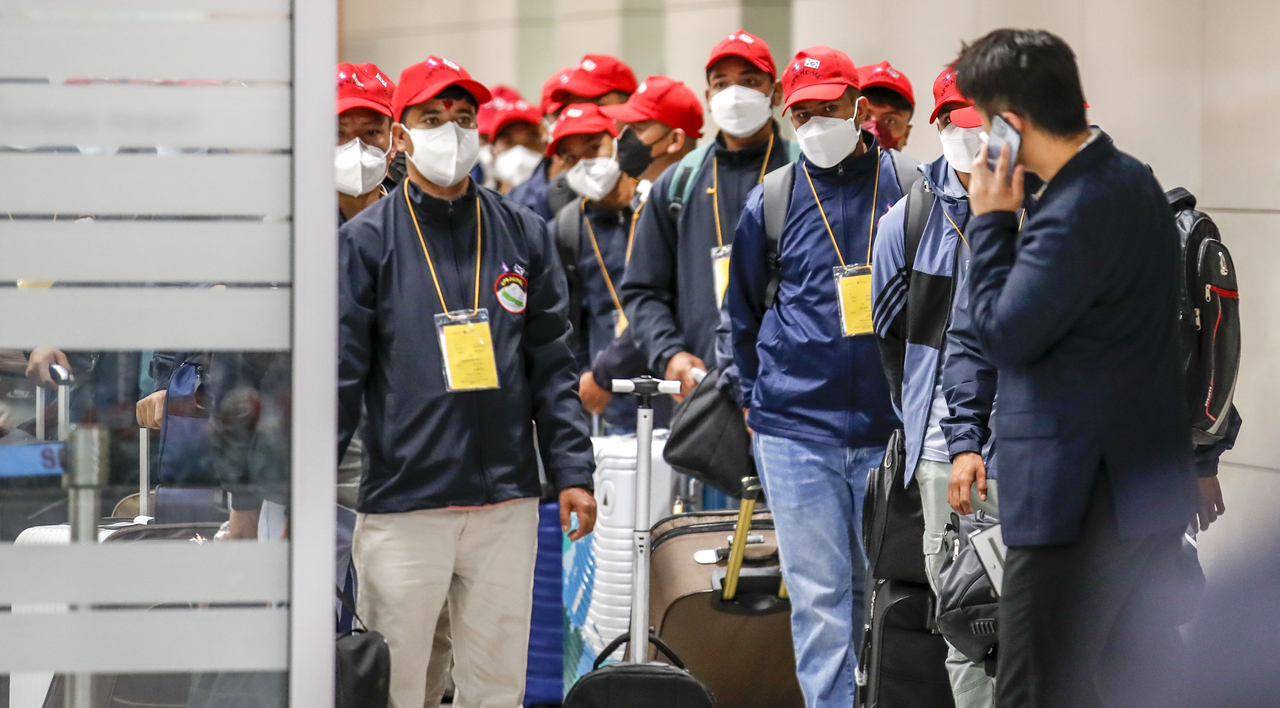
The government will begin accepting applications for the final round of new employment permits for foreign workers on non-professional work (E-9) visas this year starting Nov. 23.
A total of 6,699 foreign workers will be allocated in this round, with roughly 67 percent of the slots concentrated in manufacturing. Starting with this round, workplaces that have completed training on foreign workers' human rights protections and basic labor law will receive bonus points in the scoring system used to assign workers.
The Ministry of Employment and Labor announced Thursday that it will accept applications for the fifth round of new E-9 foreign worker employment permits for 2026 from Nov. 23 through Nov. 27 at regional employment and labor offices nationwide.
This is the final new foreign worker employment permit process of the year.
The fifth round covers a total of 6,699 new permits. By sector, manufacturing accounts for the largest share at 4,510 slots, followed by farming and livestock at 954, fishing at 897, construction at 198 and services at 140.
Manufacturing's allocation represents 67.3 percent of the total. Farming and livestock combined with fishing comes to 1,851 workers, or 27.6 percent of the total. Together, manufacturing and the agricultural and fishing sectors account for roughly 95 percent of all new allocations.
If applications in any sector exceed the allocated quota, the government plans to draw on a separate flexible reserve pool of 10,000 slots. Additional allocations can be made based on labor demand by sector.
Starting with this fifth round, the criteria for evaluating workplaces seeking to hire foreign workers will also be tightened to better protect workers' rights.
Workplaces whose employers complete a group training course on human rights protections and core labor law fundamentals — conducted by the Human Resources Development Service of Korea — will receive bonus points under the scoring system used to determine new worker allocations.
The measure aims to raise employers' understanding of labor relations law and to factor their efforts to protect workers' rights into the allocation process. It adds employers' completion of training to what has traditionally been a demand-driven allocation system.
Employers wishing to hire foreign workers must first make a seven-day effort to recruit domestic workers. They may then apply for a new employment permit by visiting their local regional employment and labor office or through the Work24 website (www.work24.go.kr).
Results will be announced Dec. 11. Employment permit certificates will be issued from Dec. 14 to 16 for manufacturing and mining, and from Dec. 17 to 21 for farming, livestock, fishing, forestry, construction and services.
The government plans to use the sector-specific allocations and the flexible reserve pool to meet labor demand at domestic workplaces, while also strengthening employer training to better protect the labor rights of foreign workers.
fact0514@heraldcorp.com