An interview with Korean National Ballet principal dancer Park Seul-ki
Rushed in 7 days before opening after Cojocaru's injury
Five days, five performances — Manon three times, Marguerite twice
'Even if the costume doesn't fit perfectly, I'll express it with every part of my body'
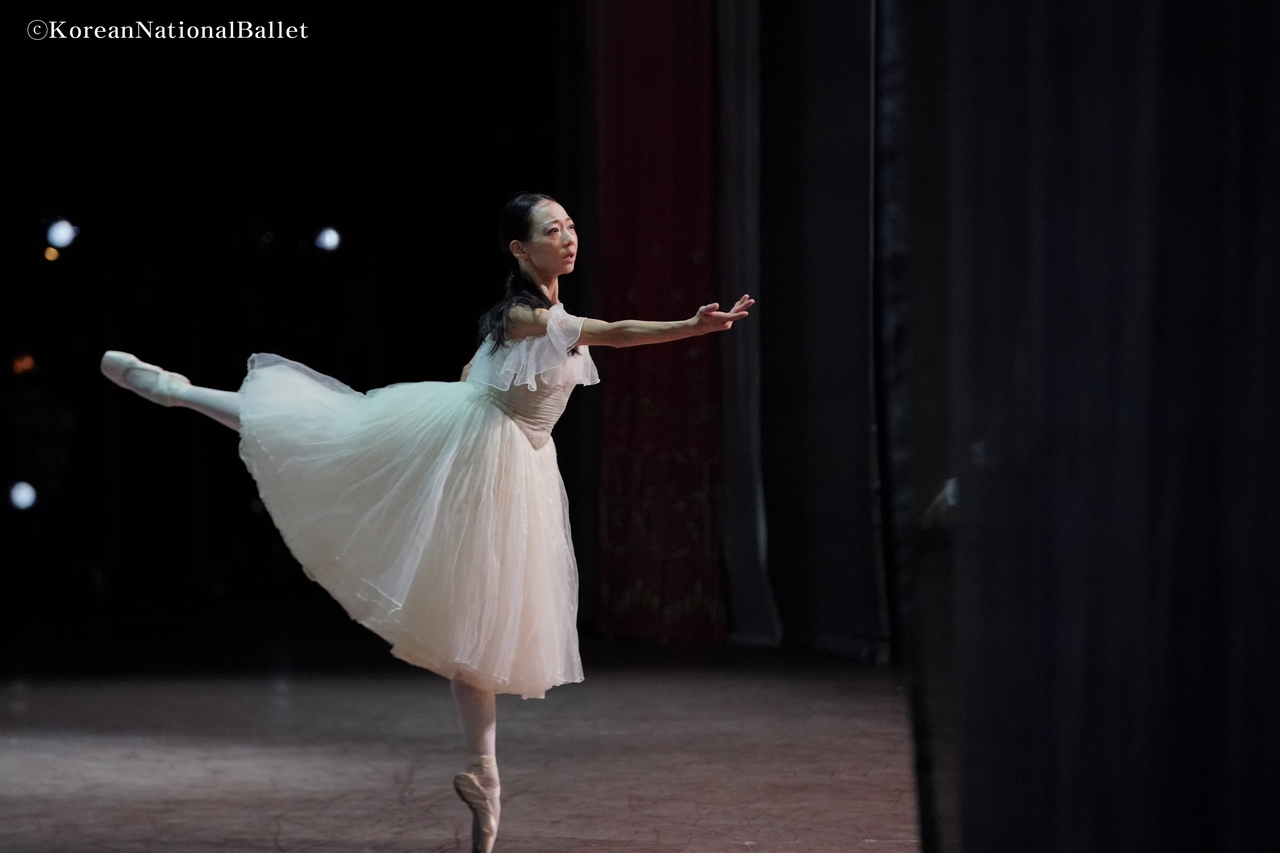
Seven days before the curtain was set to rise on "Camellia Lady," something shifted in the Korean National Ballet's rehearsal studio. Dancers, with their finely tuned instincts, sensed the change before it was spoken aloud. The requests directed at principal dancer Park Seul-ki, 40, had been quietly multiplying for days. "I kept thinking — why am I being given so many things?" she recalled. She had a vague suspicion, but it took a few more days before the picture became clear.
Until then, Park had been a quiet presence behind the scenes. The role of Marguerite — a tragic courtesan — had been assigned to world-renowned ballerina Alina Cojocaru, and Park had willingly stepped in as a rehearsal partner for Yang Jun-young, who dances Armand, in Cojocaru's place. She was already juggling three roles at once: Prudence, which she had danced in last year's premiere; Manon, newly entrusted to her by choreographer John Neumeier; and Marguerite, which she was rehearsing for her partner's benefit. "It was a lot of pressure. But the work is so beautiful that when I was rehearsing, I'd get completely absorbed — and end up dancing as if I were actually going to perform it."
When Cojocaru ultimately withdrew due to injury, the casting had to be rebuilt from scratch. Casting authority for this production rests entirely with the choreographer. Neumeier arrived in Korea a week before opening, watched Park dance in person, and only then did the revised cast list go public. That was Friday — just six days before opening night.
"Neumeier didn't say anything to me personally. But when he gave corrections, I felt that he recognized me."
Park will perform in "Camellia Lady" at the Seoul Arts Center Opera House through Sunday. She takes the stage as Manon on Tuesday, Friday and Sunday, and as Marguerite on Thursday and Saturday evenings. Park met with a reporter at Seoul Arts Center on Monday — the day before opening — and said she had been longing for this moment since the premiere last year. "Honestly, from the very beginning of last year's premiere, I desperately wanted to be on that stage as Marguerite."
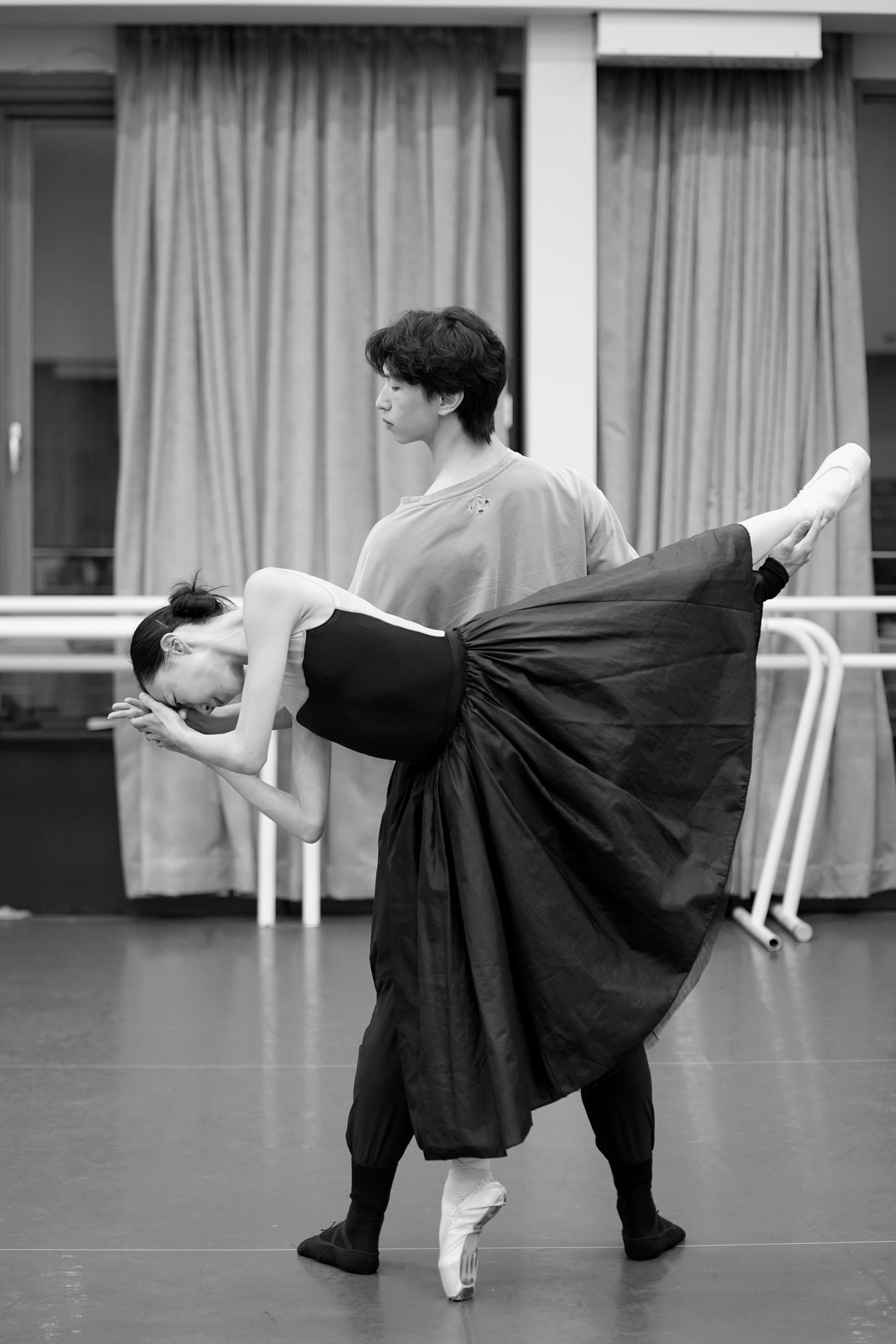
Two women like mirror images — a connection one year in the making
Two women reflect each other's tragedies across time. Manon Lescaut, a courtesan of the Rococo era, laughs radiantly at the sight of glittering jewels, weeps passionately in her lover's arms, and dies in his embrace. She holds nothing back — not joy, not sorrow, not desire.
Watching Manon from the audience, Marguerite Gautier — the queen of 19th-century Parisian society — turns away, but she knows from the outset. The fate she sees playing out before her is an omen of her own. In Neumeier's dramatic ballet, Manon is Marguerite's mirror, the suppressed inner self that Marguerite can never fully release. Based on Alexandre Dumas fils' "La Dame aux Camélias," the work was created by Neumeier in 1978 and received its Asian premiere with the Korean National Ballet last year.
This year, Park inhabits both women reflected in that mirror. It is her first time dancing both Manon and Marguerite, and she is the first dancer in the Korean National Ballet to take on both roles in the same production. In Tuesday's opening performance, Park's body carried the frivolous beauty of Manon while her face held a deep, settled emptiness. Launching off her toes and cutting through the air, her hands reached endlessly toward something just out of grasp. The tragedy dissolving from her fingertips traveled across the stage on the currents of Chopin's melodies.
The connection with Marguerite had not come easily. During last year's premiere, Park and Yang had rehearsed together as understudies for Marguerite and Armand. Near the end of rehearsals, her partner injured his shoulder and lost the role of Armand, and Park was moved to a different part.
"They said another role suited me better, so I was shifted over. I had worked so hard that the disappointment was real."
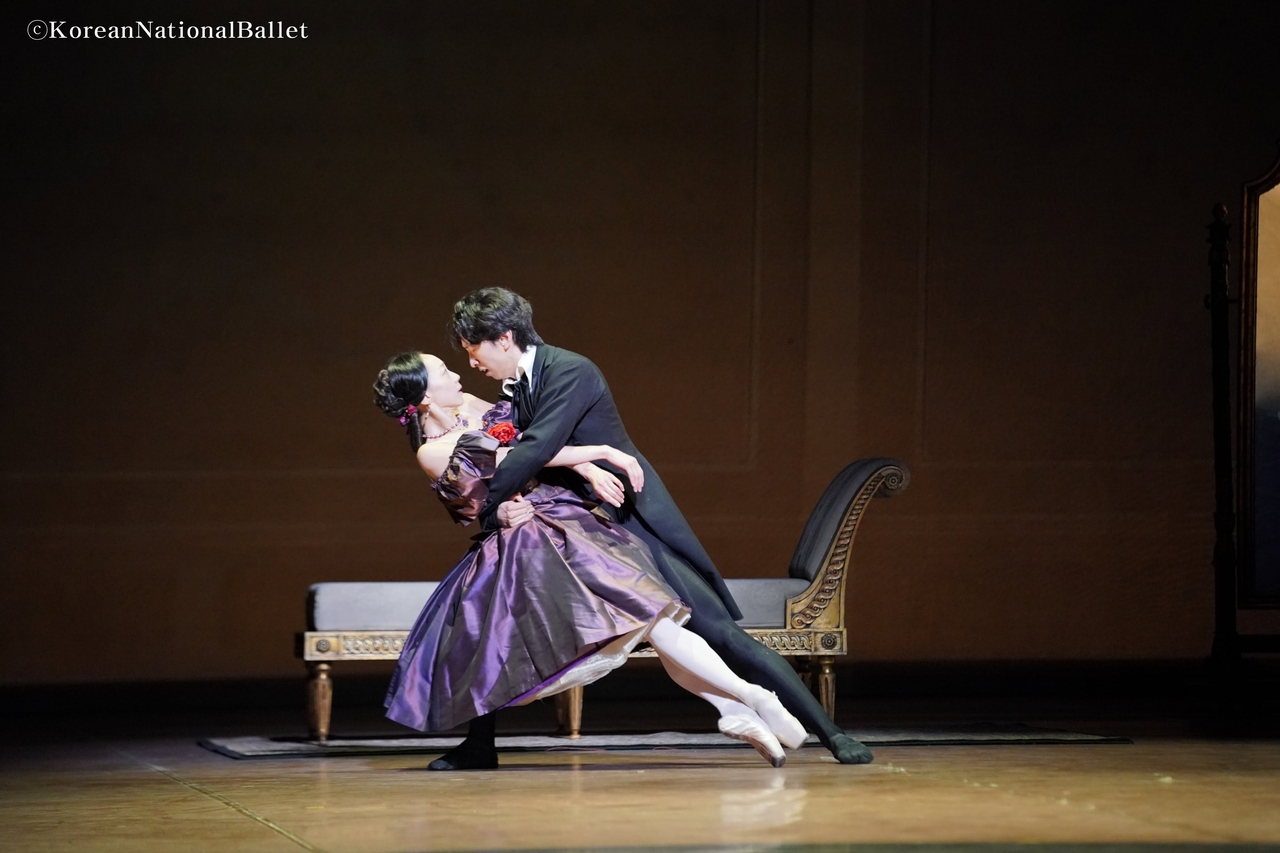
When Park returned to the stage just 100 days after giving birth during last year's premiere, the costume she wore was that of Marguerite's friend Prudence. The biggest obstacle had been image. "In Neumeier's work, once you're left out of the casting, that's really it. Once he decides your image doesn't fit, it's over."
Park has never heard Neumeier describe his vision of Marguerite directly. But she has her own read: "I think he prefers a dancer who projects a mature, womanly quality — rather than someone tall and willowy with a delicate, girlish look. And honestly, I think I'm closer to the former." She laughed.
So even this year, she had her doubts. The company had assigned her to rehearse Marguerite before Neumeier arrived, but Park said she kept wondering: "Would he really give it to me?"
What she calls the "unexpected key" turned out to be the character of Manon. "Marguerite is someone who conceals her emotions deeply and reveals them only through restraint," Park explained. "Manon freely expresses everything she feels through her face and body. Separating those two opposite emotional registers was overwhelming at first."
"The experience of letting emotions pour out freely while dancing Manon gave me a very clear picture of what I needed to hold inside when I stepped on stage as Marguerite."
Park said she had long been accustomed to a more demonstrative style of performance. "Every time I went on stage, I was thinking about how to make everything bigger and more visible — so that even the audience at the very back of the house could feel it." But Neumeier's dramatic ballet demanded something entirely different.
"Drawing out emotions naturally and just acting felt awkward to me at first. Rather than trying to show something, it seemed right to pull out whatever I have inside myself and let the audience draw from that."
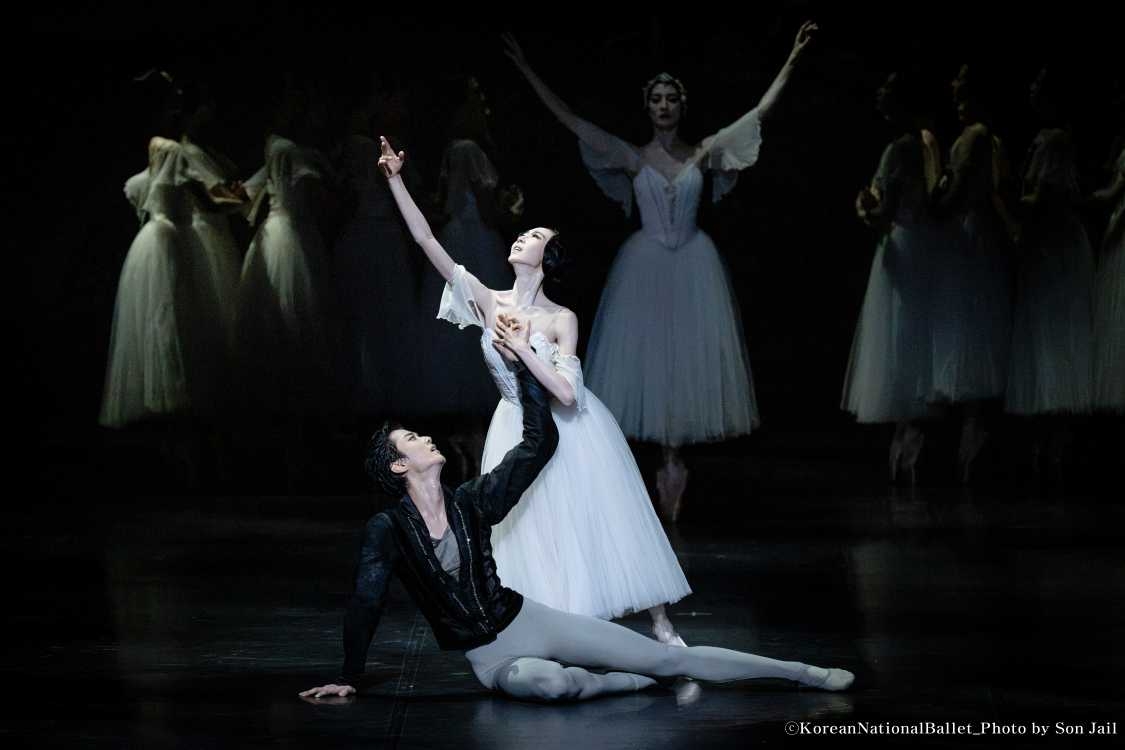
The moment she has crafted with the most care is a brief pas de deux in the second act. Marguerite has already resolved to leave Armand, but Armand, unaware of her decision, approaches her with his usual smile. It is a short, intimate dance that follows the white pas de deux — one of three in the ballet, distinguished by black, purple and white costumes.
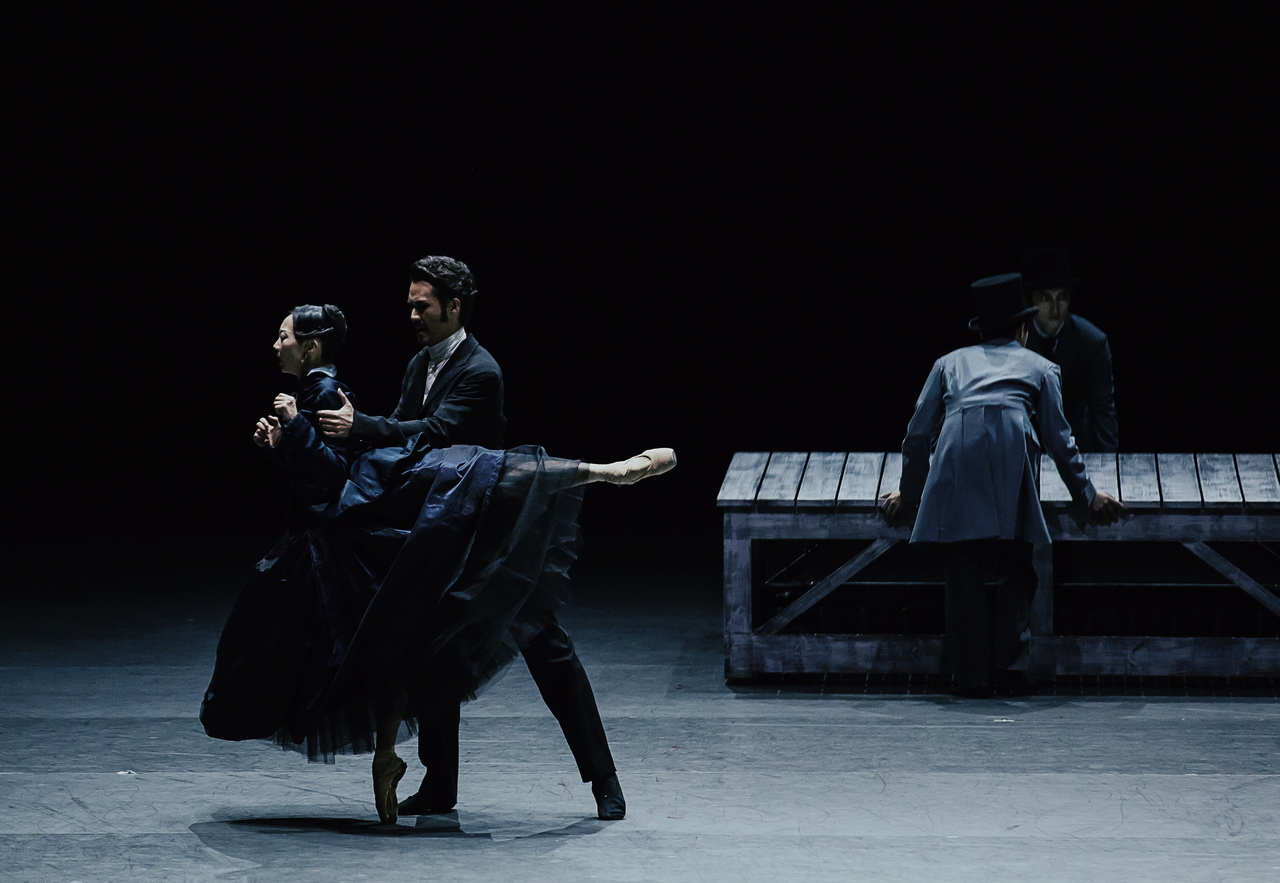
"The purple pas de deux is the scene that reveals Marguerite. The white pas de deux paints a tranquil picture of two people fully absorbed in their love for each other. When I dance the scene that comes after — after everything has turned tragic and she has made up her mind to leave — I feel heartbroken every single time. Tears come."
Park's partner Yang is the colleague who missed the stage alongside her a year ago. "I used to think he was someone without much expression, but dancing with him I realized there's a real depth in his eyes. He's a dancer who speaks with his gaze."
Shedding complexes, finding strengths — growth one step at a time
Park began ballet at age six. She followed the elite track through Sunhwa Arts High School and the Korea National University of Arts, but she looks back on those years without illusion. "I wasn't a student who stood out," she said simply.
"There's a standard physical ideal for a ballerina. I didn't think I fit it. I always had that complex." Yet her longer-than-average arms and a body that combined flexibility with strength were genuine competitive assets. Park learned to tell herself: "That might be something I can't do as well as others — but there are things I can do far better." She built her inner strength from there.
There was always an Everest in front of her. In a world defined by the body, she had long resigned herself to being wrong for the "dream roles" — the white ballets, "Giselle" and "Swan Lake." "I always thought those weren't mine to have," she said. Joining the Korean National Ballet in 2007 — a lifelong goal — and then being cast in "Giselle" became the turning point that broke that assumption. Today, "Giselle" is the role she considers her best fit.
Five years after joining the company, she was promoted to principal dancer in 2012 — faster than most of her peers. She has held that position ever since, dancing steadily at the top while expanding the range of her repertoire. "I never once set out to become a principal," she said. "Every time a role was given to me, I'd think, 'Can I really do this? This too?' — and I climbed one step at a time. That's how I got here."
Park names both her greatest strength and her greatest weakness as a dancer the same thing: having no fixed image. "My image is like water — pour it into water and it becomes water, pour it into liquor and it becomes liquor. Whatever you put me in, I become that. When I couldn't do Marguerite, that felt like a flaw. Maybe it is a weakness. But looking at the path I've walked, I think it's been more of an asset."
What has kept her going is quiet, relentless repetition. "I believe the nerves and anxiety you feel on stage are proportional to how much you've rehearsed," she said. "I don't repeat things to be perfect. I repeat them so that everything comes out naturally when I'm on stage."
'There is only one dancer named Park Seul-ki in this world'
Giving birth last year was a turning point in her journey as a ballerina. Even heavily pregnant, she came to the studio every day and held the barre. After delivery, she returned to the rehearsal room faster than anyone.
"I'm not young anymore, so I thought: if I don't get back to where I was as quickly as possible, I might never be able to dance again. I wasn't ready to stop."
From her days in the postpartum care center, Park was an unusual patient. She climbed the stairs to her fifth-floor room rather than taking the elevator, and when her doctor said rehabilitation could not begin until 60 days after delivery, she ran laps around the neighborhood track. She tied resistance bands to a pull-up bar on the hill behind her house and worked out alone. "Women passing by would ask me what kind of exercise that was," she said with a laugh. After months of four- to five-hour daily sessions at a rehabilitation center, the stage she returned to was last year's "Camellia Lady."
With every curtain rise, the weight of being a principal dancer grows heavier. Park acknowledged that physical ability and technique inevitably decline with age compared to one's 20s, "but instead I try to make every movement stable and grounded."
"Ballet isn't only about technique. My goal is to give the audience something, so I find myself thinking more and more about acting and expression." The experiences and emotions that have come with marriage and motherhood accumulate on her stage, layer by layer. Yet the anxiety never fully disappears — the shadow of knowing that if she steps away, a younger dancer will fill her place.
"Still, there is only one dancer named Park Seul-ki in this world. The time I've lived through in my body, the unique color that only I can give off — that is something real."
Park calls "Camellia Lady" a work of love and resentment. "If I hadn't been able to perform it, there would have been no love — it would have remained a work that left a knot in my life as a ballerina, never untied." These five performances are a beautiful act of proof directed at herself.
"Maybe Marguerite isn't a perfect costume that fits my body exactly. But I want to show that I have this side to me, that I can express it with everything I have — and I want to earn that recognition from myself first. People have told me I don't fit the role. Now it's time to prove them wrong."
shee@heraldcorp.com