'If there is freedom to criticize Rhee, there must also be freedom to honor him'
'Removal was a historical judgment — calls for restoration deserve equal respect'
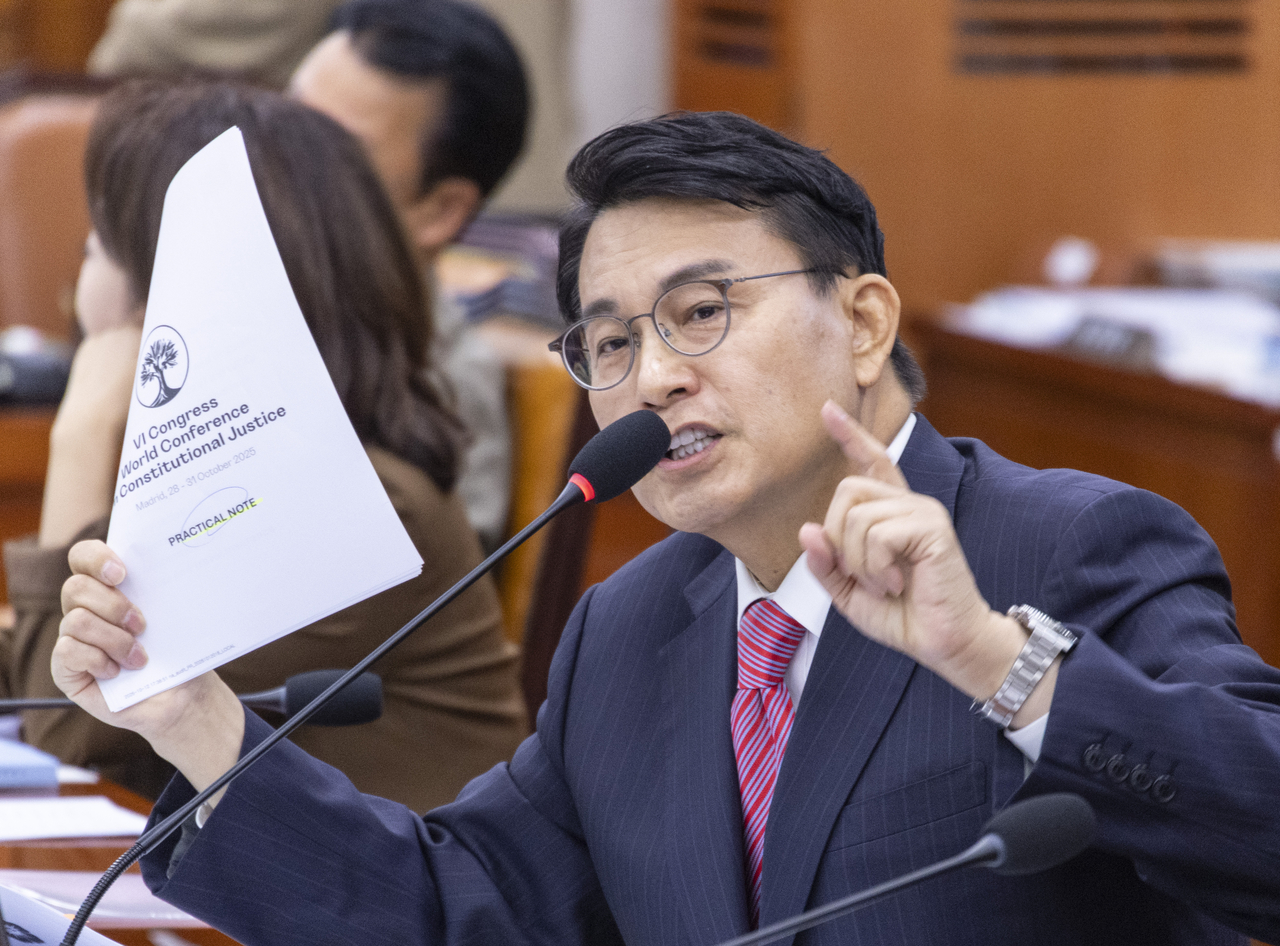
People Power Party lawmaker Yoon Sang-hyun pushed back Wednesday against progressive groups opposing a student-led effort to restore a statue of former President Syngman Rhee on the Inha University campus, questioning whether dismissing the move as "glorifying dictatorship" reflected a mature republican spirit.
"If there is freedom to criticize Syngman Rhee, there must also be freedom to honor his achievements and hold him in respect," Yoon wrote on Facebook that day.
Yoon explained that the university's name combines the first syllable of Incheon with that of Hawaii, tracing the school's origins to Korean emigrants who left Incheon's Jemulpo Port for Hawaii in 1902. "Half a century later, their love of their homeland gave rise to a university in Incheon," he wrote, adding that Rhee, South Korea's first president, played a central role in making that vision a reality. Rhee proposed establishing the university in 1952, during the Korean War, and Inha Institute of Technology opened in 1954 with funding from the Hawaiian Korean community, government support and domestic donations, Yoon said.
Yoon noted that some Inha University students are now seeking to restore a statue of Rhee that was removed in 1984, and that the youth committee of the Progressive Party's Incheon chapter, among others, has opposed the effort, calling it an attempt to glorify dictatorship.
Yoon acknowledged that Rhee's authoritarian rule and his role in the fraudulent March 15 election drew legitimate historical criticism, but argued that those failings should be weighed separately from his achievements — among them the founding of the South Korean government and the conclusion of the Mutual Defense Treaty with the United States. "Not turning away from his faults while also fully examining his contributions would be a balanced understanding of history," he said.
"A statue is not a monument certifying that a person was without fault," Yoon said. "It is a symbol honoring contributions a community deems worth remembering. Commemorating someone who helped found an institution does not justify everything that person did."
He then argued that just as the students who removed the statue in 1984 acted on the historical judgment of their time, a new generation more than 40 years later deserves equal respect for reassessing that history and calling for restoration. "The freedom to oppose the restoration must also be respected," he added. "A university should be a space where diverse ideas and views of history compete freely. Whether to restore the statue should be decided through sufficient debate and proper procedures among the university community."
Yoon said that as the Assembly member representing Michuhol-gu in Incheon, where Inha University is located, he respects the students' desire to reflect on the founding history of their institution. "Inha University is a prestigious private university that has produced countless talented people and contributed to South Korea's industrialization and national development," he wrote. "At its founding lies the dedication of the Hawaiian Korean community and their belief in education as a form of patriotism."
mkkang@heraldcorp.com