Even as AI reshapes daily life and robots take over demanding tasks, Koreans still consult fortune tellers at the new year and consider compatibility readings an essential step before marriage. Divination has seeped into Korean life much like folk religion — quietly persistent, still influential. In an age of advanced technology and expanding human capability, the old arts of fortune-telling continue to offer comfort to those anxious about the future.
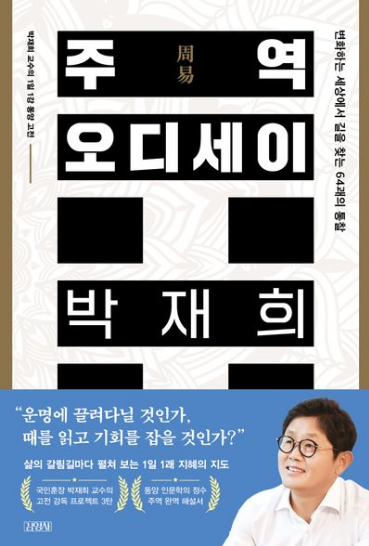
Among the many forms of divination, the Zhouyi — commonly known in the West as the I Ching — occupies a uniquely complex position. It functions simultaneously as a philosophical text and an oracle, predicting the workings of the world and the prospects of good or ill fortune through the shifting principles of 64 hexagrams. It is no coincidence, then, that Park Jae-hee, an Eastern philosophy scholar and director of Seokcheon Academy, chose the Zhouyi as the subject of his third commentary on classical Eastern thought, following earlier works on the Analects and the Tao Te Ching. In his new book "Zhouyi Odyssey," Park offers a complete translation and commentary on all 64 hexagrams and 384 lines, presenting a guide to finding one's own path in an ever-changing world.
The Zhouyi has ancient roots. According to tradition, the mythical figure Fuxi created the original eight trigrams, which the Zhou dynasty's King Wen expanded into 64 hexagrams around the 10th century BC. The Duke of Zhou later added six line statements to each hexagram, giving the text its oracular form. Its transformation into a philosophical work came in the 5th century BC, when Confucius composed the "Ten Wings" — a ten-part commentary that recast the Zhouyi's divination as a framework for moral cultivation and self-improvement, explaining the cosmos and humanity as a single unified dimension and elevating the text from oracle to philosophy.
Park identifies "change" as the Zhouyi's core philosophical insight. Nothing in the world is permanent, the text teaches; the only unchanging truth is that everything changes. The Zhouyi, Park argues, is therefore not a divine revelation but a tool for philosophical reflection and moral judgment. Rather than an encyclopedia that delivers fixed answers about predetermined fate, it functions as a kind of "matrix" — a framework in which different meanings emerge depending on the circumstances of the person asking. What matters most, Park emphasizes, is "sizhong": the capacity to make the most rational judgment and take the most fitting action given one's present situation.
In this sense, the Zhouyi does not point to a single answer but acts as a kind of "psychological mirror," guiding the reader toward finding answers within. Drawing on Confucius's teaching that humans are of heaven, and heaven holds the answers, the person asking already carries the answer inside. The Zhouyi's role, then, is to help the reader reach the insights that their inner heaven generates. For this reason, Park stresses the importance of the question itself — the preface one poses before consulting the oracle. Refining that question before a reading is, he argues, a process of self-cultivation: an act of asking oneself what one truly wants.
Park organizes the 64 hexagrams into eight chapters — chaos, harmony, recovery, hope, resolution, salvation, completion and incompletion — weaving them into a single narrative of human life. Chaos gives way to growth, success breeds new crisis, decline turns to recovery, and completion circles back to a new beginning. The commentary on each hexagram and line reflects two years of study with students at his academy, tracing classical annotations, writing new interpretations and debating the text from multiple perspectives. "In the old days, you had to divide 50 stalks dozens of times to cast a reading," Park said. "But you can actually use the coin method — just three coins — to obtain a hexagram. And if even that feels like too much, you can simply pose a question in your mind, open the book at random, and take whatever hexagram appears as your answer."
"Zhouyi Odyssey" / By Park Jae-hee / Gimm-Young Publishers
carrier@heraldcorp.com