Ruling party calls for shifting project approval authority to land ministry; minister urges caution
Seoul cites need to review infrastructure ahead of 1.4x floor-area ratio relaxation
Working-level talks stalled; Hong-Oh meeting seen as unlikely for now

The Ministry of Land, Infrastructure and Transport and the ruling party are stepping up pressure on the Seoul Metropolitan Government, blaming it for delays in an urban public housing complex project. The ruling party argued that Seoul's lack of cooperation has brought housing supply to a halt, and floated the idea of returning project approval authority to the land minister. Seoul pushed back, saying the government had unilaterally eased floor-area ratios without consultation and was now offloading the consequences of overdevelopment onto the city.
Democratic Party calls for returning urban housing project approval authority to land minister
Land Minister Hong Ji-seon visited the Yaksu Station Urban Public Housing Complex District in Seoul on Wednesday and said Seoul was insisting on a pre-planning consultation process that has no basis in law. "From our perspective, housing supply needs to move quickly — excessive delays in project progress must be prevented," Hong said.
The pre-planning consultative body coordinates floor-area ratio increases, the number of units to be supplied, and the share of public contributions. It is meant to resolve key issues before a project plan receives approval. A session scheduled for June was canceled by Seoul and has remained stalled since.
Among ruling party lawmakers, calls emerged to bring project approval authority back to the central government as a way to resolve Seoul's delays. Democratic Party of Korea lawmaker Kim Nam-geun said he suspected Seoul was deliberately stalling. "We should also consider amending the enforcement decree of the Special Act on Public Housing so that the land minister holds approval authority and can push projects forward quickly, in line with the original legislative intent," Kim said.
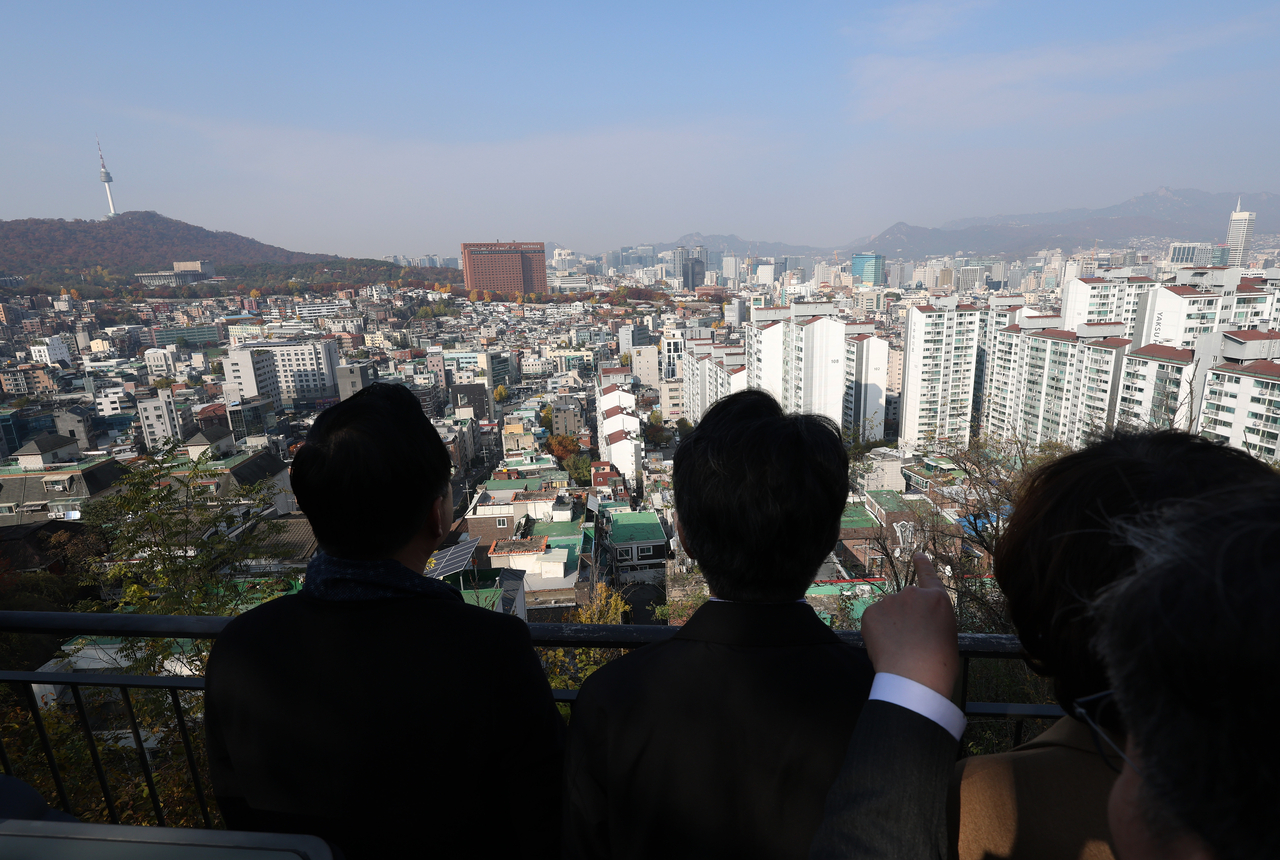
Kim said the urban public housing complex project covers 34 sites across Seoul and would supply about 59,000 units. "Had it proceeded normally, it would have played a major role in easing Seoul's housing shortage and the jeonse and monthly rent crisis," Kim said.
Hong was cautious about an immediate transfer of approval authority but urged Seoul to cooperate without delay. "The original intent of the law was that granting licensing authority to local governments, which carry out administrative work directly on the ground, would speed up projects and allow residents' opinions to be reflected more quickly," Hong said. "We will proceed with working-level consultations with Seoul as swiftly as possible."
At a briefing on the urban public housing complex project, Hong also said the pre-planning consultative body is not a procedure stipulated in law. "It may not be intentional, but the project is being delayed excessively over a process that is not even required by law," he said.
Dispute over floor-area ratio relaxation deepens; Hong and Oh yet to meet as working-level talks take priority
A significant number of projects are already experiencing delays in inter-agency consultations. According to the redevelopment industry, pre-planning consultative body meetings have been delayed at sites including Suyu District 12 in Gangbuk-gu, the Sangbong Terminal in Jungnang-gu, Bulgwang Neighborhood Park in Eunpyeong-gu, Jangwi District 12 in Seongbuk-gu, the area near Yaksu Station in Jung-gu, and the western side of Goeunsan.
The holdup stems from a disagreement between the government and Seoul over a 1.4-times relaxation of floor-area ratios for urban public housing complex projects. Seoul is currently coordinating with the National Assembly on a plan to raise floor-area ratios for private redevelopment projects by up to 1.2 times, and argues that granting an even more generous benefit exclusively to urban public housing complex projects is excessive.
Seoul also maintains that it cannot proceed with projects under a 1.4-times floor-area ratio relaxation without first reviewing infrastructure capacity and appropriate density levels.
Seoul criticized the government for focusing solely on expanding housing supply while unilaterally passing the urban management burden of overdevelopment onto the city. "The urban burden from overdevelopment will ultimately be passed on to future generations," a Seoul city official said. "Seoul has an obligation to manage appropriate density for all development projects in the city — is it really right to raise floor-area ratios to 420 percent and build cramped, chicken-coop apartments?"
On the question of transferring approval authority, the official said negative impacts on the city as a whole — including infrastructure shortfalls — need to be reviewed, and that expert input on appropriate density levels must be gathered. "It is not right for the land ministry and the ruling party to ignore these fundamental issues, claim that Seoul is delaying projects, and talk about transferring authority," the official said.
Kim Jun-hyung, a professor in the real estate studies department at Myongji University, also said that no matter how important housing supply is, it must move within the broader framework of urban planning. "Isn't this essentially the land ministry trying to take all authority away from the city?" Kim said.
Meanwhile, a meeting between Minister Hong and Seoul Mayor Oh Se-hoon is expected to remain out of reach for now, as the gap between the government and Seoul widens across multiple fronts — including housing supply at Yongsan Park, the transfer of redevelopment and reconstruction licensing authority, and the push to build a gondola on Namsan.
On Wednesday, Hong also made clear that working-level issues must be resolved before any meeting with Seoul takes place, responding to the city's request for a sit-down. "Meeting without resolving the problems would just bring us back to square one," Hong said. A Seoul city official added that there has been no significant progress at the working level.
lucky@heraldcorp.com
hss@heraldcorp.com