Indicted on obstruction of business and other charges
First trial: 10-month prison term, 2-year suspended sentence
Appeals court: 'First ruling lacked sufficient grounds'
Former vice president also acquitted on appeal
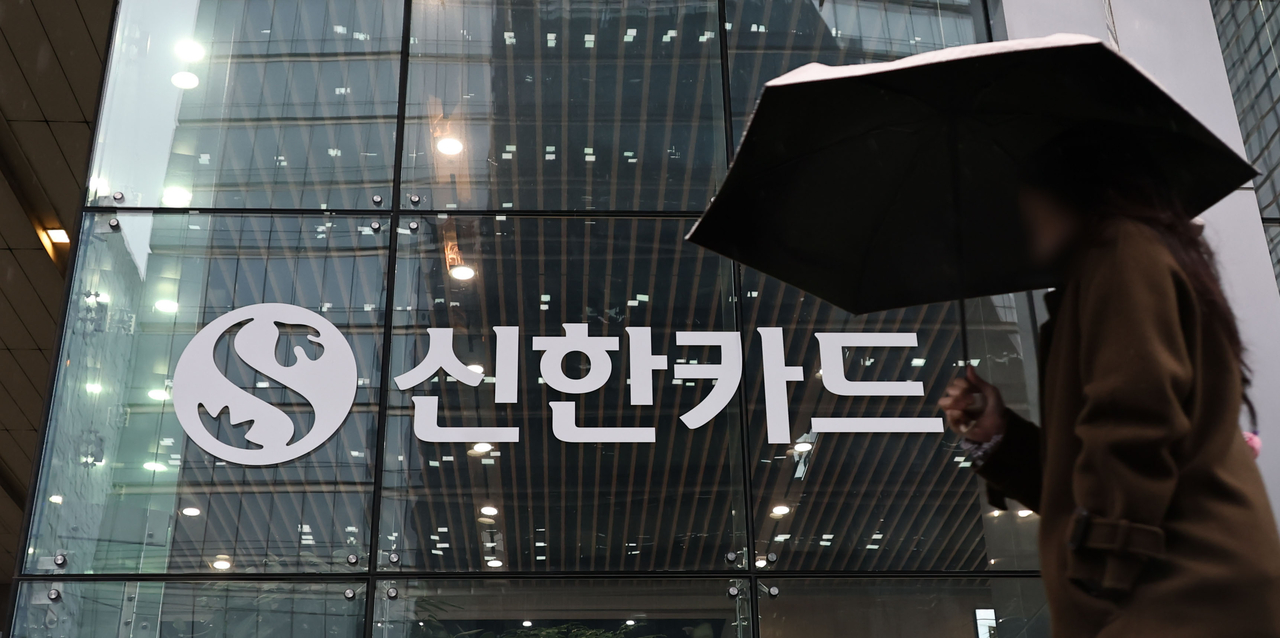
Wi Seong-ho, the former chief executive of Shinhan Card who was indicted on charges of involvement in preferential hiring of new employees, was acquitted on appeal after being found guilty at trial. Former Vice President Lee Gi-bong, who was tried alongside Wi, was also acquitted by the appeals court.
The Seoul Central District Court's Criminal Appeals Division 2-3, presided over by Judge Kim Yeong-hyeon, handed down not-guilty verdicts Wednesday to both Wi and Lee. The first trial had sentenced Wi to 10 months in prison with a two-year suspended sentence and Lee to six months with a two-year suspended sentence. The appeals court reversed those rulings, saying it had reconsidered the case because "the grounds for the first-trial ruling appeared insufficient."
"Taking Shinhan Card's hiring procedures into account as a whole, it is difficult to conclude that the evidence submitted by prosecutors alone proves beyond reasonable doubt that the defendants passed individual applicants without consultation or posed a risk of undermining the fairness of the hiring process," the appeals court said.
The court elaborated, saying that while document screening had been conducted improperly and the process had advanced to the next stage regardless, "the possibility cannot be ruled out that each applicant's qualifications were further verified in subsequent stages" and that they "could have passed regardless of the defendants' actions."
The court added that "even at the interview stage, evaluations by working-level staff were compiled by job category to determine whether to advance candidates," and that "the mere fact that first- and second-priority rankings differed cannot be taken as evidence that passing a given screening round was improper."
The court further said that "viewing it as unlawful solely because the final decision-maker instructed that some applicants be additionally passed after considering their backgrounds would amount to negating the final outcome of the hiring process," and announced it had accepted the defendants' appeals on those grounds.
Wi and others were accused of receiving requests from executives at affiliates during Shinhan Card's new employee recruitment in 2016 and 2017 and granting preferential treatment to eight applicants. Wi was suspected of passing a list of recommended candidates through Lee to the hiring manager and having them cleared through the document screening stage despite falling short of the required standards.
The first trial, held in August 2025, sentenced Wi to 10 months in prison with a two-year suspended sentence and Lee to six months with a two-year suspended sentence.
At the time, the court said it had determined that "some applicants passed the screening not through normal hiring procedures but based on Wi's personal decision-making," adding that the conduct "undermined the fairness and integrity of the hiring process and caused a sense of relative deprivation among many people."
The first-trial court found that four of the eight applicants had in fact received improper preferential treatment. It acquitted Wi on charges related to the remaining four, saying it could not rule out the possibility that they would have passed regardless of his involvement.
The case originated after the Financial Supervisory Service detected signs of preferential hiring at Shinhan Bank, Shinhan Card and Shinhan Capital and referred the matter to prosecutors in May 2018.
In the course of that investigation, Shinhan Financial Chairman Cho Yong-byung was also indicted on charges of improperly intervening in Shinhan Bank's new employee hiring. Cho was found guilty at the first trial but acquitted on appeal, and the Supreme Court issued a final not-guilty ruling in 2022.
notstrong@heraldcorp.com