A 6-million-year-old pygmy sperm whale skull unearthed in Peru
Both nasal passages shifted to the left
Its name means 'tacky' or 'outlandish'
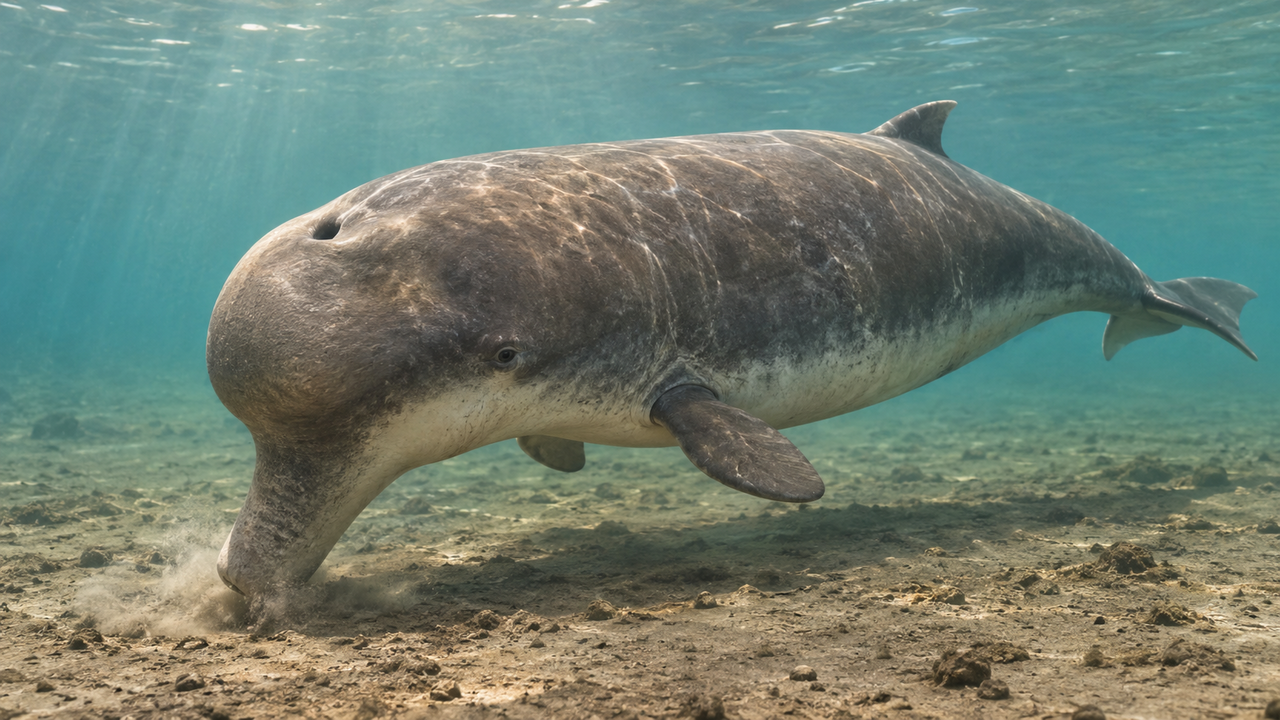
A 6-million-year-old whale fossil with both nasal passages shifted entirely to the left side of its head — making it the most asymmetrical-faced whale ever identified — has been confirmed from specimens found in Peru.
Toothed whales naturally have asymmetrical skulls. A fatty organ in the forehead, used to produce and receive sound for echolocation, grows to one side, pulling the surrounding bones with it. Sperm whales and their relatives the pygmy sperm whales rank among the most extreme examples of this asymmetry.
A research team led by Professor Aldo Benites-Palomino of the University of Zurich and the University of Erlangen-Nuremberg published findings in volume 9 of the international journal Communications Biology, formally registering an extinct pygmy sperm whale skull found in Peru as a new species.
A name that means 'tacky'
The fossil was recovered in the mid-1990s from the Sacaco Basin in the Arequipa region of southern Peru. The exposed rock layers of this desert site are known for yielding exceptionally well-preserved marine fossils. The strata in which the fossil was buried formed in a shallow sea between 6.3 million and 5.6 million years ago. Based on the skull, the animal is estimated to have been about 2.7 meters long.
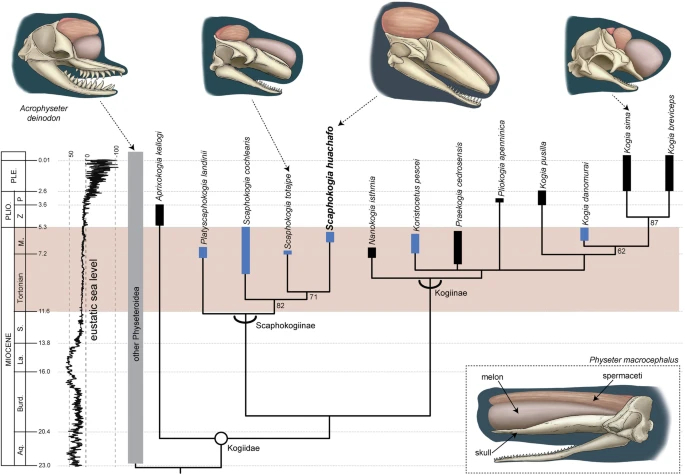
The research team named the 6-million-year-old whale Scaphokogia huachapo. "Huachapo" is a Peruvian Spanish word for something loud, tacky, bizarre or outlandish.
Benites-Palomino said through the University of Zurich that in Peru, "huachapo is commonly used for something so over-the-top, excessive and strange that it defies easy description," adding that "this whale had a face that was dramatically skewed to the left, with a snout that was oversized and curved downward — completely unlike the balanced appearance of whales today."
Both nostrils on the left
A whale's nostrils connect to the blowhole at the top of its head. In huachapo, both bony nasal passages cross the midline of the skull and sit to the left. The left nostril is considerably larger than the right, and the facial bones surrounding the nasal passages differ markedly in size and position on each side.
Benites-Palomino said that while toothed whales are typically asymmetrical only around the blowhole area, "this whale was something else entirely — the entire skull was twisted."
When the fossil was first discovered, the team suspected the distortion might have been caused by millions of years of compression underground. However, all the sutures between the skull bones were fully closed, indicating the animal was fully grown, and there were no signs of fractures or disease-related deformation. Benites-Palomino said the asymmetry "was its actual appearance, not an artifact of preservation."
The team took 3D measurements of the skulls of 31 toothed whale species for comparison. The Scaphokogia group, to which huachapo belongs, showed the greatest facial asymmetry of any whale examined.
The research team said it may represent the most extreme cranial asymmetry recorded in any mammal.
A whale that could bow its head
Modern sperm whales feed by suction in the deep ocean, targeting squid. The research team believes huachapo, by contrast, foraged along the seafloor in shallow water.
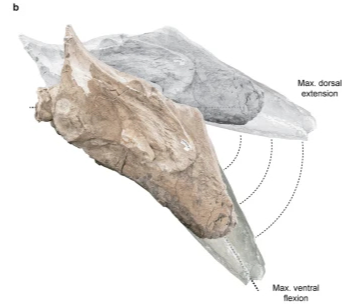
According to the team, the whale's snout was a thick, tube-like structure packed with dense bone and calcified cartilage. This heavy snout acted like a counterweight, shifting the animal's center of gravity forward and downward, and angled 31 degrees below the head.
Reconstructing the neck joint from the first cervical vertebra preserved in another fossil from the same group, the team found the animal could tilt its head downward by up to 55 degrees. The upper jaw had eight tooth sockets, but they were filled with spongy bone, suggesting the teeth may have fallen out as the animal matured.
Co-author Gabriel Aguirre-Fernández, a researcher at the University of Zurich, said "the entire head and neck were adapted to point the snout directly at the seafloor," and that "the heavy bones, the downward-curved snout and the flexible neck would have allowed it to swim just above the bottom and search for prey close to the sediment."
The research team said no living toothed whale appears to share a similar lifestyle, suggesting huachapo occupied an ecological niche that has since disappeared.
However, the species was registered on the basis of a single skull fossil, and the interpretation that it fed on the seafloor is inferred from bone structure alone. The fatty forehead organ used for echolocation does not preserve as a fossil, so its actual size and shape remain unknown.
Reference
DOI: 10.1038/s42003-026-11074-2
A. Benites-Palomino, M.R. Sánchez-Villagra, F. Paolucci, J. Vélez-Juarbe, A. Collareta, A. Alfsen, A. Dooley, D. Omura, M. Urbina, R. Salas-Gismondi, & G. Aguirre-Fernández, Extreme cranial asymmetry in extinct benthic feeding sperm whales, Commun. Biol. 9 (2026) 1406.
dbsdn1110@heraldcorp.com