19 millionth vehicle rolls off line at Xian factory in China's Shaanxi Province
Fang Cheng Bao's flagship SUV 'Tai 9' marks the milestone
Overseas sales reach about 1.5 million units this year, up 92% on-year
Premium brand sales also rise 75%
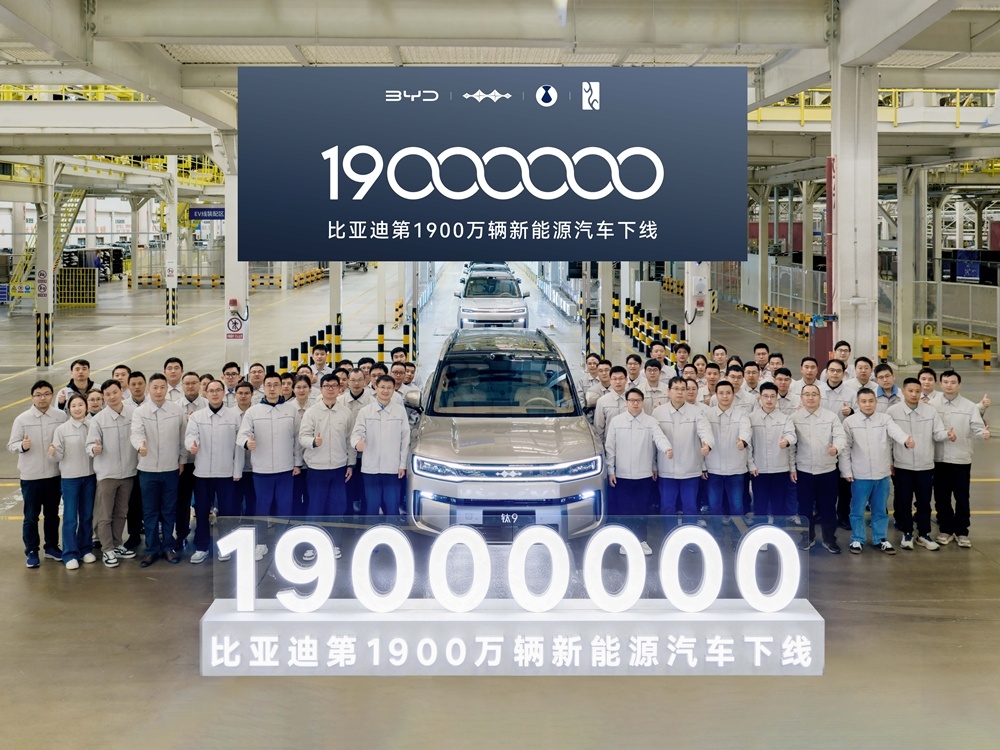
Chinese automaker BYD has surpassed 19 million cumulative new-energy vehicle units produced, adding 2 million units in roughly four months since reaching the 17 million mark in July. The company is broadening its growth base through overseas sales expansion and premium brand development amid intensifying competition in China's domestic market.
BYD announced Wednesday that it held a ceremony at its factory in Xian, Shaanxi Province, to mark the milestone.
The 19 millionth vehicle off the line was the Tai 9, a flagship SUV from BYD's premium brand Fang Cheng Bao. The Tai 9 is a six-seat plug-in hybrid electric vehicle set to launch in the Chinese market this month.
BYD produced its first new-energy vehicle in 2008 and reached a cumulative 1 million units in May 2021. It then crossed 10 million units in November 2024, surpassed 15 million in December last year, and hit 17 million in July this year.
The pace of the latest stretch was particularly notable: BYD took just 124 days to go from 17 million to 19 million units, reflecting the rapid scaling of electric vehicle and PHEV production across China and global markets.
Overseas markets have been the primary driver of recent growth.
BYD's total vehicle sales from January through October reached about 3.62 million units. Overseas passenger car and pickup truck sales accounted for about 1.5 million of that total, up 92 percent from the same period last year.
In the third quarter, overseas sales accounted for 41.6 percent of total sales, up 25.9 percentage points from the same period a year earlier.
However, the company continues to face pressure in China's domestic market from intensifying competition. Total vehicle sales from January through October fell about 2.2 percent from the same period last year.
With domestic sales sluggish, overseas markets are effectively cushioning the overall sales decline.
BYD is also expanding in the premium segment. Combined sales of its three premium brands — Fang Cheng Bao, Denza and Yangwang — reached about 410,000 units in the first three quarters of this year, up 75 percent year-on-year, accounting for more than 13 percent of total sales.
Fang Cheng Bao alone sold 126,000 units in the third quarter, up 32.6 percent from the previous quarter, and represented about 70 percent of combined premium brand sales during the period, leading growth in the luxury segment.
Investment in technology development continues as well.
BYD spent 36.3 billion yuan ($5.45 billion) on research and development in the first three quarters of this year. Cumulative R&D investment since the company's founding has exceeded 280 billion yuan.
In March, BYD unveiled its second-generation Blade Battery and flash-charging technology, focusing on improving battery safety and charging performance while expanding fast-charging infrastructure.
The company has built more than 10,000 flash-charging stations in China and is rolling out the technology and charging infrastructure in overseas markets including the United Kingdom, Italy, Hong Kong, Indonesia and Brazil.
BYD is also pursuing vehicle intelligence. In May, it unveiled an AI-based "BYD Super Agent" system and announced a one-year safety guarantee policy covering urban driving-assistance features.
BYD describes its technology development strategy through the concept of a "technology ocean."
The concept, championed by BYD Chairman Wang Chuanfu, involves developing and accumulating a broad range of technologies in advance, then applying them to mass-production vehicles as market demand dictates. The Blade Battery, the DM-i hybrid system and the DiSus chassis-control technology are among the most prominent examples.
BYD plans to continue advancing its battery, electrification and intelligent driving technologies while expanding overseas production bases and sales networks, with a focus on reducing reliance on China's domestic market and strengthening its competitiveness in the global automotive industry.
kwater@heraldcorp.com