Company joins Ministry of Trade, Industry and Energy's AI factory support project to expand physical AI in manufacturing
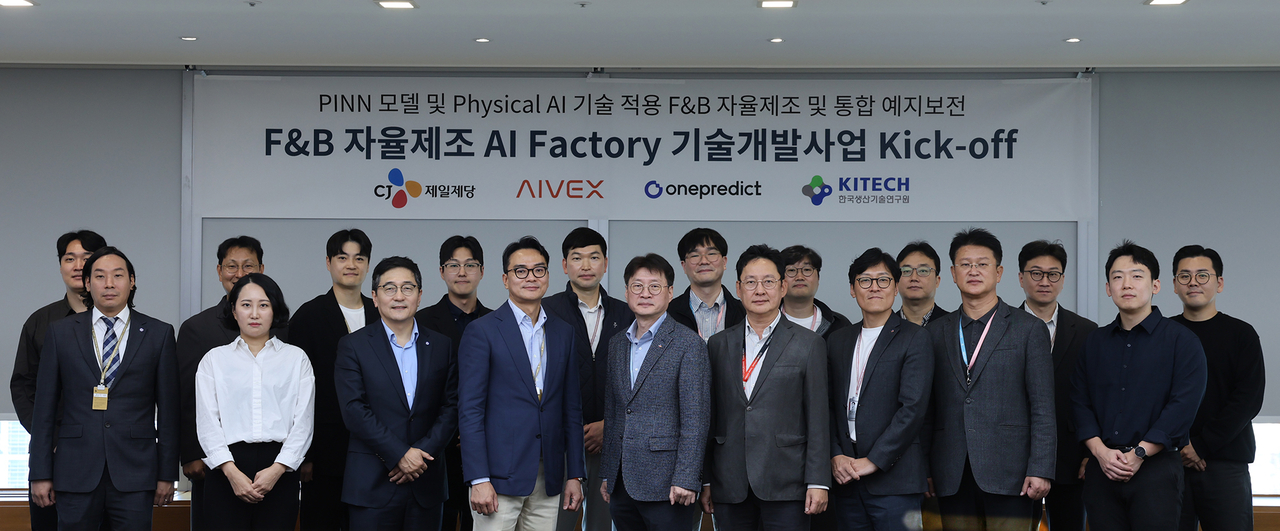
CJ CheilJedang announced Wednesday that it will join the Ministry of Trade, Industry and Energy's AI Factory Support Project as the representative company from the food sector. The company plans to develop physical AI-based autonomous manufacturing technology tailored to the food and beverage industry and deploy it on production floors.
CJ CheilJedang will pursue the project — formally titled "Development of F&B Autonomous Manufacturing and Integrated Predictive Maintenance Technology Using PINN Models and Physical AI" — together with One Predict, Ibex and the Korea Institute of Industrial Technology. Building on its existing digital transformation foundation of smart factory and production automation systems, the initiative aims to establish a manufacturing framework in which AI predicts and controls equipment and processes.
The first step involves connecting and analyzing data from different pieces of equipment in real time to build an AI-ready data foundation suitable for AI training. That foundation will then support the application of physics-informed neural networks, or PINN, which analyze process characteristics alongside sensor data to predict optimal operating conditions and autonomously control production processes.
Quality management will combine machine vision, robotics and edge AI to detect defects — including foreign objects, damage and packaging failures — in real time and link those detections to equipment controls. AI will also be applied to equipment management to identify early signs of malfunction and reduce unexpected shutdowns.
Worker safety is another key application area. AI-enabled CCTV will monitor for worker falls and unauthorized entry into hazardous zones in real time, automatically slowing or stopping production equipment when a risk is detected. The company said the system is designed to strengthen its ability to prevent serious industrial accidents on food manufacturing floors.
Central to the effort is CJ CheilJedang's goal of building a physical AI system in which the full cycle of perception, prediction, judgment and control operates seamlessly on the factory floor. The structure has AI continuously reading equipment and process data, forecasting the state of processes, quality and equipment, determining optimal production conditions, and then executing direct control of actual machinery.
"In food manufacturing, raw material characteristics and changes in the production environment directly affect product quality, which makes AI technology that understands both on-site data and process characteristics essential," said Kang Min-su, executive vice president overseeing production at CJ CheilJedang. "We will secure physical AI technology optimized for F&B manufacturing floors to strengthen our competitiveness in productivity, quality and safety, and contribute to enhancing the global competitiveness of K-food."
andy@heraldcorp.com