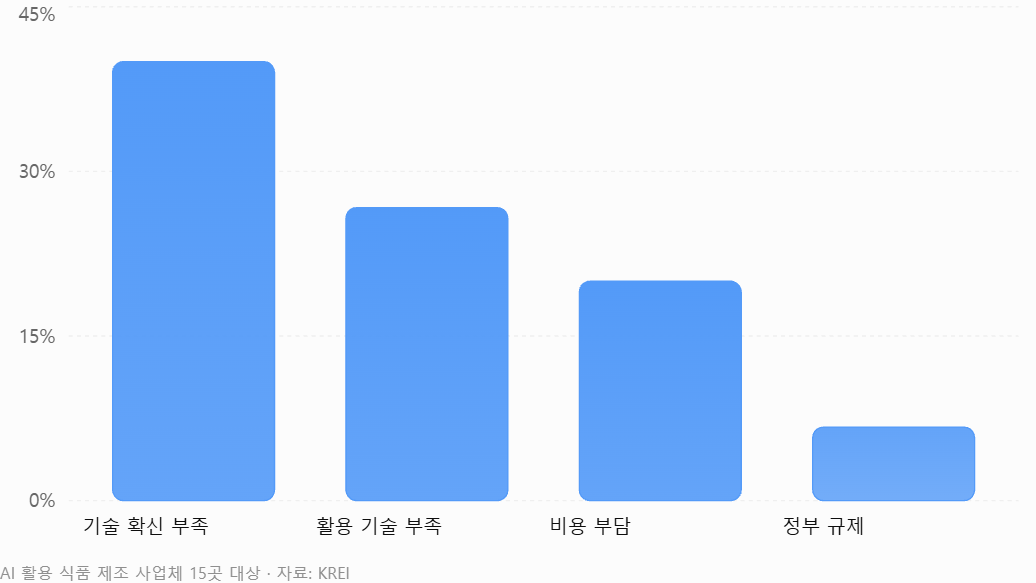
Lack of confidence in AI cited by 40% of adopters, outpacing cost concerns at 20%
Government support programs hampered by complex procedures and delayed agreements

The biggest barrier food manufacturers face when adopting AI is not cost but uncertainty about the technology itself, a new report has found. Complex administrative procedures and delays in finalizing government support agreements were also identified as factors holding back AI adoption in the sector.
According to a report released Wednesday by the Korea Rural Economic Institute titled "AI Adoption in the Food and Beverage Manufacturing Sector: Current Status and Challenges," 40 percent of the 15 food manufacturers already using AI cited a lack of confidence in the technology as the primary obstacle. Insufficient in-house expertise in adopting and applying AI was cited by 26.7 percent, excessive costs by 20 percent, and government regulation by 6.7 percent.
The analysis drew on raw data from the Korea Labor Institute's Workplace Panel Survey, examining responses from 15 of 115 food and beverage manufacturers surveyed in 2023 that had adopted AI. Given the limited sample size, the findings cannot be generalized to the broader food manufacturing industry.
On the factory floor, the report found that many companies lack even the basic infrastructure needed to apply AI. Some small and medium-sized enterprises had production equipment with no connectivity, or were still recording production data by hand. Even where data existed, it was often scattered across multiple systems or had not accumulated to a level sufficient for AI analysis.
The way government support programs are run also drew criticism. In-depth interviews with three companies that had supplied AI solutions in the agriculture and food sector revealed that complex administrative procedures and delays in signing formal agreements were constraining project progress.
In some programs, a significant amount of time passed between the start of actual work and the signing of agreements, making it difficult for participating companies and their partners to execute contracts or disburse project funds on schedule. Both demand-side and supply-side companies also reported difficulties finding technology providers with the right AI capabilities.
The researchers recommended that, rather than providing blanket support for equipment and technology, the government should first assess each company's production processes and data readiness before offering assistance.
They particularly emphasized the need for a phased approach — starting with proof-of-concept trials on select production lines to verify reductions in defect rates, productivity gains, and return on investment before expanding AI to other processes.
"We need to build a support framework for AI adoption that is tailored to the factory floor and takes into account each company's production processes and data conditions," said Park Si-hyeon, an associate research fellow at KREI.
adastra@heraldcorp.com