Women's Enterprise Support Center holds femtech conference in Daejeon
About 180 industry, medical and investment experts attend
Global market forecast to grow 18.37% annually through 2034
Women's health draws only 6% of private healthcare investment
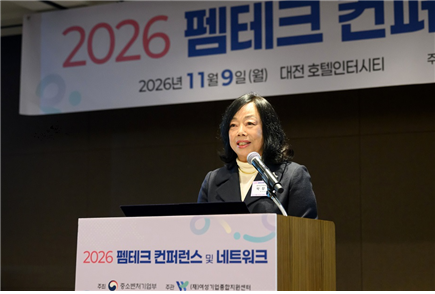
The global femtech market — which applies advanced technology to women's health management and disease diagnosis — is projected to reach $41.1 billion by 2034, prompting calls for stronger support to boost the competitiveness of South Korea's femtech industry and attract greater investment.
The Women's Enterprise Support Center held the 2026 Femtech Conference and Network on Monday at Hotel Intercity in Daejeon, drawing about 180 participants from femtech companies and the industry, medical and investment sectors.
The event was organized as part of the Ministry of SMEs and Startups' femtech industry development project. Its aim was to assess the current state of the domestic femtech sector and explore ways to support companies across the full growth cycle — from technology development and proof-of-concept to investment and overseas market entry.
Lee Seung-hyun, a research fellow at the Korean Women's Development Institute, delivered a keynote projecting that the global femtech market would grow from about $10.7 billion this year to approximately $41.1 billion by 2034, at a compound annual growth rate of 18.37 percent.
Despite that growth potential, women's health accounted for only about 6 percent of global private healthcare investment over the past five years, highlighting a relative shortfall in the investment base compared with the market's prospects.
Lee said femtech companies need coordinated, stage-by-stage support — covering proof-of-concept, regulatory approval, investment attraction and market entry — to translate their technology development achievements into actual sales and business growth.
Femtech is a portmanteau of "female" and "technology," encompassing products and services designed to improve women's health and quality of life. Its applications are expanding from menstrual, pregnancy and childbirth health management to the diagnosis of women's diseases and digital healthcare. A growing range of business models are emerging that combine medical technology with AI and biotech.
A panel discussion followed, moderated by Kim Young-ju, a professor at Ewha Medical Center, with Lee, Hong Young-jin of Hanwha General Insurance, Kim Hyo-i, chief executive of Innersia, and Choi Hyun-soon of CNT Tech taking part. Participants discussed policy support and cooperation strategies to help femtech companies commercialize their technologies, attract investment and expand their market reach.
Kim Jun-gil, head of the statistical research team at the Women's Economic Research Institute, presented findings from the 2026 Femtech Industry Survey, sharing an overview of the domestic sector.
Several companies also showcased their technology development and commercialization efforts. CoreMotion presented a customized pelvic floor rehabilitation algorithm and device, while Reactree introduced an AI platform for the early diagnosis of autism spectrum disorder and developmental delays in children. Choice unveiled a feminine hygiene product with a self-diagnosis function for vaginitis, and Boreum Bio presented a self-diagnosis kit for vaginitis based on repeated measurements along with a quantitative analysis device.
The event also included an awards ceremony for the 2026 Outstanding Resident Company Competition, open to businesses housed in the center's women's startup incubation facilities.
Stylemate, which operates an AI-based influencer matching platform, took the grand prize, while Crazy Azit won the top excellence award. Kift Company and Wellbeto Bio received excellence awards, and Broccos, BIC Korea and Airuon earned merit awards.
The Women's Enterprise Support Center currently operates 230 women's startup incubation units across 18 regional centers nationwide, supporting women-led ventures from discovery through incubation to growth.
"What matters now, as the global market grows rapidly, is that our companies turn these changes into real competitive strength," said Park Chang-suk, chairperson of the Women's Enterprise Support Center. "To that end, we will work to broaden cooperation across the medical, research and investment sectors and ensure that outstanding technologies and ideas translate into business results."
boo@heraldcorp.com