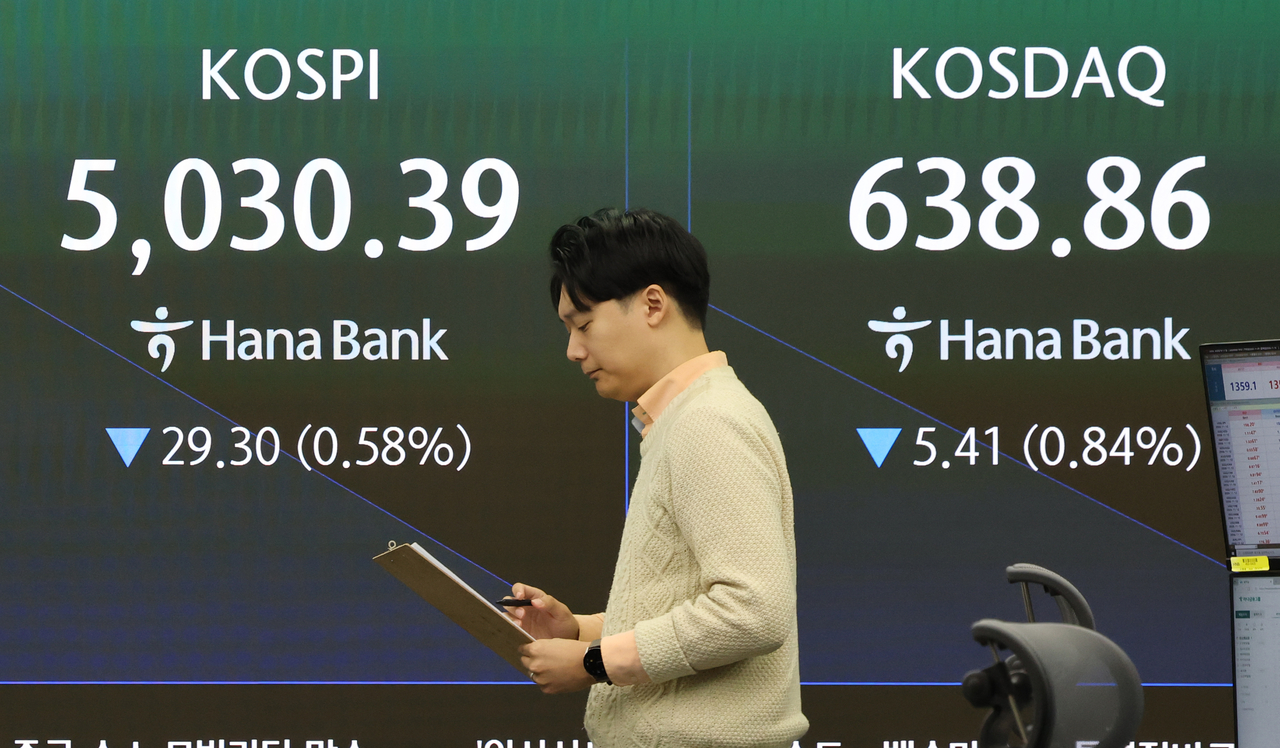
The Kospi tumbled below 5,000 during intraday trading in the wake of the Democratic Party's sweeping victory in US midterm elections, and a "bottom" thesis is emerging in the brokerage community. Research centers have issued emergency assessments saying that while fears of a pullback in AI investment have spread to concerns about slowing chipmaker earnings and triggered panic selling, the recent share price declines have already priced in much of that risk — limiting the scope for further losses. Analysts caution, however, that with AI investment uncertainty unresolved, a conservative approach is preferable to aggressive buying in anticipation of a sustained rebound.
The Kospi closed Friday at 5,059.69, down 324.11 points, or 6.02 percent, from the previous session. During trading it fell as low as 4,911.28, surrendering the 5,000 level, and the two-day decline exceeded 11 percent. Samsung Electronics and SK hynix shares tumbled roughly 13 percent and 18 percent, respectively, over the same two sessions. Foreign investors net sold 7.6 trillion won ($5.6 billion) worth of the two stocks last week, driving selling pressure that pushed one in three listed companies to their lowest levels of the year. The net assets of domestic exchange-traded funds also fell below 400 trillion won.
Major domestic brokerage research heads said Monday that despite the recent Kospi plunge, the medium-to-long-term growth trajectory of the AI industry and the earnings improvement trend at chipmakers remain intact. They noted, however, that data center regulation concerns that surfaced after the midterm elections — and the risk of slowing semiconductor demand — could widen index volatility over the medium to long term, and suggested investors may need to shift attention toward sectors such as secondary batteries and healthcare that stand to benefit from US policy.
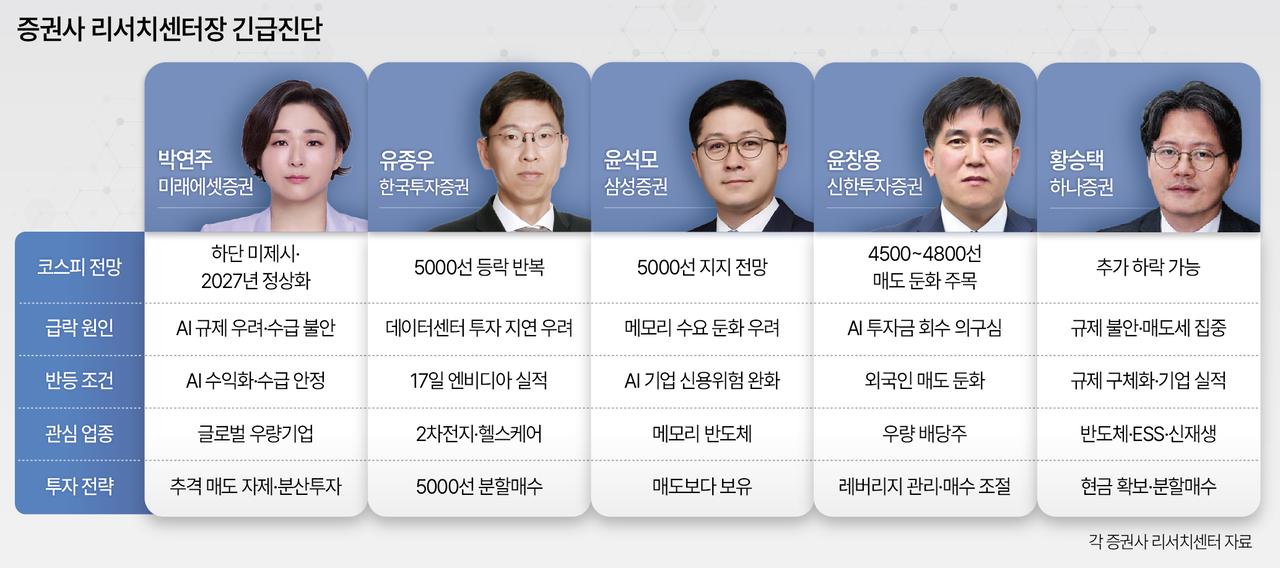
A majority of analysts also said investors should keep open the possibility of further Kospi declines. The short-term support levels cited by domestic research heads ranged from 4,500 to 5,000. The key pivot for any rebound, they said, will be Nvidia's earnings and whether big tech companies maintain their AI investment commitments. If Nvidia's results and investment guidance restore market confidence in AI chip demand and calm foreign selling, a rebound becomes possible — but if data center construction delays and financing burdens materialize into actual cuts in capital expenditure, further correction would be unavoidable.
AI sentiment buckles on bad news, shrugs off good — 'market pricing in excessive fear'
Park Yeon-ju, head of research at Mirae Asset Securities, characterized the recent Kospi decline as an "excessive correction." Park said chipmakers' earnings power remains solid and that the Kospi, already undervalued relative to fundamentals, has entered an "undershoot" phase in which short-term supply-demand shocks are driving share prices down beyond what earnings justify.
Yang Ji-hwan, head of research at Daishin Securities, also said the market is reacting with a negative bias. Yang said the market is pricing in only the risks from data center construction delays while failing to adequately reflect positive developments such as falling oil prices and interest rates and lower financing costs for big tech. Yang added weight to a scenario in which the pace of AI investment slows rather than the total volume shrinking sharply, given the ongoing AI rivalry between the United States and China.
Lee Byung-geon, head of research at DB Securities, said the plunge reflects a recalibration of the speed and beneficiary structure of AI investment rather than the end of the AI industry's growth. Lee noted that the domestic stock market is relatively vulnerable to deteriorating AI sentiment because of its high concentration of companies in the AI infrastructure supply chain — semiconductors, materials, components, equipment and power devices.
Yoo Jong-woo, head of research at Korea Investment Securities, said regulatory concerns have yet to translate into concrete policy. Yoo said investor sentiment has been dampened by remarks from election winners even though no specific AI data center regulations or legislation have emerged, and said it is difficult to conclude that the medium-to-long-term growth prospects of AI infrastructure-related companies — including semiconductor and multilayer ceramic capacitor makers — have been impaired.
Yoon Seok-mo, head of research at Samsung Securities, said that even if memory chip demand slows, a correction beginning before a full-scale supply expansion would limit the downside. Yoon added that even if US data center regulations tighten, facilities already permitted and under construction for 2027 would face only limited impact, with the full effect more likely to be felt from 2028 onward.
Kospi seen fluctuating around 4,500–5,000; further losses seen as limited
The lowest short-term support level cited by research heads is 4,500. That implies the Kospi could fall further from its current level — Monday's opening price was 5,034.20.
Yoon Seok-mo put the short-term support at 5,000, while Yoo Jong-woo of Korea Investment Securities forecast the Kospi would oscillate around that level for now. Lee Byung-geon of DB Securities expected high volatility to persist in the 4,800–5,500 range in the near term. Yoon Chang-yong, head of research at Shinhan Securities, said foreign selling could ease in the 4,500–4,800 range.
Analysts also raised the possibility that foreign selling could stabilize as valuation burdens ease following the recent price declines. The view is that supply-demand conditions could stabilize at current levels as long as corporate earnings forecasts are not revised down sharply or global capital flows do not fracture. Yoon Chang-yong said that in past downturns, foreign selling has weakened when the Kospi's 12-month forward price-to-book ratio entered the 0.85–0.90 times range, and noted that the ratio approached that level during Friday's intraday session, making it worth monitoring foreign investor flows.
Sustainability of rebound hinges on Nvidia earnings, data center investment
The prevailing view is that a sustained market rebound requires evidence that AI investment will continue. Nvidia's earnings, big tech financing conditions and whether data center construction delays materialize are seen as the key variables determining whether investor sentiment recovers.
Yang said AI investment volume is unlikely to change dramatically given the continuing US-China AI rivalry, with only the pace of investment expected to moderate. Under that scenario, Yang said the recent decline in the domestic market is excessive.
Yoo said investors should watch Nvidia's earnings release on Nov. 17 and any changes to its guidance, adding that with no specific regulations or legislation yet in place and sentiment dampened only by remarks from election winners, it is hard to conclude that the medium-to-long-term growth prospects of AI infrastructure companies — including semiconductor and multilayer ceramic capacitor makers — have been damaged.
Hwang Seung-taek, head of research at Hana Securities, said investors need to monitor data center permitting and construction delays as well as big tech financing conditions. Hwang also said institutional demand and the offering price for Anthropic's initial public offering, along with the earnings of CoreWeave and Nebius, would serve as indicators of AI investment sustainability.
Lee said the plunge reflects a recalibration of the pace and beneficiary structure of AI investment rather than the end of the industry's growth, and said investors need to confirm whether data center regulation and financing uncertainty eases, whether CoreWeave and Nvidia earnings meet market expectations, and whether US government bond yields stabilize.
Build cash reserves rather than rush to buy the dip; policy beneficiaries such as secondary batteries and healthcare in focus
On investment strategy, analysts advised against both hasty selling and aggressive bottom-fishing. The consensus is to maintain cash reserves and invest selectively rather than trying to call the bottom during a period of heightened short-term volatility. Lee Byung-geon advised retail investors not to sell out of panic or prematurely declare a bottom and buy the dip, recommending diversified investment in quality companies from a medium-to-long-term perspective and urging investors to avoid leveraged positions. Yoon Chang-yong also said that at this stage, managing leverage and liquidity risk and pacing new purchases should take priority over aggressively adding to equity positions on valuation grounds alone.
Analysts also recommended focusing on US policy beneficiaries rather than AI-related stocks, given the need to be selective within the AI sector. Yoo recommended looking for opportunities in secondary battery and healthcare stocks that stand to benefit from US policy rather than AI-related names, and said investors taking an index approach could consider a phased buying strategy around the 5,000 level. Hwang advised building cash reserves and responding with phased purchases while maintaining a medium-to-long-term interest in memory chips, but said investors should pay attention in the near term to renewable energy stocks expected to benefit from clean energy policies — including secondary batteries, energy storage systems and solar.

kacew@heraldcorp.com