Survey of 100-person citizen panel finds strongest support for hazard pay; 89% back public parental-leave substitute worker pool; final deliberation set for Dec. 8
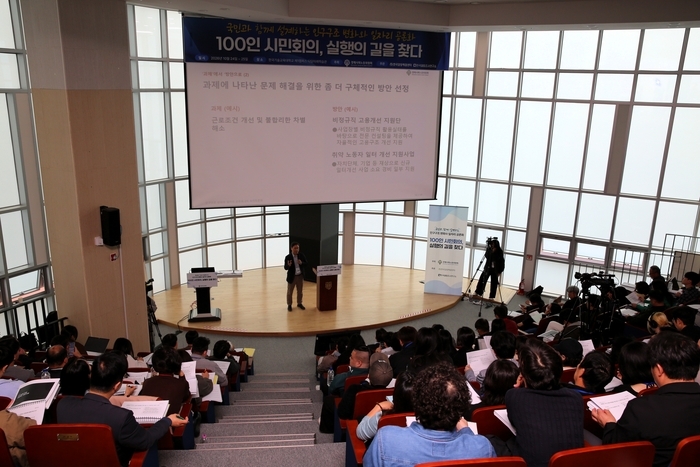
Citizens who gathered to discuss employment policy responses to South Korea's low birth rate and aging population showed the strongest support for boosting compensation for high-intensity and high-risk work. More than 90 percent of respondents also backed guaranteeing workers the right to disconnect from work communications after hours, as well as expanding flexible work arrangements tailored to each industry. To fill staffing gaps caused by parental leave, a public substitute worker pool drawing on retirees and career-interrupted workers drew broad support.
According to the Economic, Social and Labor Council (ESLC), the Special Committee on Demographic Change and Employment received a report Thursday on a draft "employment green paper" and the results of the 100-person citizens' assembly at its fourth plenary session.
The citizens' assembly was held Oct. 24-25 at Korea University of Technology and Education. Participants put forward a total of 64 action proposals — 33 in the category of "mutually beneficial jobs," promoting cooperation between younger and older workers, and 31 in the "lifelong employment" category, covering career continuity across all stages of life.
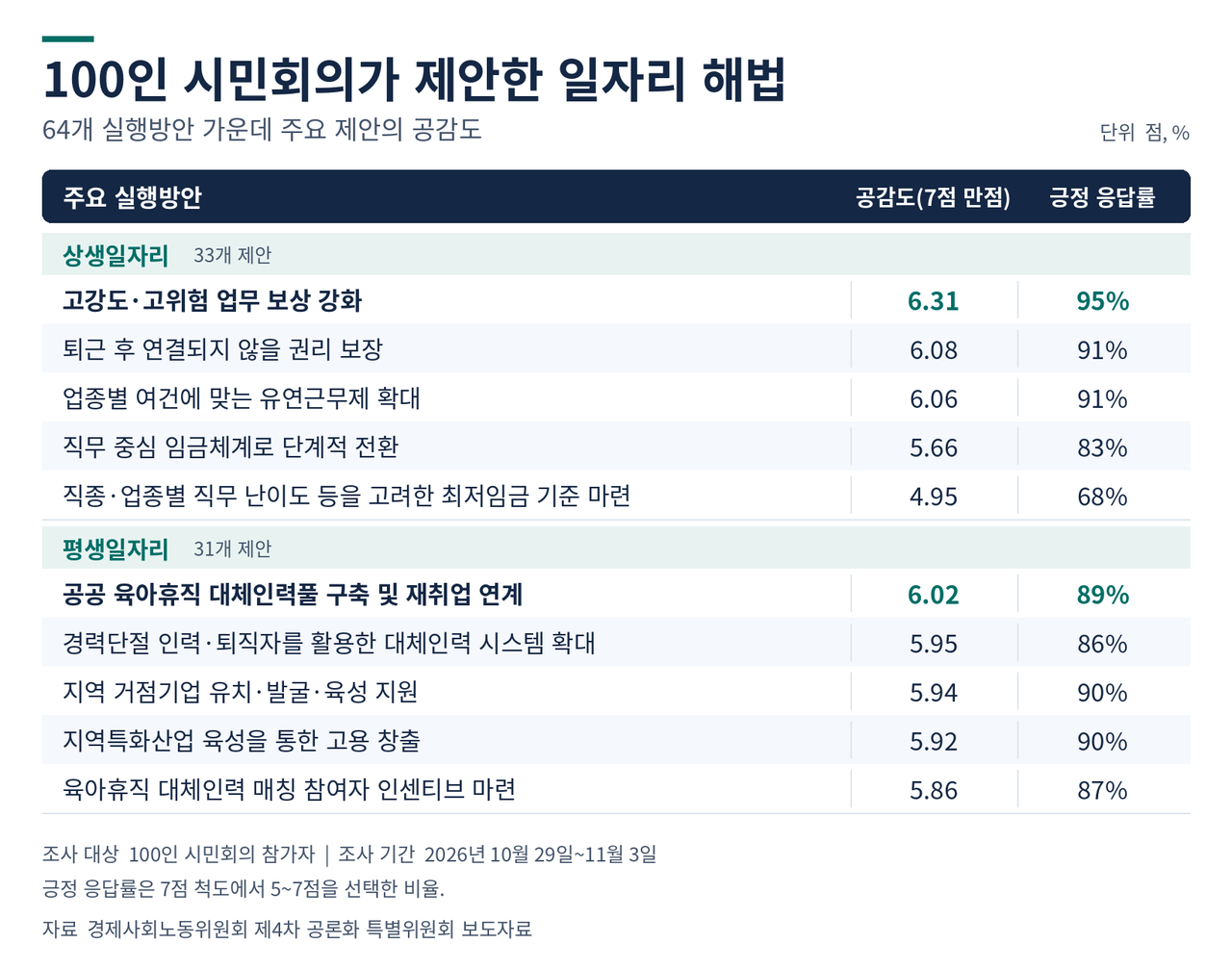
In a survey the ESLC conducted from Oct. 29 to Tuesday among the 100 assembly participants, stronger compensation for high-intensity and high-risk work scored 6.31 out of 7, the highest of all proposals, with 95 percent of respondents giving it a positive rating of 5 or above. Guaranteeing the right to disconnect after hours scored 6.08 points, and expanding flexible work arrangements suited to each industry's conditions scored 6.06 points; both drew 91 percent positive responses.
Among proposals to overhaul compensation structures, a gradual shift to a job-based pay system scored 5.66 points, with 83 percent in favor. A proposal to establish new minimum wage standards accounting for job difficulty by occupation and industry scored 4.95 points, with 68 percent in favor. Some 81 percent responded positively to a "1+1 collaborative job" model in which older workers pass on skilled expertise while helping younger colleagues adapt to the workplace.
In the lifelong employment category, the top-rated proposal — scoring 6.02 points with 89 percent support — called for creating a public substitute worker pool using retirees and career-interrupted workers to cover parental leave absences, while linking participants to re-employment opportunities. A proposal to activate worker matching by offering incentives to both employers and substitute workers scored 5.86 points, with 87 percent in favor. Among regional employment measures, 90 percent backed both government support for attracting and nurturing anchor companies in local areas and expanding region-specific industries to increase jobs.
The draft green paper presented to the committee summarized issues raised by citizens in earlier regional deliberations into six key challenges. The mutually beneficial jobs challenges cover redesigning job duties, working hours and compensation structures; intergenerational skills transfer and collaboration; and improving workplace communication and conflict resolution. The lifelong employment challenges address vocational education across life stages, expanding parental leave and flexible work, and creating quality jobs in regional areas.
The ESLC plans to hold a 30-person citizens' assembly Saturday to review the action proposals and draft a citizens' proposal document. A final public deliberation is scheduled for Dec. 8 at Sejong University's convention center, where the citizens' proposal will be finalized and submitted to the special committee.
fact0514@heraldcorp.com