About 250 representatives of agricultural corporations hoping to join the 2027 project attended a pre-training session.
The training covered successful cases, relevant laws and regulations, cropping systems and business plan development to strengthen corporate capacity.
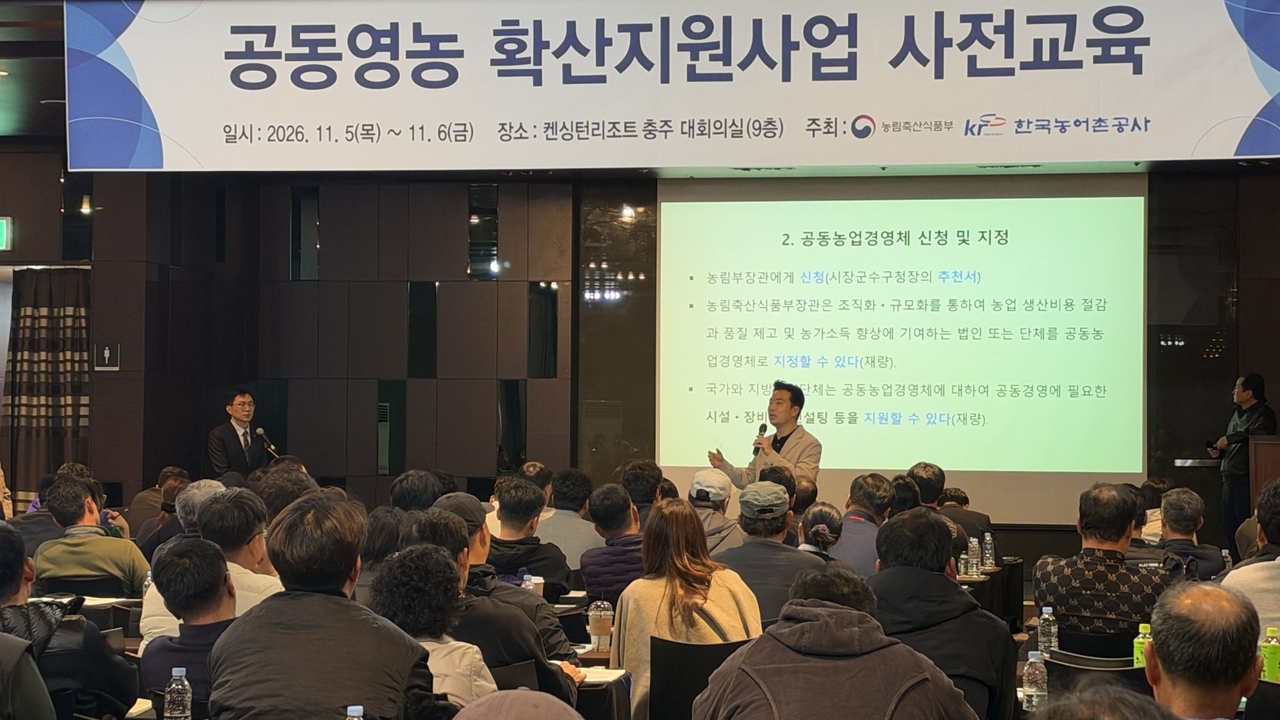
Korea Rural Community Corporation held a two-day pre-training session Thursday and Friday in Chungju, North Chungcheong Province, for about 250 representatives of agricultural corporations interested in joining the 2027 cooperative farming expansion support project.
Interest in cooperative farming has grown as rural areas face an aging population and a shrinking agricultural workforce. The model centers on corporations that jointly use and manage farmland, consolidating scattered plots to improve the scale and efficiency of mechanized farming. By coordinating operations from production through retail, participating entities can cut costs and raise farm income.
The Ministry of Agriculture, Food and Rural Affairs is running a pilot cooperative farming expansion support project to promote the model. Six agricultural corporations are taking part this year, and the ministry plans to designate 30 additional sites for the 2027 expansion.
Korea Rural Community Corporation organized the training to help corporations interested in joining the 2027 expansion prepare systematically for participation.
The session opened with presentations on successful cooperative farming cases. Hong Eui-sik, head of Neulbom Agricultural Cooperative Corporation, described how the model was implemented in the Yeongsun district of Mungyeong, North Gyeongsang Province, covering crop production results and income distribution among participating farm households. Hwang Jae-hyeon, a professor at Dongguk University, then drew on successful examples of collective farming in Japan to explain the roles that corporations and local governments should play in promoting cooperative farming.
The training also covered laws and regulations related to cooperative farming and the operation of agricultural corporations. Attorney Choi Jeong-un addressed the eligibility requirements for cooperative farming entities and relevant legal matters including farmland lease arrangements, while accountant Kim Tae-yong covered the establishment, operation and tax practices of agricultural corporations. Seok Tae-mun, a former professor at Daegu University, introduced high-income cropping systems using double-cropping and explained methods for calculating and distributing corporate earnings.
Additional sessions addressed government policy, the direction of the project and how to draft a business plan. Hong Seong-uk, a ministry official, outlined the 2027 project's direction, support criteria and upcoming application schedule. Yun Seok-hwan, a director at the Agricultural Policy Research Center, explained indicators for improving farm management and methods for assessing the appropriateness of facility and equipment investment, then led participants through exercises applying those methods to a business plan.
"It was helpful in understanding the concept of cooperative farming and the specific steps involved in preparing to join," one participating corporate representative said. "We will use what we learned to get ready for the project."
Korea Rural Community Corporation said it plans to provide training, tailored consulting and performance management for corporations that join the cooperative farming expansion support project, offering step-by-step support from preparation through operation to help the model take stable root on the ground.
"Cooperative farming improves the use efficiency of scattered farmland while pooling production and management capabilities," said Kim Yun, head of the corporation's Farmland Bank Division. "As the on-site support agency for the cooperative farming expansion support project, we will provide systematic support from preparation through operation and performance management to ensure cooperative farming spreads in a stable manner."
kkm9971@heraldcorp.com