Labor and management at six urban rail operators launch simultaneous campaigns in Seoul, Busan, Daegu and three other cities; annual free-ride losses nationwide reach 775.4 billion won; Seoul Metro faces full capital erosion by 2033 without additional investment; 73.6% of public say government should cover costs
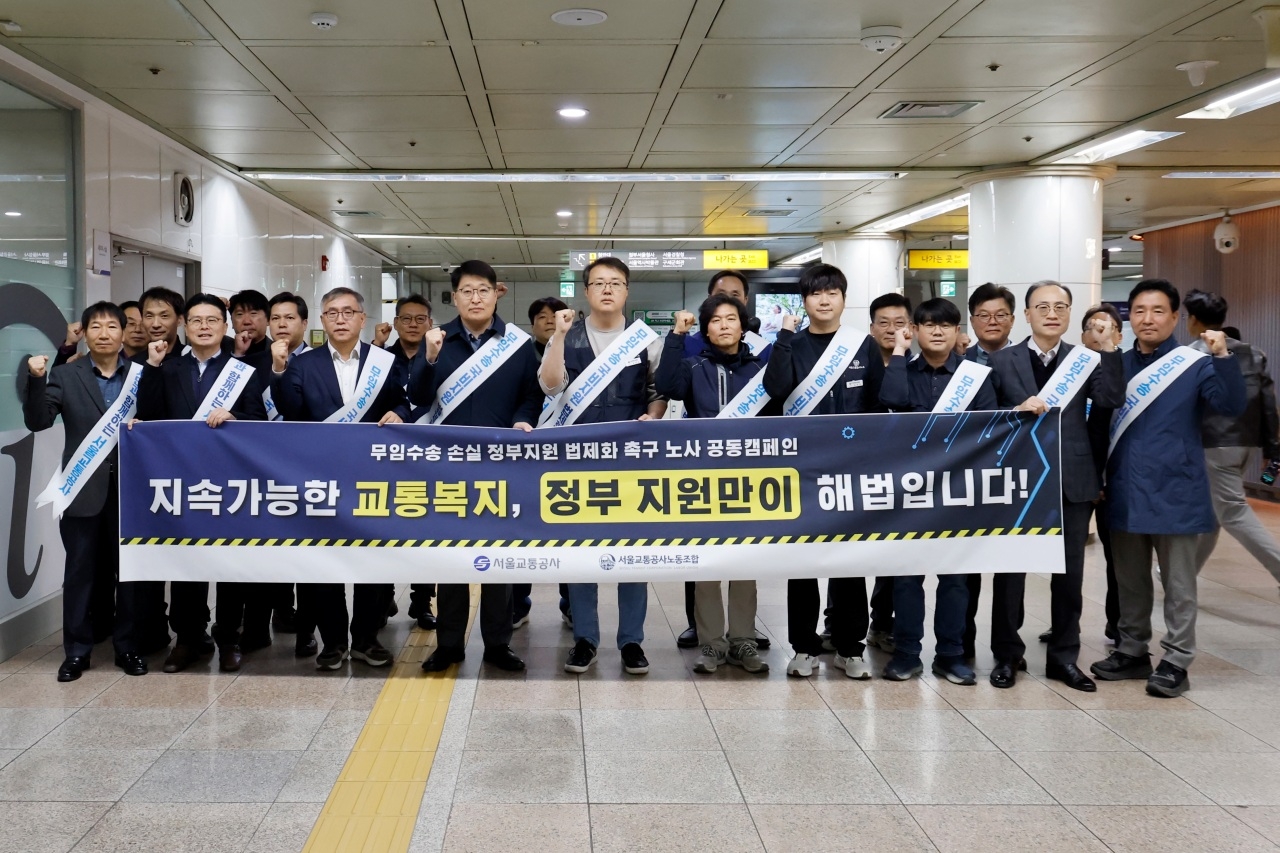
Seoul Metro's labor and management took to the morning commute Monday to urge the government to enshrine state funding for urban rail free-ride losses in law.
The joint action came even as the two sides remain at odds over wage and collective bargaining negotiations — a sign that the free-ride funding issue has forged rare common ground.
Seoul Metro and the Seoul Metro Labor Union held a public awareness campaign Monday morning at Gwanghwamun Station on subway Line 5, calling on the government to legislate national funding for free-ride losses.
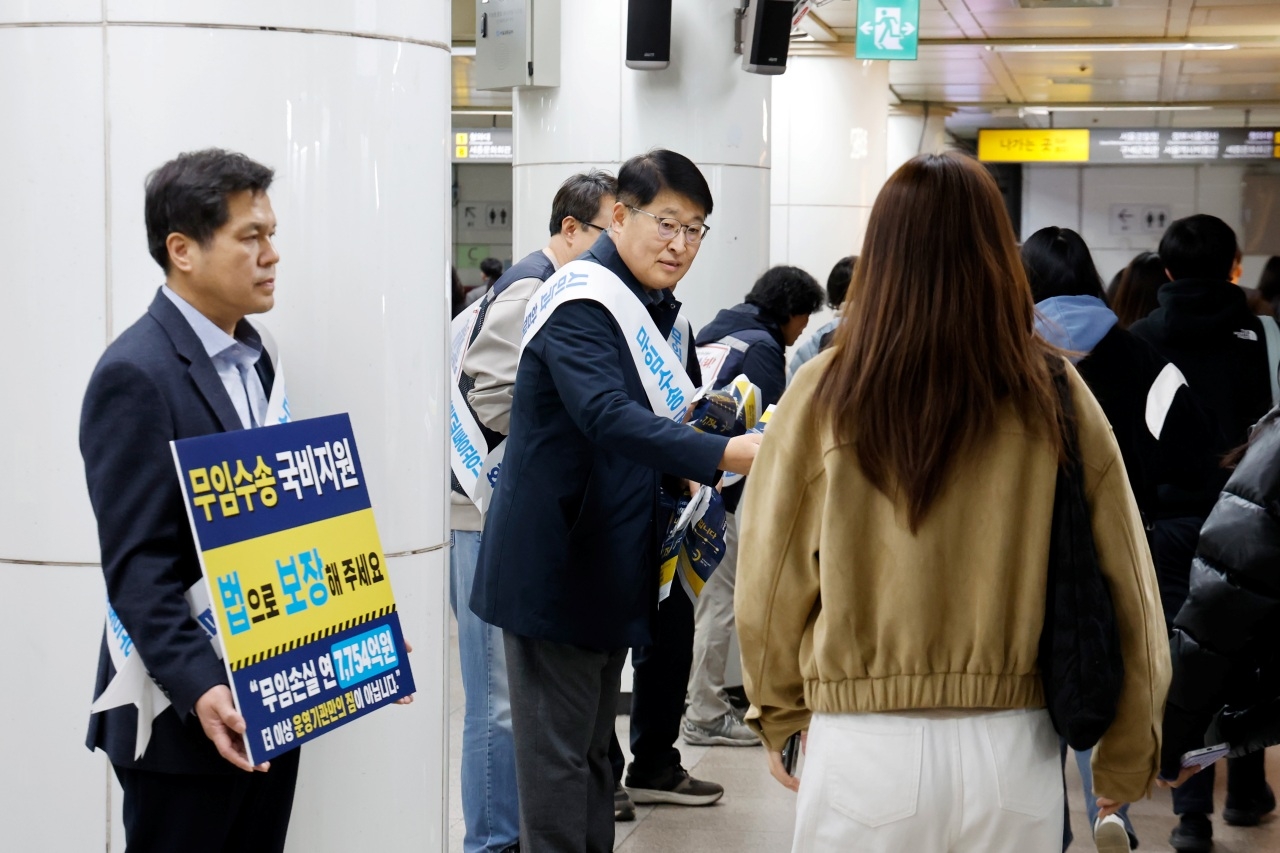
About 30 people took part, including Seoul Metro President Kim Tae-gyun and Seoul Metro Labor Union Chairman Kim Jeong-seop. Participants handed out leaflets to commuters and held placards reading "Please guarantee national funding for free rides by law" and "A safe subway starts with national support for free-ride costs."
The campaign ran simultaneously in six cities — Seoul, Busan, Daegu, Incheon, Gwangju and Daejeon — with labor and management at each urban rail operator staging joint actions at major high-traffic stations. It was the second nationwide simultaneous labor-management campaign, following one in October last year.
Free rides on urban rail have been a national transportation welfare policy for more than 40 years, rooted in the Senior Welfare Act and other national statutes since 1984. The costs, however, have been borne almost entirely by the urban rail operators and local governments.
Last year, the six urban rail operators nationwide recorded combined free-ride losses of 775.4 billion won ($571 million), equivalent to 52 percent of their total net losses.
By contrast, Korail receives government compensation for public-service obligations under the Framework Act on Railroad Industry Development. Of the 2.84 trillion won settled over the past six years (2019–2024), the government covered 2.23 trillion won, or 78.5 percent. Urban rail operators point to this disparity as grounds for establishing a legal basis for national support of their own free-ride costs.
The burden is set to grow as South Korea ages rapidly.
A study commissioned jointly by the six operators and conducted by the Korean Society of Transportation projected that the share of free-ride passengers will rise from 21.4 percent in 2025 to 38.5 percent by 2050.
Daegu is projected to cross the 50 percent threshold by 2040, Busan by 2045 and Gwangju by 2050 — meaning one in two passengers would ride for free. The researchers said this scenario could become reality.
As a result, the combined annual net losses of the six operators are projected to more than double, from 1.48 trillion won in 2025 to 3.15 trillion won by 2050.
Seoul Metro faces an especially dire outlook: if the current fiscal structure continues without additional capital injections, the operator is expected to fall into full capital erosion by 2033. The researchers warned that accumulated free-ride losses would swell debt and interest burdens while undermining investment in aging infrastructure and safety.
A public survey confirmed broad consensus on who should bear the cost.
In a poll of 2,000 adults aged 19 and older conducted by the Korean Society of Transportation, 41.7 percent said the central government should fund free rides and 31.9 percent said local governments should — putting the combined share favoring government responsibility at 73.6 percent. Only 9 percent said urban rail operators should bear the cost.
Support for keeping the free-ride system was also strong: 51.5 percent said it should be maintained, more than double the 24.5 percent who said it was unnecessary.
A separate survey of 300 people aged 65 and older rated the importance of the free-ride system at 7.89 out of 9, with 88.7 percent calling it important. If the system were abolished, 57.4 percent said they would reduce their subway use — and 15.5 percent of those said they would not replace the lost trips with other modes of transport but would simply forgo the journeys altogether.
Four bills are currently pending in the National Assembly that would require the state to cover urban rail free-ride costs — three amendments to the Urban Railroad Act and one to the Framework Act on Railroad Industry Development. A public petition calling for the legislation, which gathered more than 50,000 signatures last November, is awaiting review by the relevant Assembly committee.
The six urban rail operators plan to continue raising awareness of the need for national funding legislation through promotional videos and announcements on trains and at stations through December.
"Free rides are a transportation welfare right enshrined in national law and a public investment that protects the health and social participation of older citizens," Seoul Metro President Kim said. "For the system to continue, the state must share the cost."
Kim added that he hoped citizens would actively support the swift passage of the pending Urban Railroad Act amendments in the National Assembly.
seouldream01@heraldcorp.com